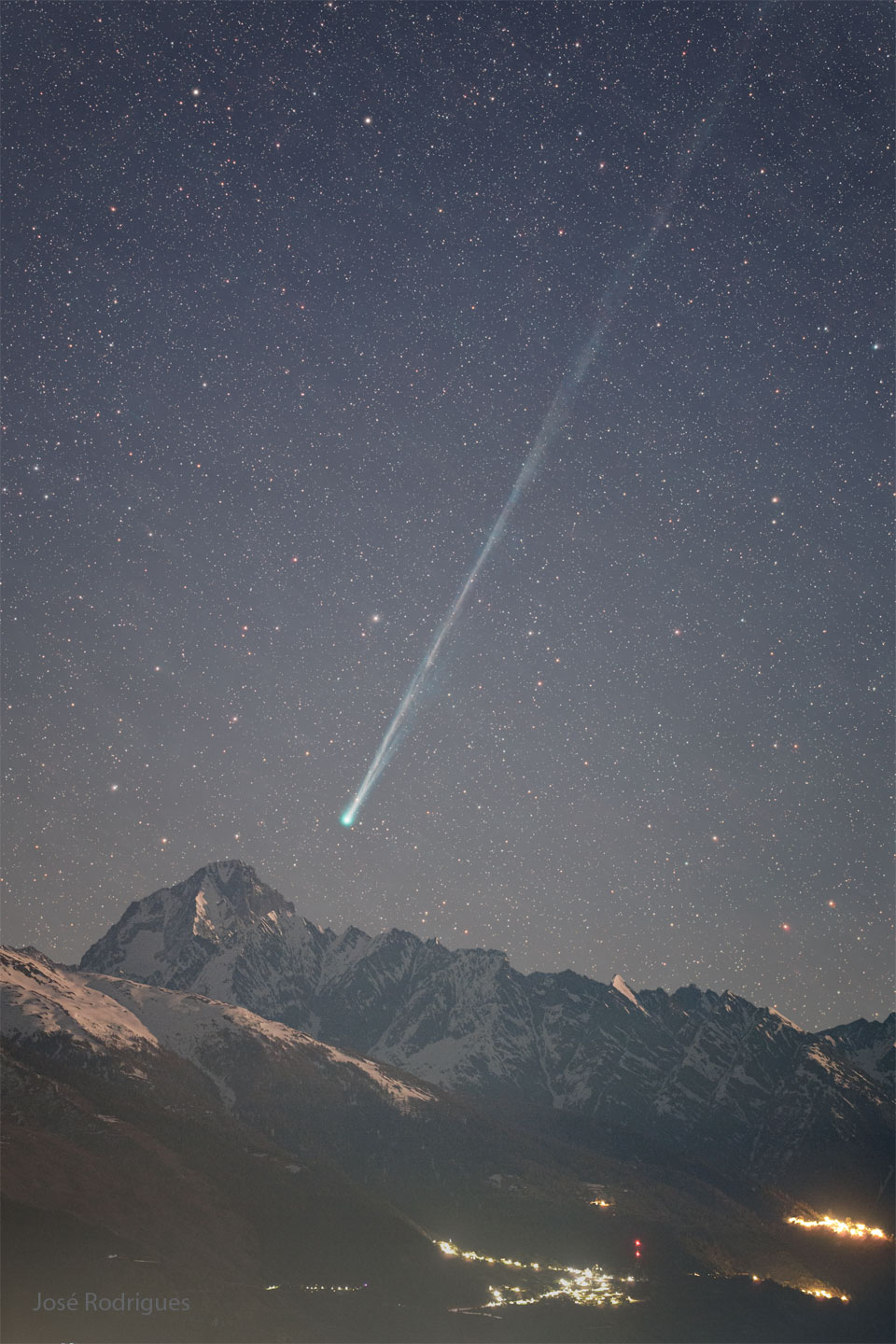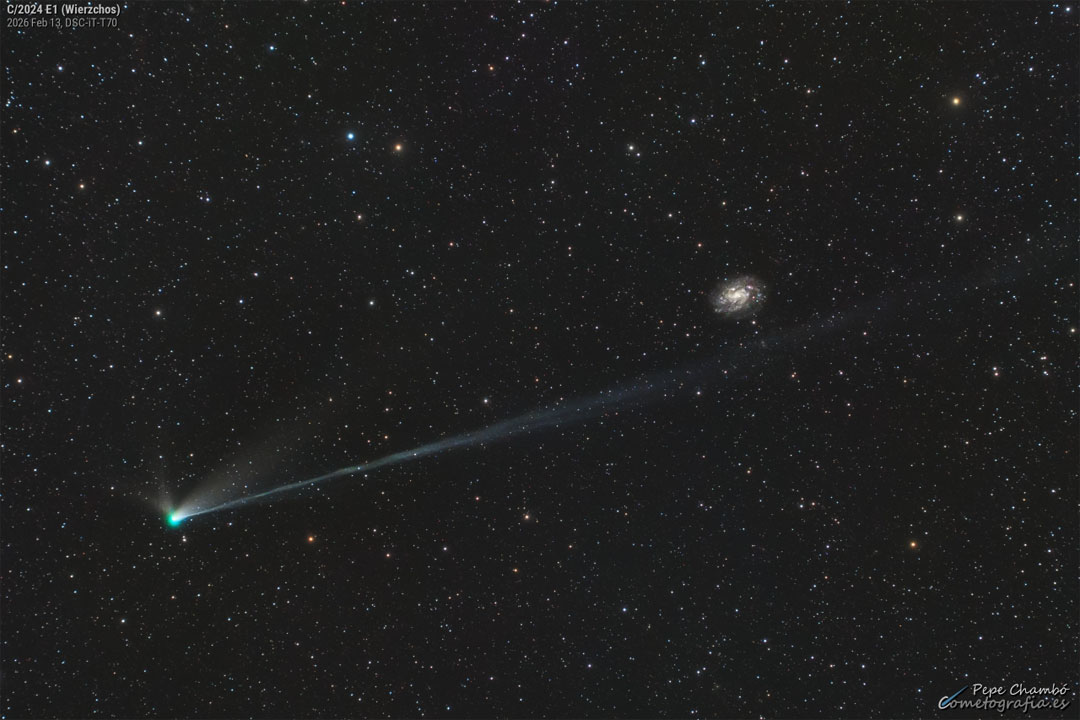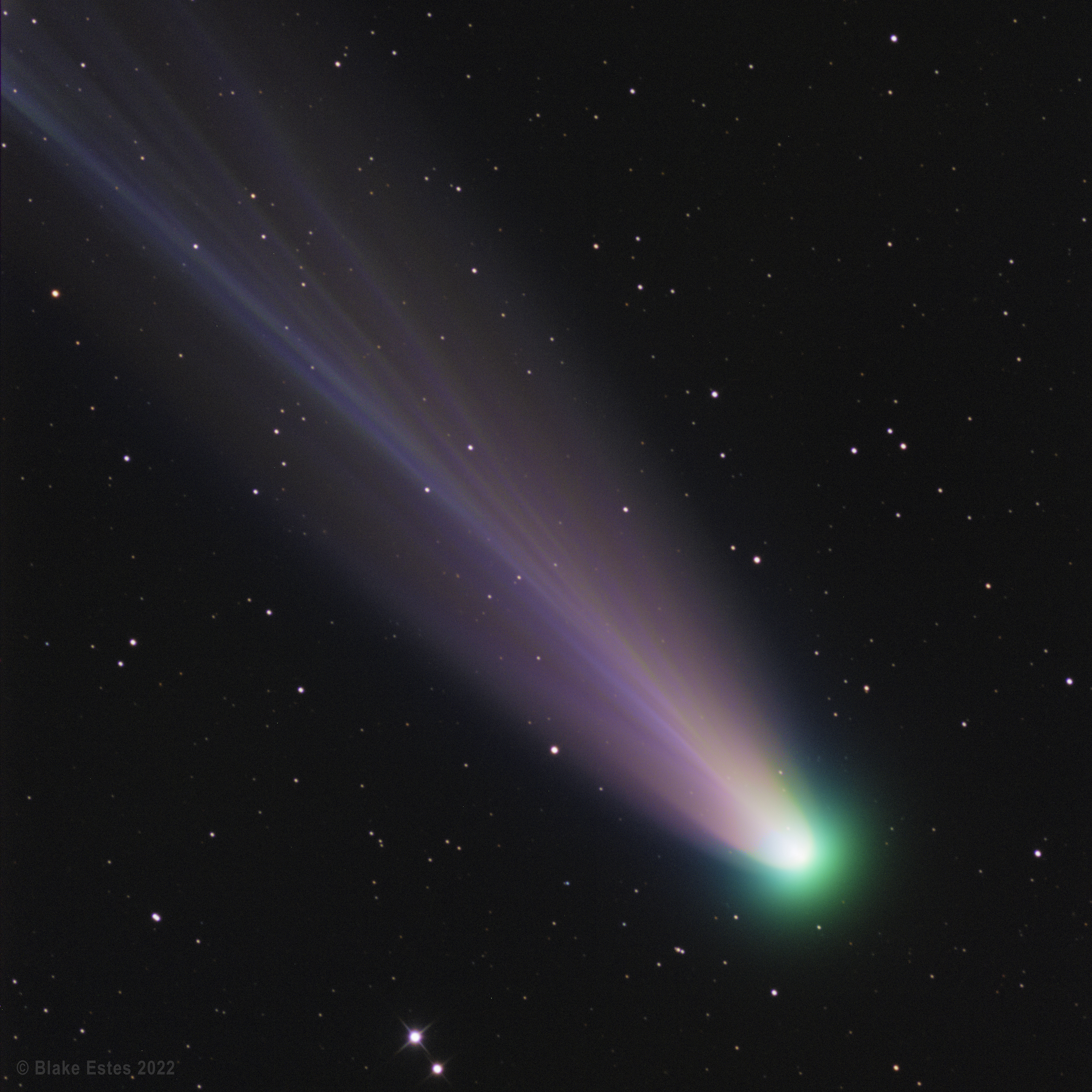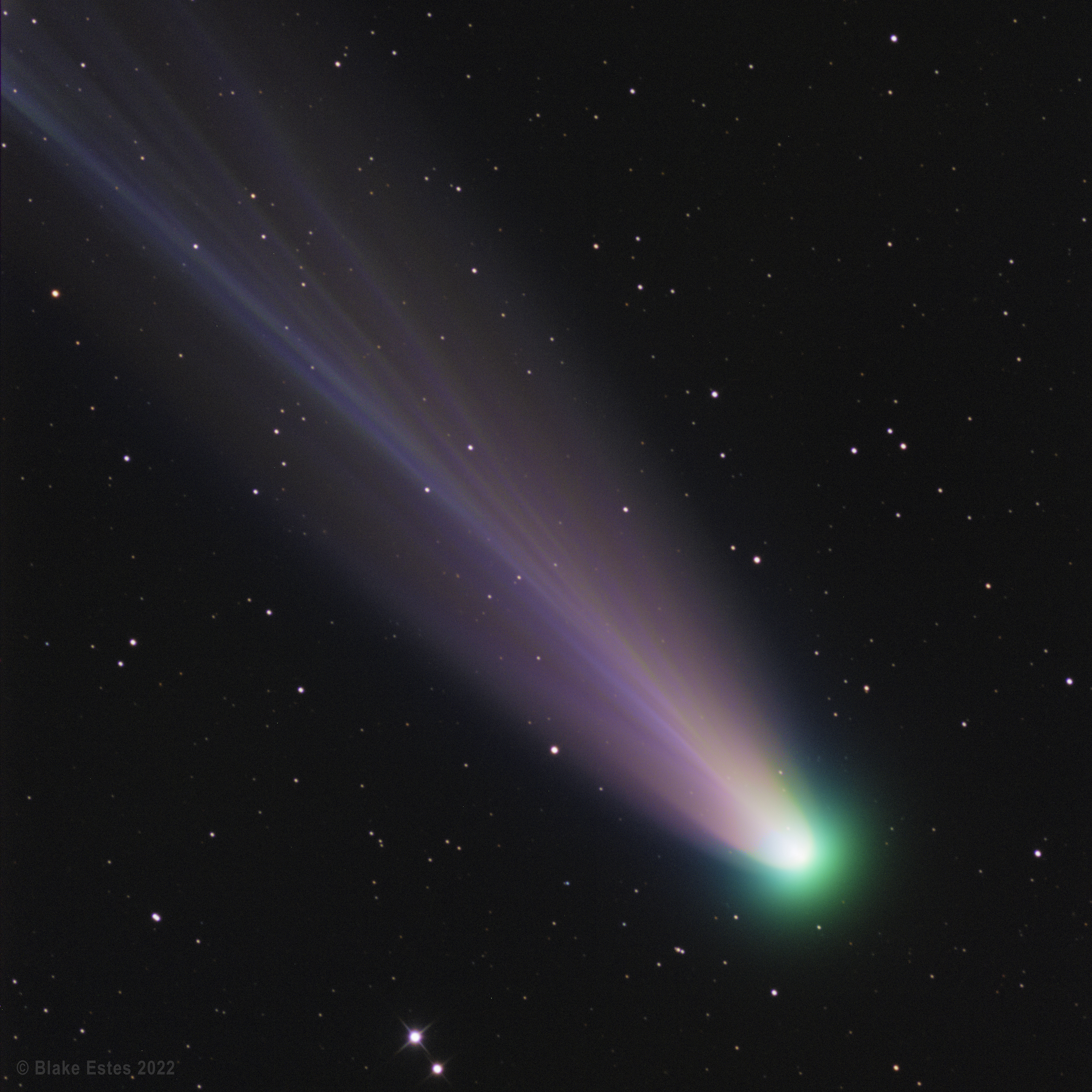
What does Comet Leonard look like up close? Although we can't go there, imaging the comet's coma and inner tails through a small telescope gives us a good idea. As the name implies, the ion tail is made of ionized gas -- gas energized by ultraviolet light from the Sun and pushed outward by the solar wind. The solar wind is quite structured and sculpted by the Sun's complex and ever changing magnetic field. The effect of the variable solar wind combined with different gas jets venting from the comet's nucleus accounts for the tail's complex structure. Following the wind, structure in Comet Leonard's tail can be seen to move outward from the Sun even alter its wavy appearance over time. The blue color of the ion tail is dominated by recombining carbon monoxide molecules, while the green color of the coma surrounding the head of the comet is created mostly by a slight amount of recombining diatomic carbon molecules. Diatomic carbon is destroyed by sunlight in about 50 hours -- which is why its green glow does not make it far into the ion tail. The featured image was taken on January 2 from Siding Spring Observatory in Australia. Comet Leonard, presently best viewed from Earth's Southern Hemisphere, has rounded the Sun and is now headed out of the Solar System.
¿Cómo se ve el cometa Leonard de cerca? Aunque no podemos ir allí, tomar imágenes de su coma y colas interiores mediante un telescopio pequeño nos da una buena idea. Como sugiere su nombre, la cola iónica está compuesta por gas ionizado — gas energizado por la luz ultravioleta del Sol y empujado hacia afuera por el viento solar. El viento solar tiene una estructura muy definida y es moldeado por el campo magnético complejo y en constante cambio del Sol. El efecto combinado del viento solar variable y los distintos chorros de gas que salen del núcleo del cometa explican la estructura compleja de la cola. Siguiendo el viento, se puede observar en la cola del cometa Leonard cómo la estructura se mueve hacia afuera del Sol y cómo su apariencia ondulada cambia con el tiempo. El color azul de la cola iónica es dominado por moléculas de monóxido de carbono en proceso de recombinación, mientras que el color verde del coma que rodea la cabeza del cometa es producido principalmente por una pequeña cantidad de moléculas de carbono diatómico en proceso de recombinación. El carbono diatómico es destruido por la luz solar en aproximadamente 50 horas — por eso su brillo verde no llega muy lejos en la cola iónica. La imagen mostrada fue tomada el 2 de enero desde el Observatorio de Siding Spring en Australia. El cometa Leonard, que actualmente se ve mejor desde el hemisferio sur de la Tierra, ha rodeado al Sol y ahora se aleja del Sistema Solar.