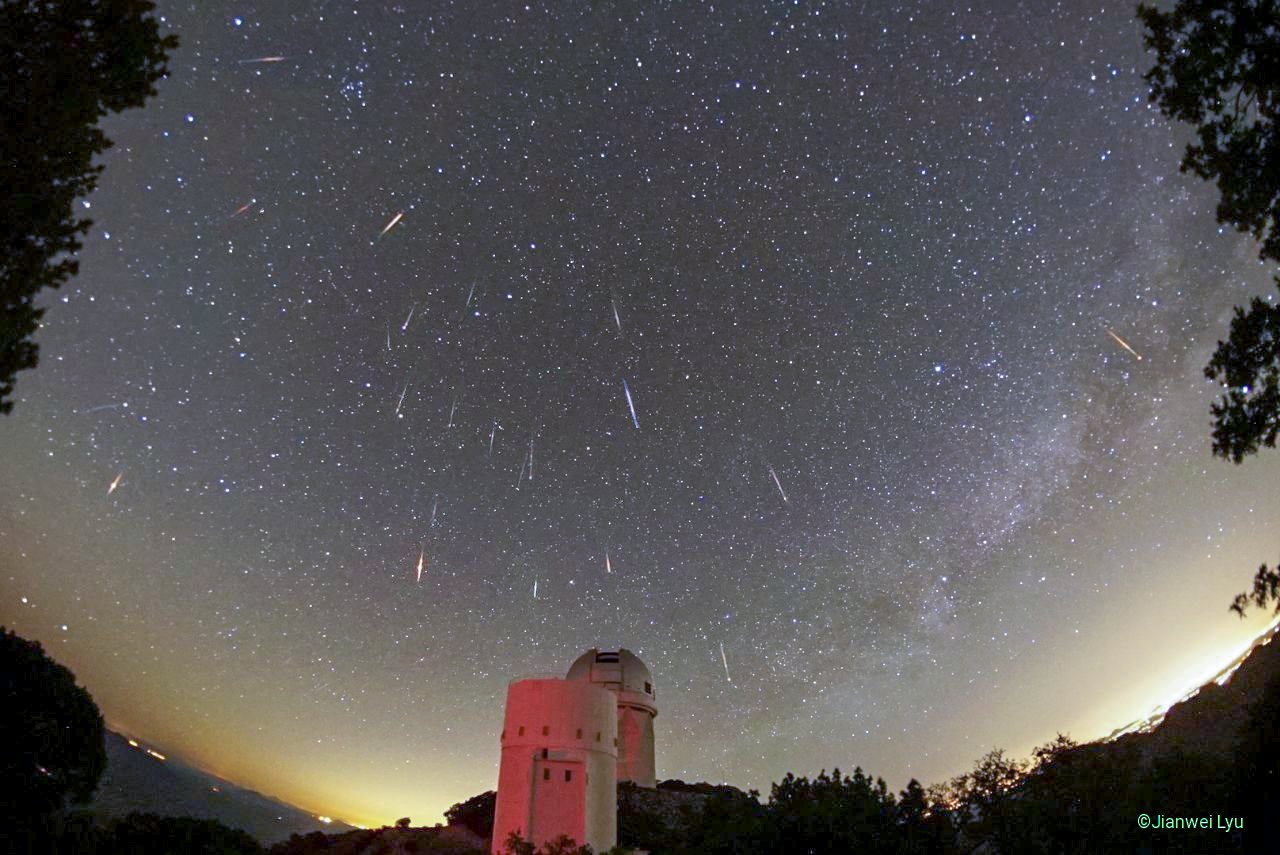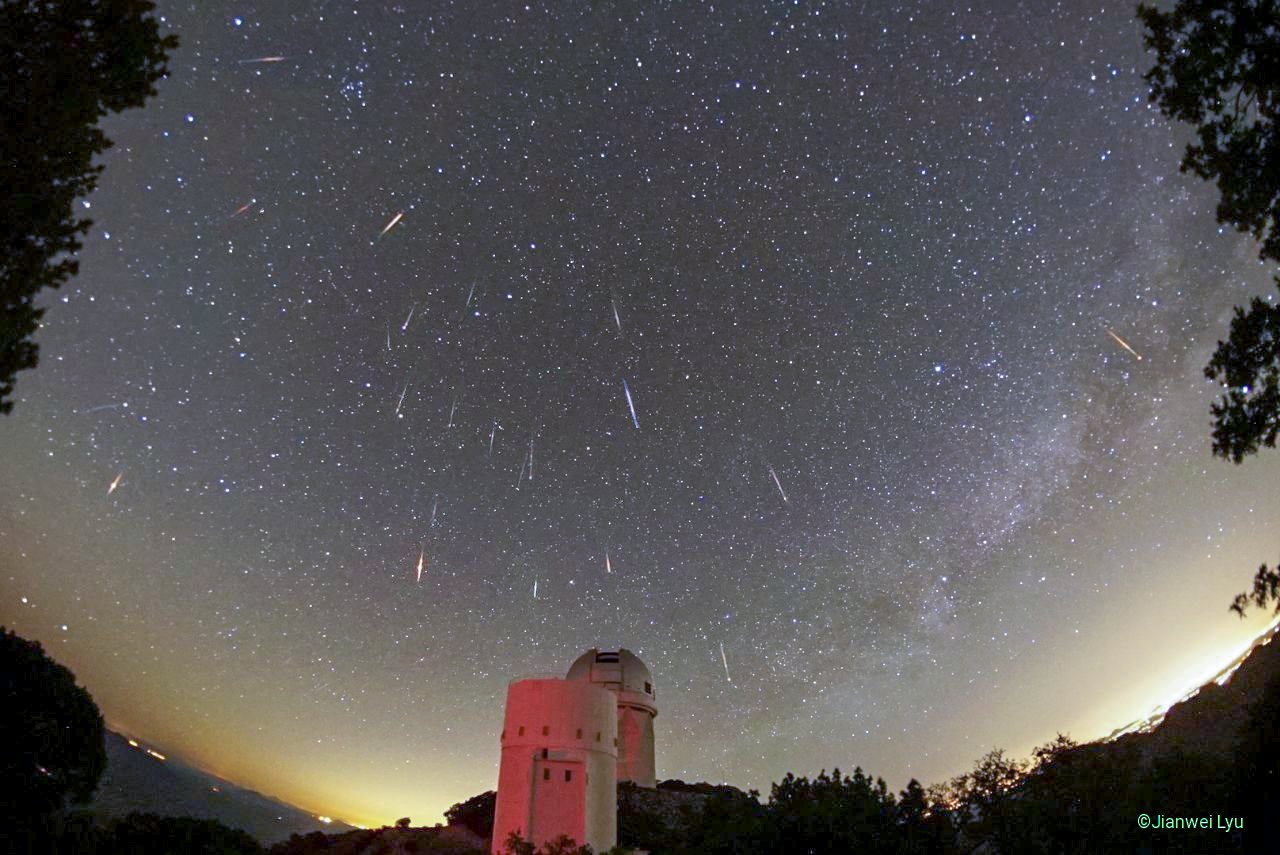
It wasn't the storm of the century -- but it was a night to remember. Last night was the peak of the Tau Herculid meteor shower, a usually modest dribble of occasional meteors originating from the disintegrating Comet 73P/Schwassmann-Wachmann 3. This year, calculations showed that the Earth might be passing through a particularly dense stream of comet debris -- at best creating a storm of bright meteors streaking out from the constellation of Hercules. What actually happened fell short of a meteor storm, but could be called a decent meteor shower. Featured here is a composite image taken at Kitt Peak National Observatory in Arizona, USA accumulated over 2.5 hours very late on May 30. Over that time, 19 Tau Herculids meteors were captured, along with 4 unrelated meteors. (Can you find them?) In the near foreground is the Bok 2.3-meter Telescope with the 4.0-meter Mayall Telescope just behind it. Next year, the annual Tau Herculids are expected to return to its normal low rate, with the next active night forecast for 2049.
No fue la tormenta del siglo, pero fue una noche inolvidable. La noche pasada fue el pico de la lluvia de meteoros Tau Herculid, un fenómeno normalmente modesto, con escasos meteoros que provienen del desintegrado cometa 73P/Schwassmann-Wachmann 3. Este año, los cálculos mostraron que la Tierra podría estar atravesando un flujo particularmente denso de escombros cometarios, lo que en el mejor de los casos podría crear una tormenta de meteoros brillantes que se originaran en la constelación de Hércules. Lo que realmente ocurrió no alcanzó el nivel de una tormenta de meteoros, pero podría calificarse como una buena lluvia de meteoros. La imagen destacada es una composición tomada en el Observatorio Nacional Kitt Peak en Arizona, EE. UU., acumulada durante 2.5 horas muy tarde el 30 de mayo. Durante ese tiempo, se capturaron 19 meteoros Tau Herculids, junto con 4 meteoros no relacionados. (¿Puedes encontrarlos?). En primer plano está el telescopio Bok de 2.3 metros, con el telescopio Mayall de 4.0 metros justo detrás. El año que viene, los anuales Tau Herculids se espera que regresen a su tasa normalmente baja, con la próxima noche activa prevista para el año 2049.