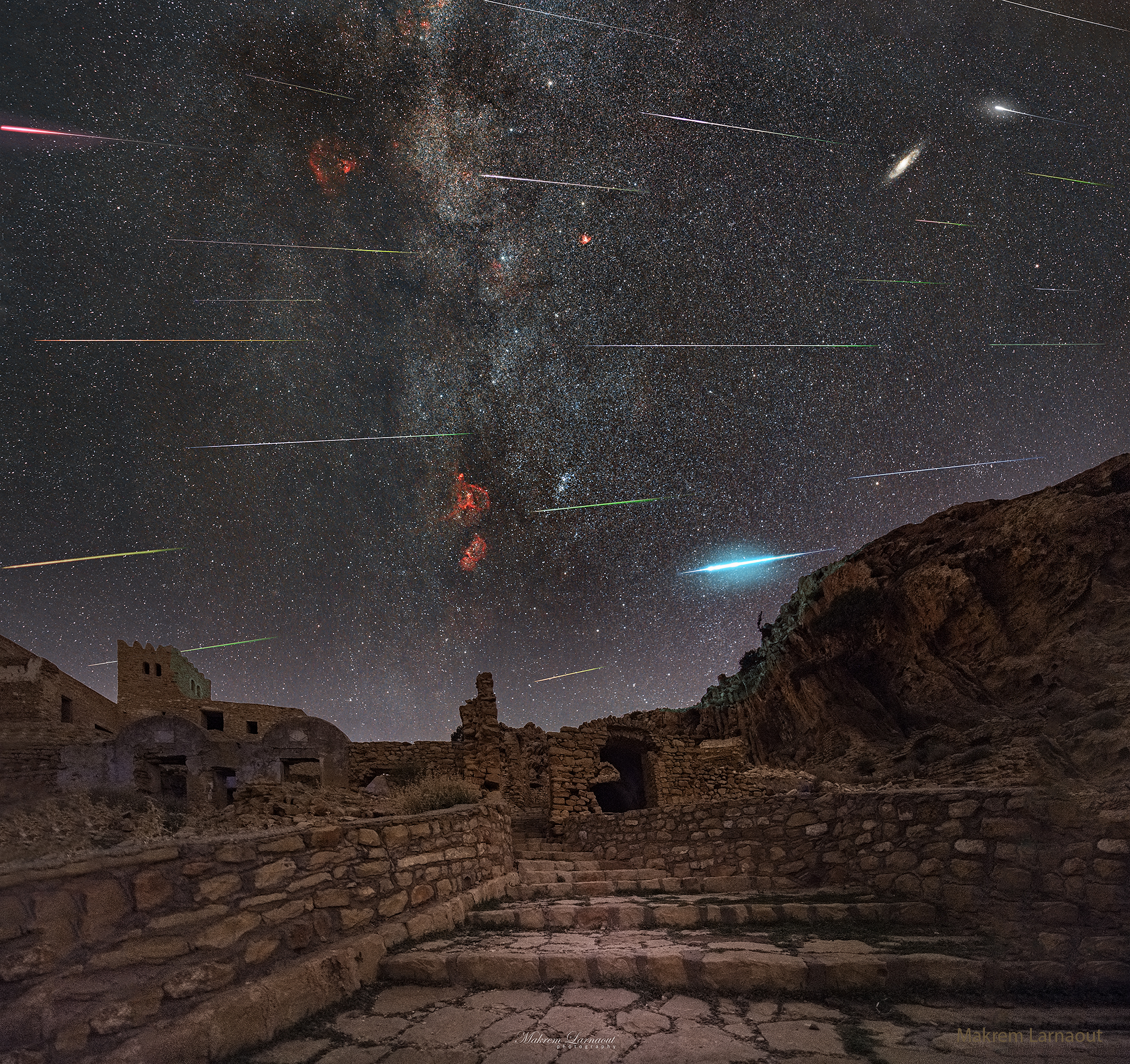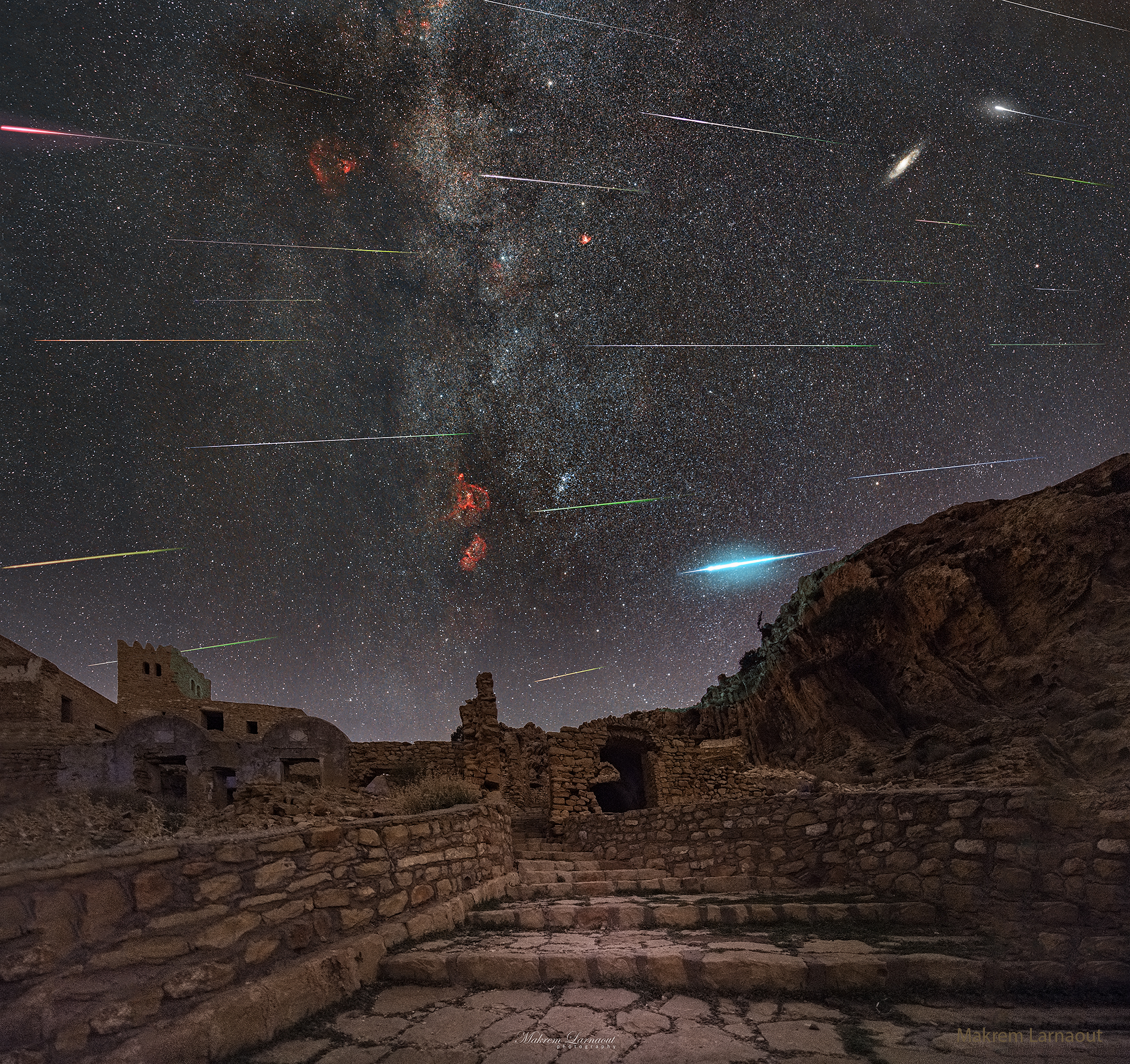
Does the Earth ever pass through a wind of meteors? Yes, and they are frequently visible as meteor showers. Almost all meteors are sand-sized debris that escaped from a Sun-orbiting comet or asteroid, debris that continues in an elongated orbit around the Sun. Circling the same Sun, our Earth can move through an orbiting debris stream, where it can appear, over time, as a meteor wind. The meteors that light up in Earth's atmosphere, however, are usually destroyed. Their streaks, though, can all be traced back to a single point on the sky called the radiant. The featured image composite was taken over two days in late July near the ancient Berber village Zriba El Alia in Tunisia, during the peak of the Southern Delta Aquariids meteor shower. The radiant is to the right of the image. A few days ago our Earth experienced the peak of a more famous meteor wind -- the Perseids.
¿La Tierra alguna vez pasa a través de un viento de meteoros? Sí, y con frecuencia se ven como lluvias de meteoros. Casi todos los meteoros son partículas del tamaño de la arena que escaparon de un cometa o asteroide que orbita al Sol, escombros que continúan en una órbita alargada alrededor del Sol. Al orbitar al mismo Sol, la Tierra puede moverse a través de un flujo de escombros orbitales, donde con el tiempo puede parecer un viento de meteoros. Sin embargo, los meteoros que se iluminan en la atmósfera terrestre suelen destruirse. Sus rastros, sin embargo, pueden rastrearse todos hacia un solo punto en el cielo llamado radiante. La imagen compuesta destacada se tomó durante dos días a finales de julio cerca del antiguo pueblo bereber Zriba El Alia en Túnez, durante el pico de la lluvia de meteoros Southern Delta Aquariids. El radiante está a la derecha de la imagen. Hace unos días, la Tierra experimentó el pico de un viento de meteoros más famoso: los Perseidas.