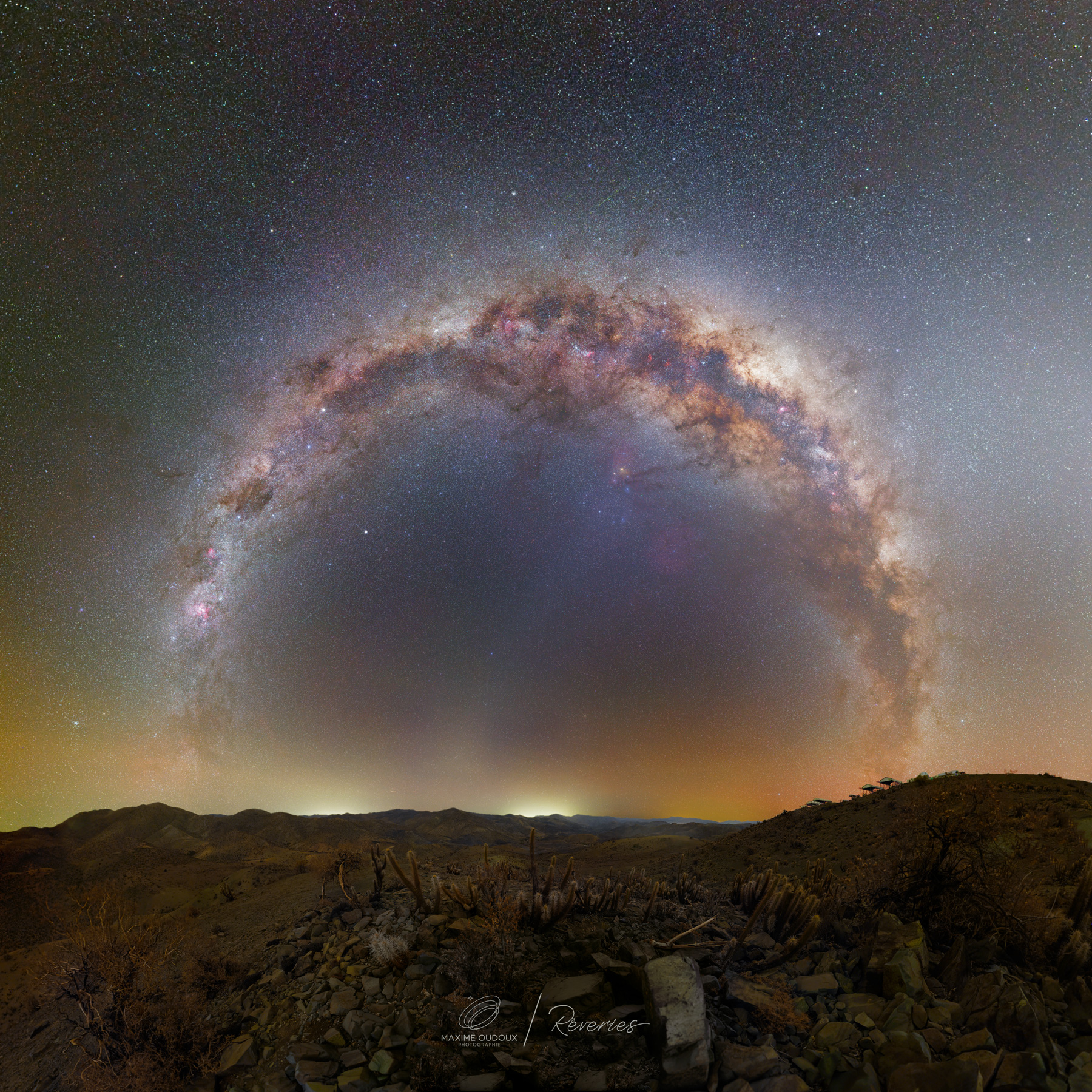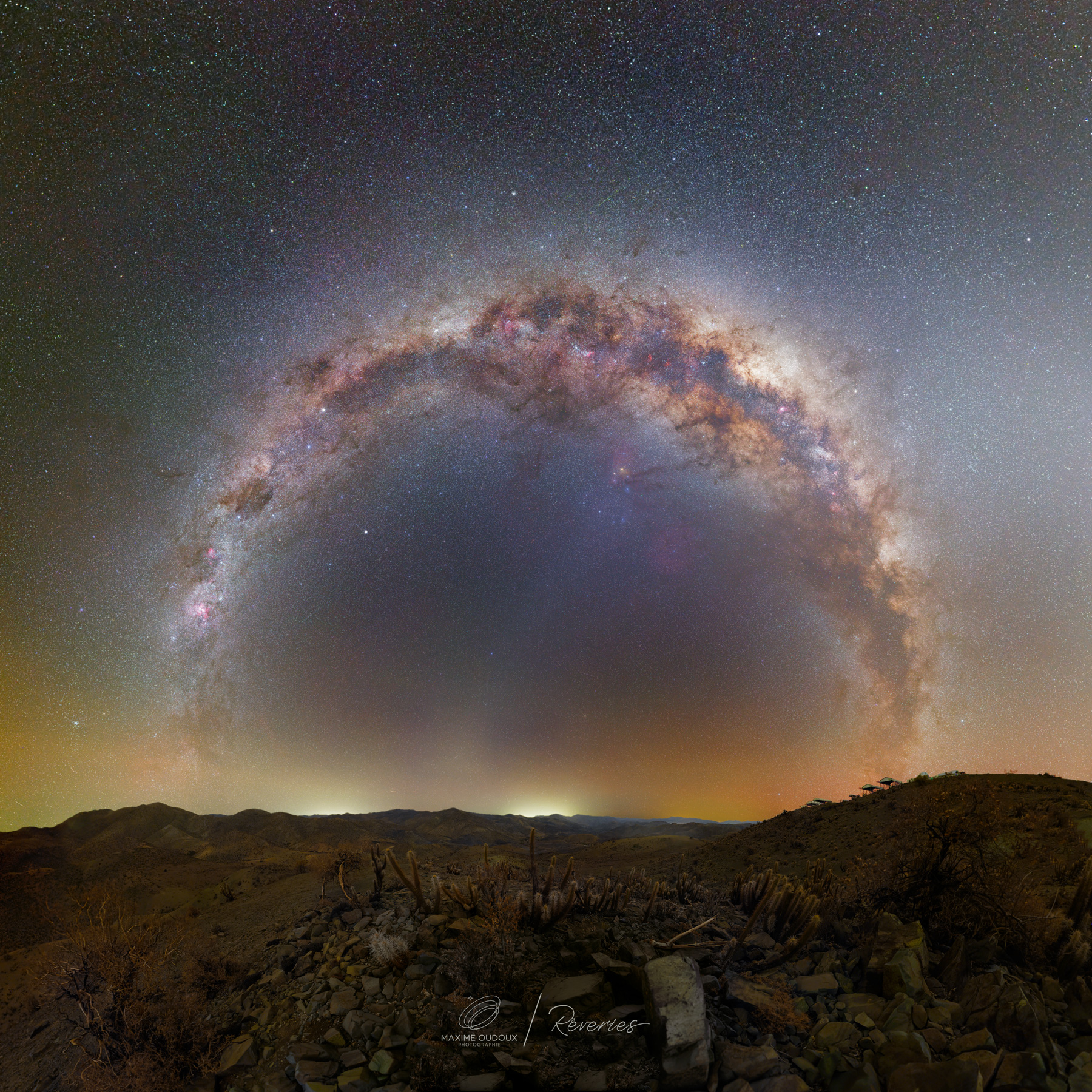
There is a huge gate of stars in the sky, and you pass through it twice a day. The stargate is actually our Milky Way Galaxy, and it is the spin of the Earth that appears to propel you through it. More typically, the central band of our Milky Way appears as a faint band stretching across the sky, only visible in away from bright city lights. In a long-exposure wide-angle image from a dark location like this, though, the Milky Way's central plane is easily visible. The featured picture is a digital composite involving multiple exposures taken on the same night and with the same camera, but employing a stereographic projection that causes the Milky Way to appear as a giant circular portal. Inside the stargate-like arc of our Galaxy is a faint stripe called zodiacal light -- sunlight reflected by dust in our Solar System. In the foreground are cacti and dry rocks found in the rough terrain of the high desert of Chile, not far from the El Sauce Observatory and the developing Vera Rubin Observatory, the latter expected to begin routine operations in 2024.
Hay una enorme puerta de estrellas en el cielo, y tú la atraviesas dos veces al día. La puerta estelar es en realidad nuestra galaxia, la Vía Láctea, y es la rotación de la Tierra la que parece impulsarte a través de ella. Típicamente, la banda central de nuestra Vía Láctea aparece como una tira tenue que se extiende a través del cielo, visible solo lejos de las luces brillantes de las ciudades. En una imagen de larga exposición de ángulo amplio tomada desde un lugar oscuro como este, sin embargo, el plano central de la Vía Láctea es fácilmente visible. La imagen destacada es un compuesto digital que involucra múltiples exposiciones tomadas la misma noche y con la misma cámara, pero empleando una proyección estereográfica que hace que la Vía Láctea aparezca como un portal circular gigante. Dentro del arco similar a una puerta estelar de nuestra galaxia hay una tira tenue llamada luz zodiacal — luz solar reflejada por polvo en nuestro sistema solar. En primer plano se encuentran cactus y rocas secas halladas en el terreno accidentado del desierto alto de Chile, no muy lejos del Observatorio El Sauce y del recientemente desarrollado Observatorio Vera Rubin, este último que se espera comience operaciones rutinarias en 2024.