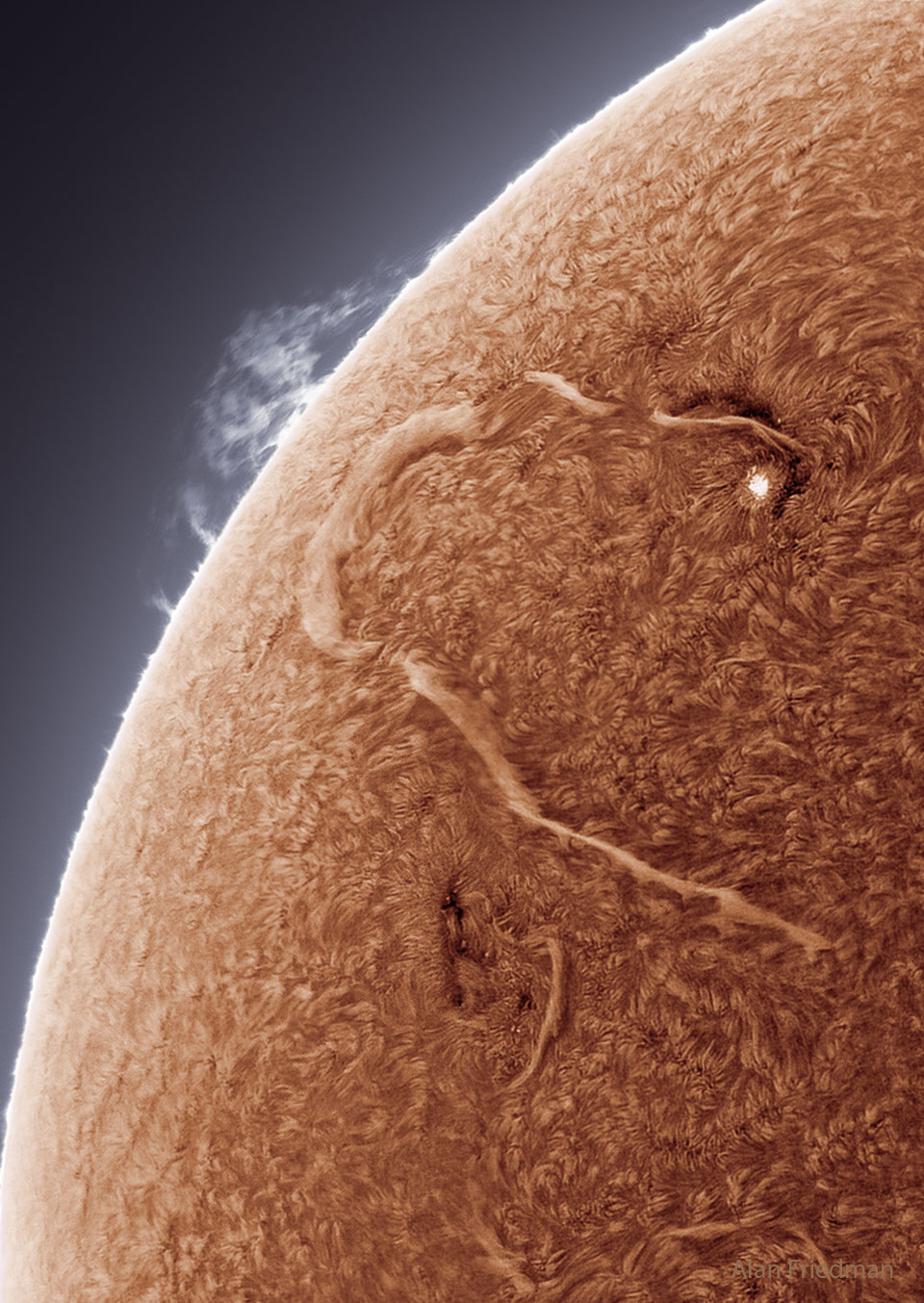
rlier this month, the Sun exhibited one of the longer filaments on record. Visible as the bright curving streak around the image center, the snaking filament's full extent was estimated to be over half of the Sun's radius -- more than 350,000 kilometers long. A filament is composed of hot gas held aloft by the Sun's magnetic field, so that viewed from the side it would appear as a raised prominence. A different, smaller prominence is simultaneously visible at the Sun's edge. The featured image is in false-color and color-inverted to highlight not only the filament but the Sun's carpet chromosphere. The bright dot on the upper right is actually a dark sunspot about the size of the Earth. Solar filaments typically last from hours to days, eventually collapsing to return hot plasma back to the Sun. Sometimes, though, they explode and expel particles into the Solar System, some of which trigger auroras on Earth. The pictured filament appeared in early September and continued to hold steady for about a week.
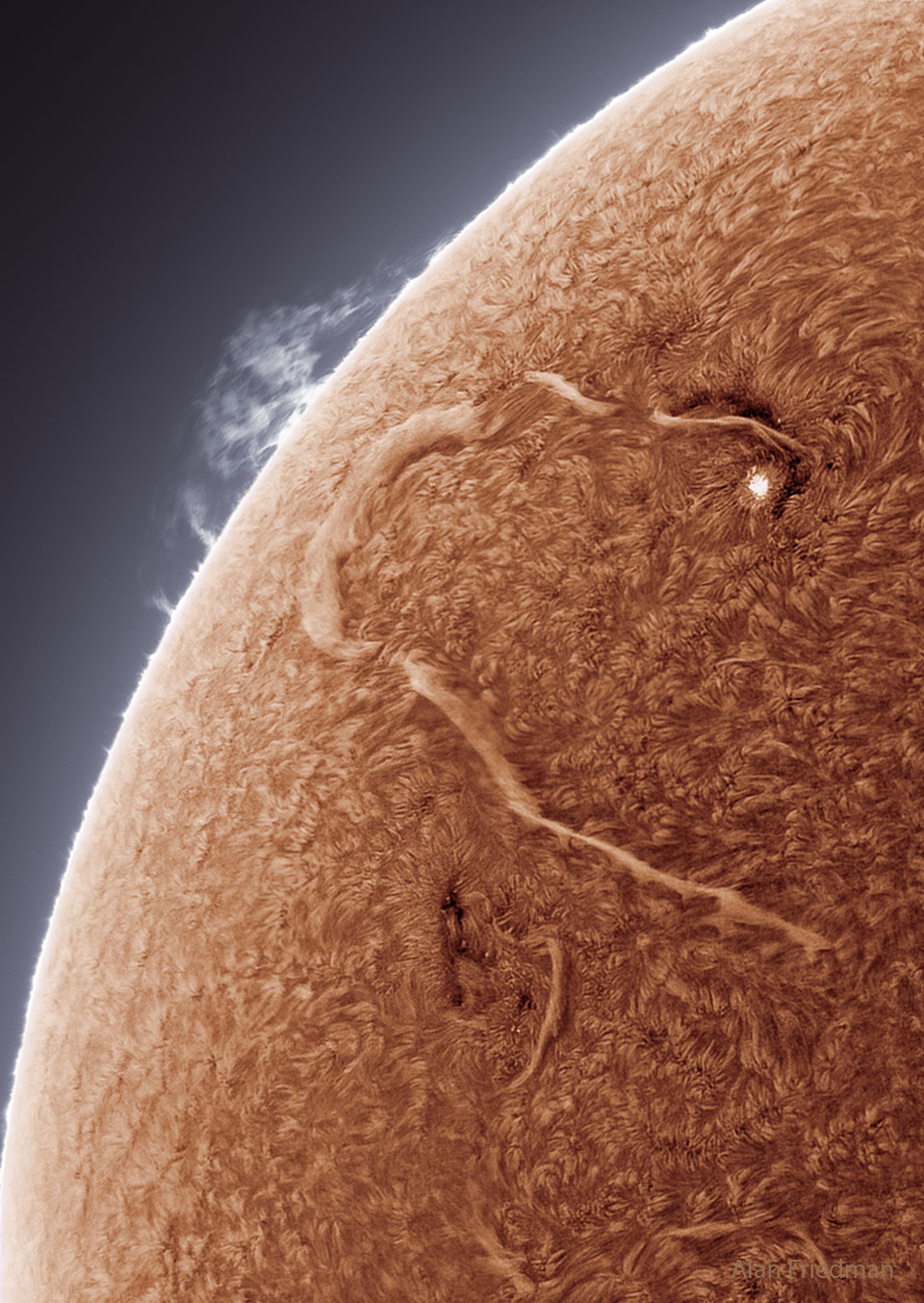
Crédito: NASA, SDO A principios de este mes, el Sol exhibió uno de los filamentos más largos registrados. Visible como el resplandor curvado alrededor del centro de la imagen, la extensión completa del filamento serpenteante se estimó en más de la mitad del radio solar, es decir, más de 350.000 kilómetros de largo. Un filamento está compuesto por gas caliente sostenido por el campo magnético del Sol, por lo que visto desde el costado aparecería como una prominencia elevada. Una prominencia diferente y más pequeña es simultáneamente visible en el borde del Sol. La imagen destacada está en color falso e invertido para resaltar no solo el filamento, sino también la cromosfera del Sol. El punto brillante en la esquina superior derecha es en realidad una mancha solar oscura del tamaño de la Tierra. Los filamentos solares típicamente duran desde horas hasta días, eventualmente colapsando para devolver el plasma caliente al Sol. A veces, sin embargo, explotan y expulsan partículas al Sistema Solar, algunas de las cuales desencadenan auroras en la Tierra. El filamento mostrado apareció a principios de septiembre y se mantuvo estable durante aproximadamente una semana.