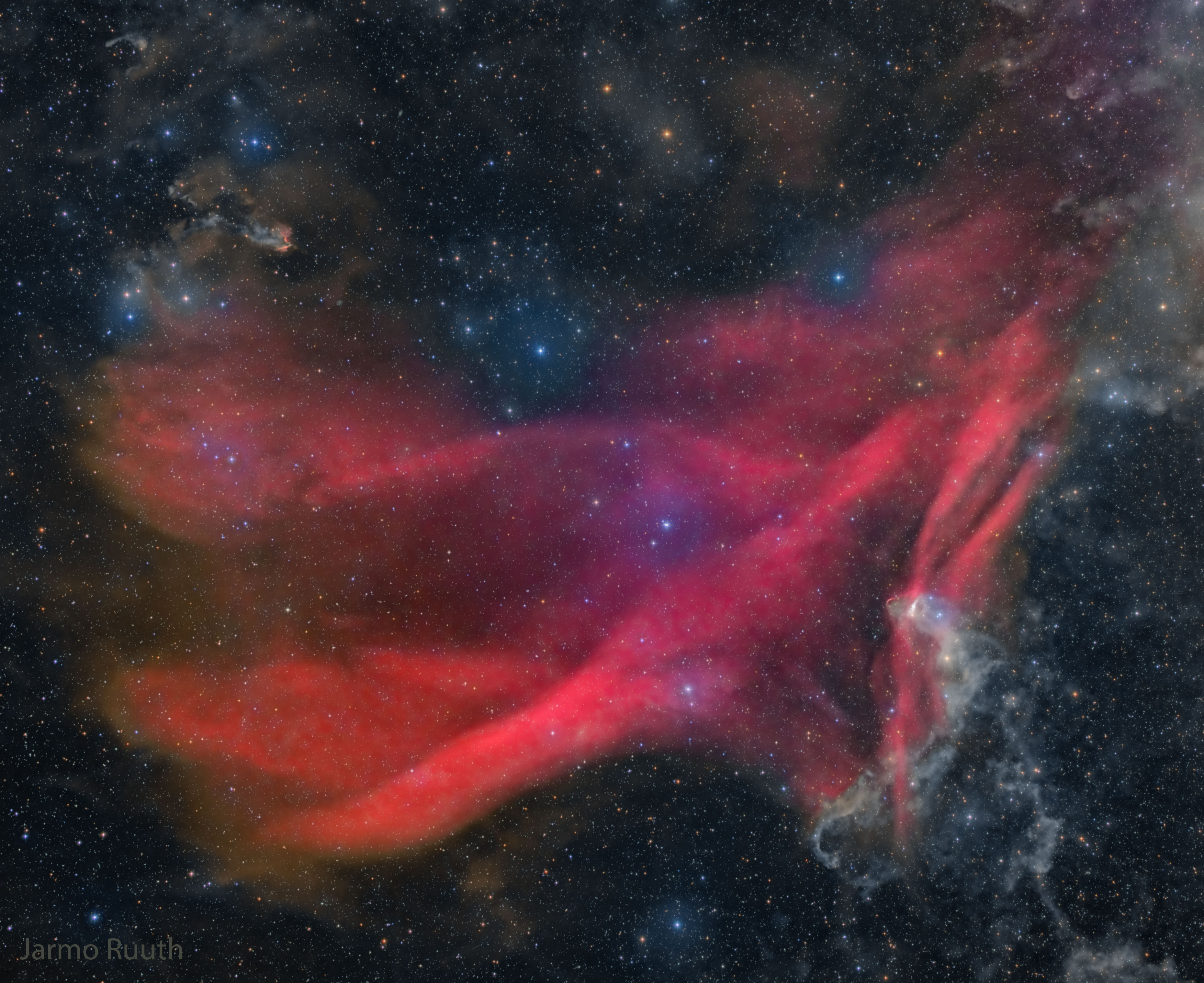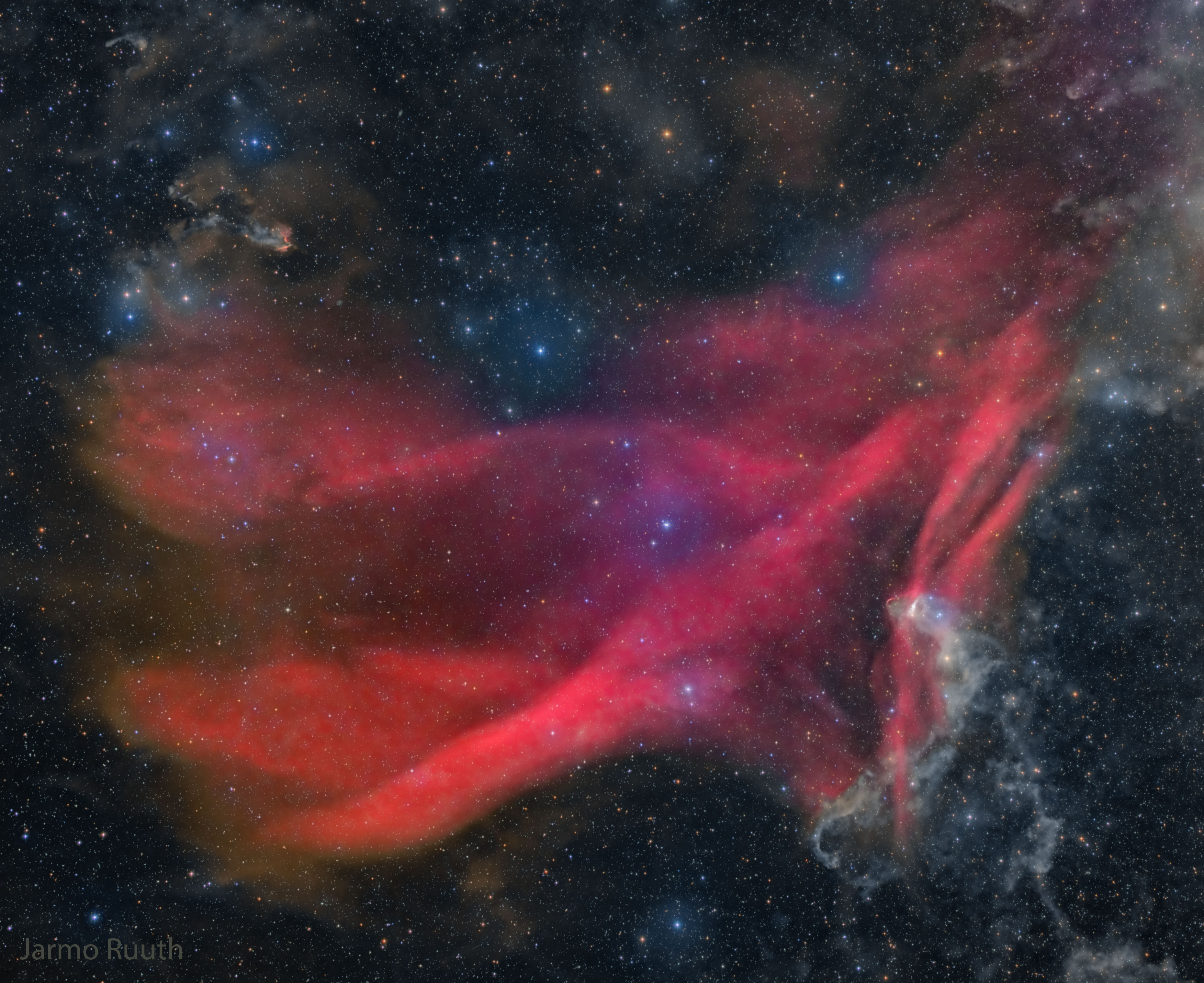
It is one of the largest nebulas on the sky -- why isn't it better known? Roughly the same angular size as the Andromeda Galaxy, the Great Lacerta Nebula can be found toward the constellation of the Lizard (Lacerta). The emission nebula is difficult to see with wide-field binoculars because it is so faint, but also usually difficult to see with a large telescope because it is so great in angle -- spanning about three degrees. The depth, breadth, waves, and beauty of the nebula -- cataloged as Sharpless 126 (Sh2-126) -- can best be seen and appreciated with a long duration camera exposure. The featured image is one such combined exposure -- in this case 10 hours over five different colors and over six nights during this past June and July at the IC Astronomy Observatory in Spain. The hydrogen gas in the Great Lacerta Nebula glows red because it is excited by light from the bright star 10 Lacertae, one of the bright blue stars just above the red-glowing nebula's center. The stars and nebula are about 1,200 light years distant. Harvest Full Moon 2022: Notable Submissions to APOD
Crédito: NASA, IC Astronomy Observatory Es una de las nebulosas más grandes del cielo — ¿por qué no es más conocida? Aproximadamente del mismo tamaño angular que la Galaxia de Andrómeda, la Gran Nebulosa de Lacerta se encuentra en dirección a la constelación de la Lagartija (Lacerta). La nebulosa emisora es difícil de ver con binoculares de campo amplio porque es muy tenue, pero también suele ser difícil de observar con un telescopio grande debido a su gran tamaño angular — abarcando aproximadamente tres grados. La profundidad, amplitud, ondulaciones y belleza de la nebulosa — catalogada como Sharpless 126 (Sh2-126) — se ven y aprecian mejor con una exposición prolongada de la cámara. La imagen destacada es una exposición combinada de este tipo — en este caso, 10 horas sobre cinco diferentes colores y durante seis noches en junio y julio de este año en el Observatorio de Astronomía IC en España. El gas de hidrógeno en la Gran Nebulosa de Lacerta brilla de color rojo porque es excitado por la luz de la estrella brillante 10 Lacertae, una de las estrellas azules brillantes justo encima del centro de la nebulosa que brilla en rojo. Las estrellas y la nebulosa se encuentran a unos 1200 años luz de distancia.