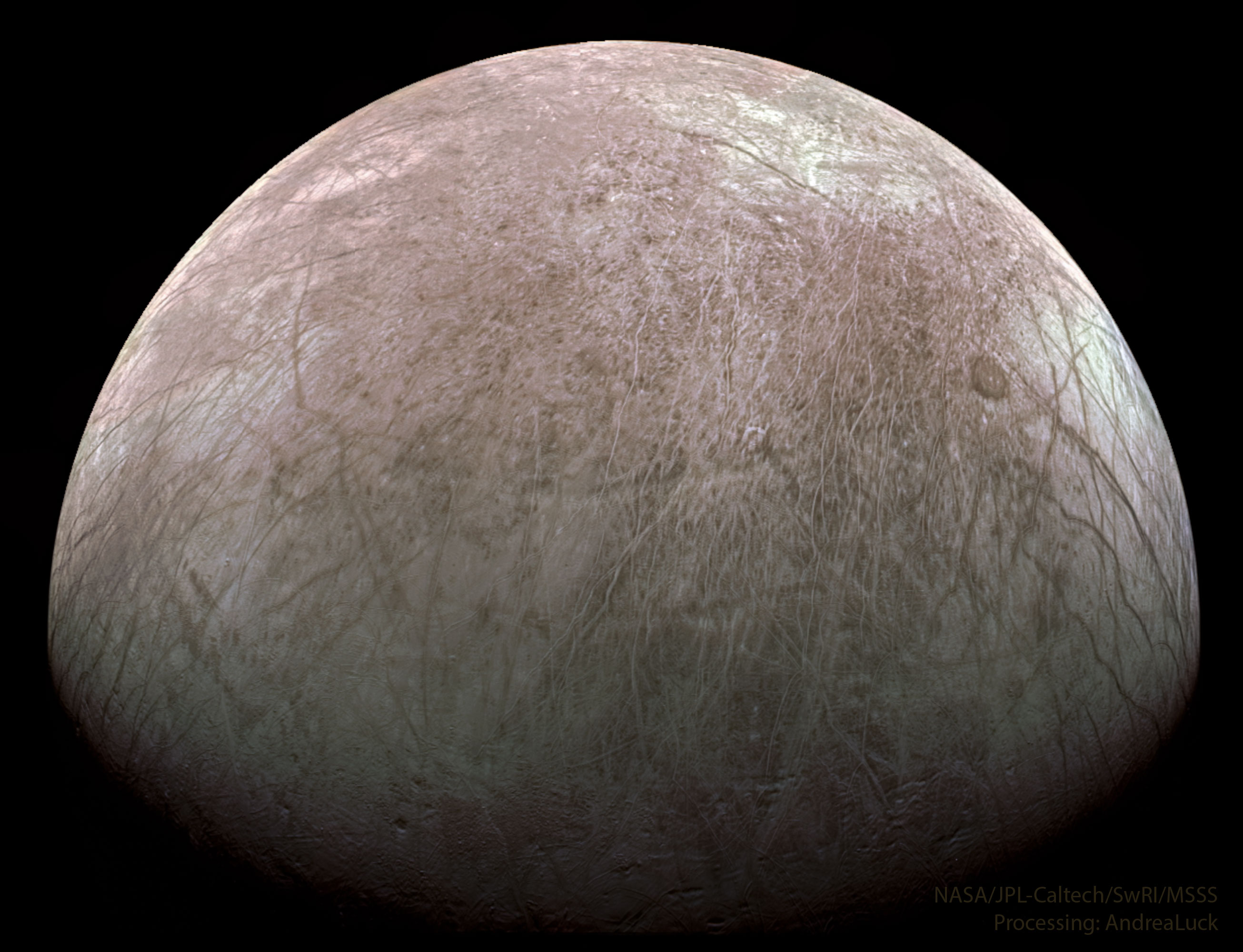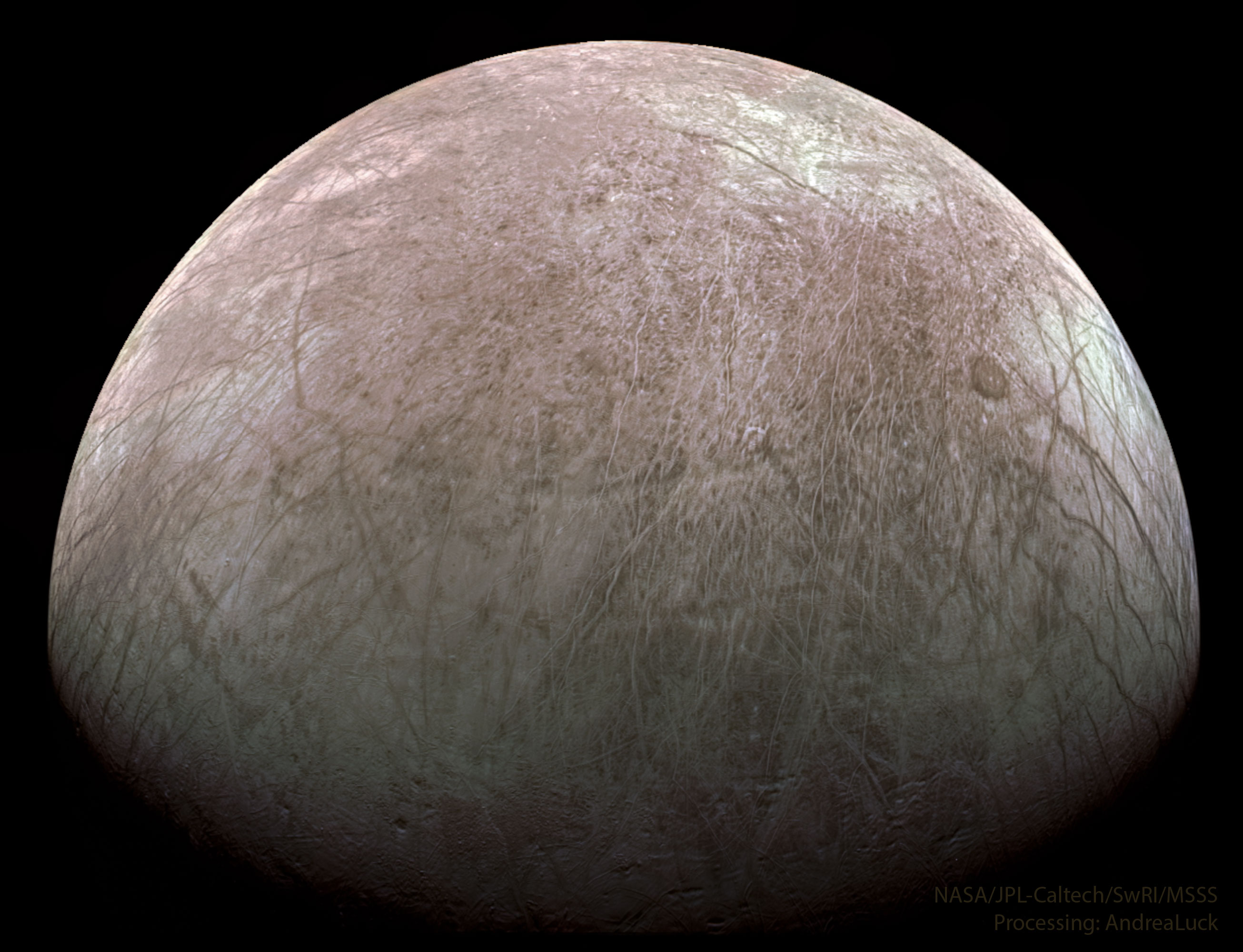
What mysteries might be solved by peering into this crystal ball? In this case, the ball is actually a moon of Jupiter, the crystals are ice, and the moon is not only dirty but cracked beyond repair. Nevertheless, speculation is rampant that oceans exist under Europa's fractured ice-plains that could support life. Europa, roughly the size of Earth's Moon, is pictured here in an image taken a few days ago when the Jupiter-orbiting robotic spacecraft Juno passed within 325 kilometers of its streaked and shifting surface. Underground oceans are thought likely because Europa undergoes global flexing due to its changing gravitational attraction with Jupiter during its slightly elliptical orbit, and this flexing heats the interior. Studying Juno's close-up images may further humanity's understanding not only of Europa and the early Solar System but also of the possibility that life exists elsewhere in the universe.
¿Qué misterios podrían resolverse al mirar en esta bola de cristal? En este caso, la bola es en realidad un satélite de Júpiter, los cristales son hielo, y la luna no solo está sucia sino que también está fracturada de manera irreparable. Sin embargo, la especulación es abundante sobre la existencia de océanos bajo las llanuras heladas de Europa que podrían albergar vida. Europa, de tamaño aproximadamente similar al de la Luna terrestre, se muestra aquí en una imagen tomada hace unos días cuando la nave espacial robótica Juno, en órbita alrededor de Júpiter, pasó a menos de 325 kilómetros de su superficie rayada y en constante cambio. Se cree probable la existencia de océanos subterráneos porque Europa experimenta un flexionamiento global debido a su atracción gravitacional cambiante con Júpiter durante su órbita ligeramente elíptica, y este flexionamiento calienta el interior. Estudiar las imágenes de Juno a alta resolución podría ampliar el conocimiento humano no solo sobre Europa y el Sistema Solar primitivo, sino también sobre la posibilidad de que exista vida en otras partes del universo.