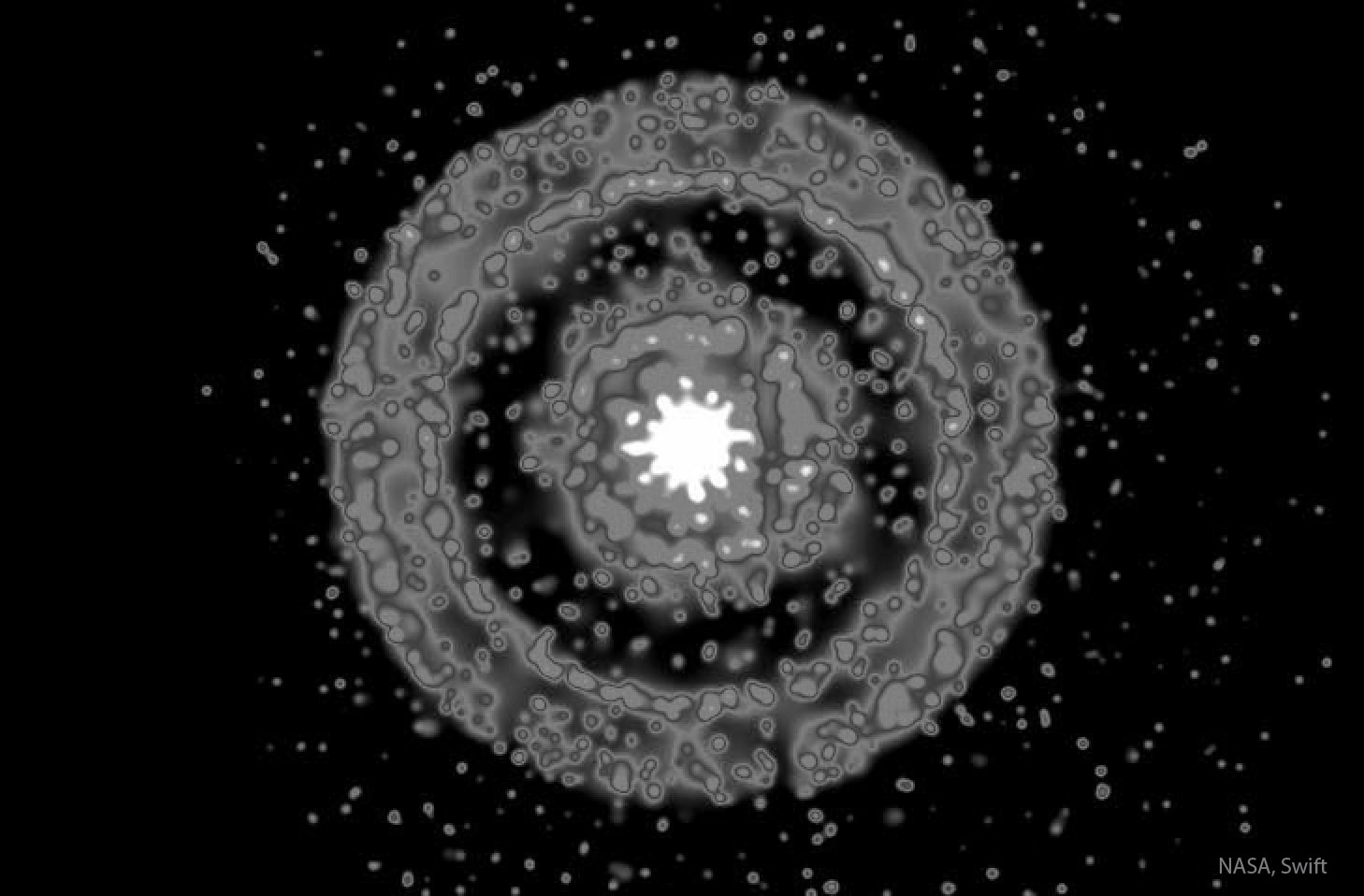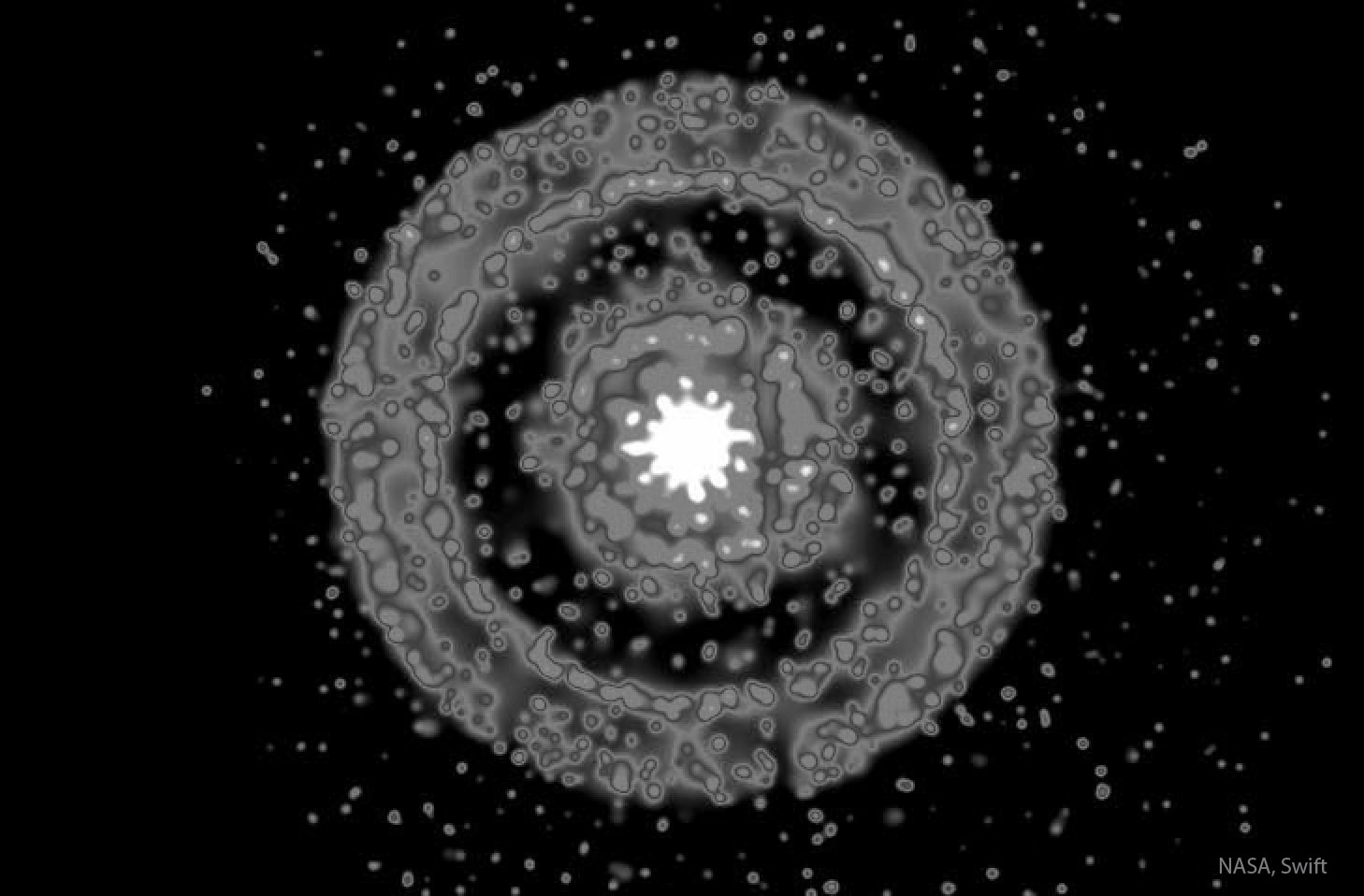
Why would x-ray rings appear around a gamma-ray burst? The surprising answer has little to do with the explosion itself but rather with light reflected off areas of dust-laden gas in our own Milky Way Galaxy. GRB 221009A was a tremendous explosion -- a very bright gamma-ray burst (GRB) that occurred far across the universe with radiation just arriving in our Solar System last week. Since GRBs can also emit copious amounts of x-rays, a bright flash of x-rays arrived nearly simultaneously with the gamma-radiation. In this case, the X-rays also bounced off regions high in dust right here in our Milky Way Galaxy, creating the unusual reflections. The greater the angle between reflecting Milky Way dust and the GRB, the greater the radius of the X-ray rings, and, typically, the longer it takes for these light-echoes to arrive.
¿Por qué aparecerían anillos de rayos X alrededor de un estallido de rayos gamma? La sorprendente respuesta tiene poco que ver con la explosión en sí, sino más bien con la luz reflejada en regiones de gas cargado de polvo dentro de nuestra propia Galaxia Vía Láctea. GRB 221009A fue una explosión tremenda: un estallido de rayos gamma (GRB) muy brillante que ocurrió muy lejos en el universo, con su radiación llegando a nuestro Sistema Solar solo la semana pasada. Dado que los GRB también pueden emitir grandes cantidades de rayos X, un destello brillante de rayos X llegó casi simultáneamente con la radiación gamma. En este caso, los rayos X también rebotaron en regiones ricas en polvo aquí mismo en nuestra Vía Láctea, creando estas reflexiones inusuales. Cuanto mayor sea el ángulo entre el polvo reflejante de la Vía Láctea y el GRB, mayor será el radio de los anillos de rayos X, y típicamente, más tiempo tomará para que estos ecos luminosos lleguen.