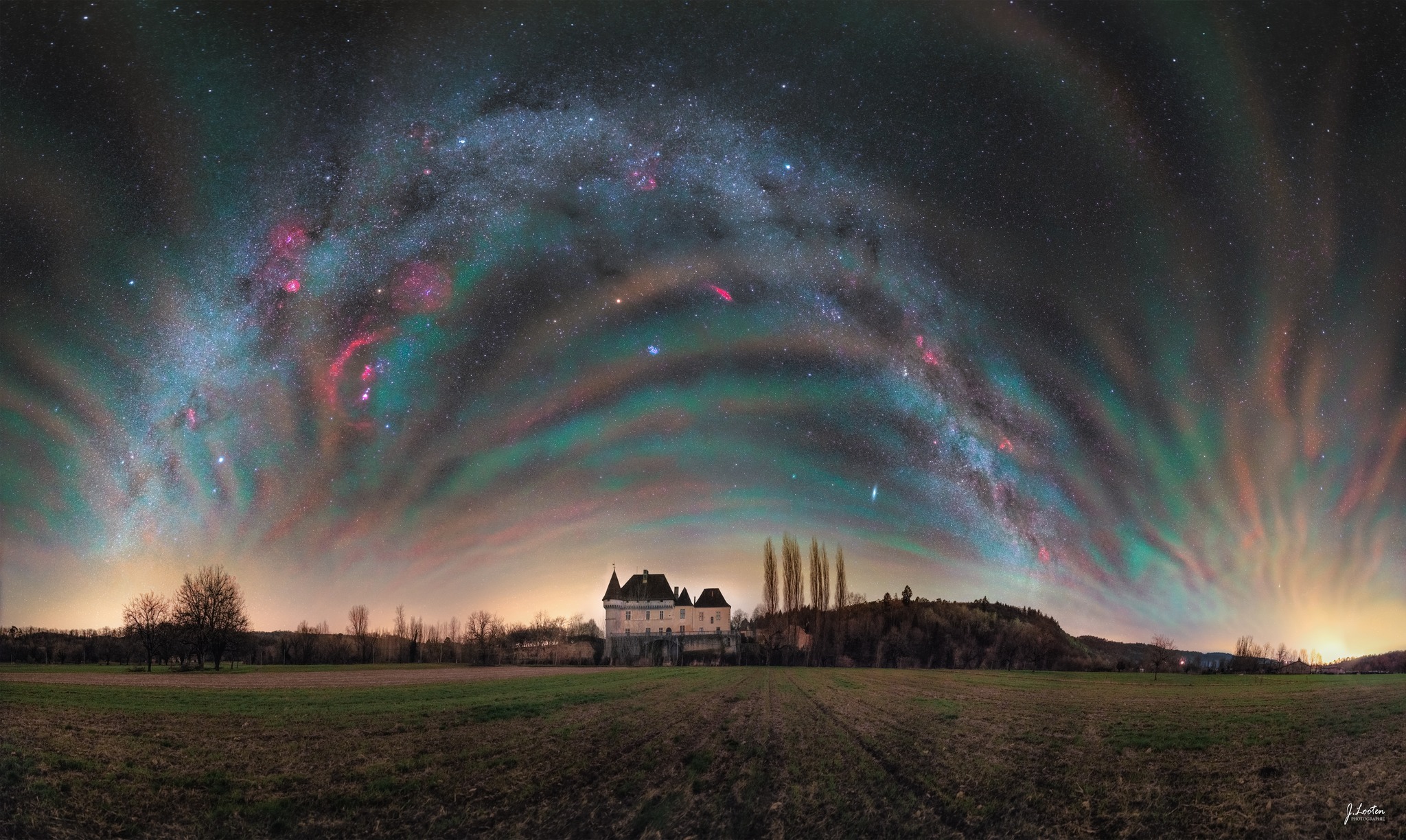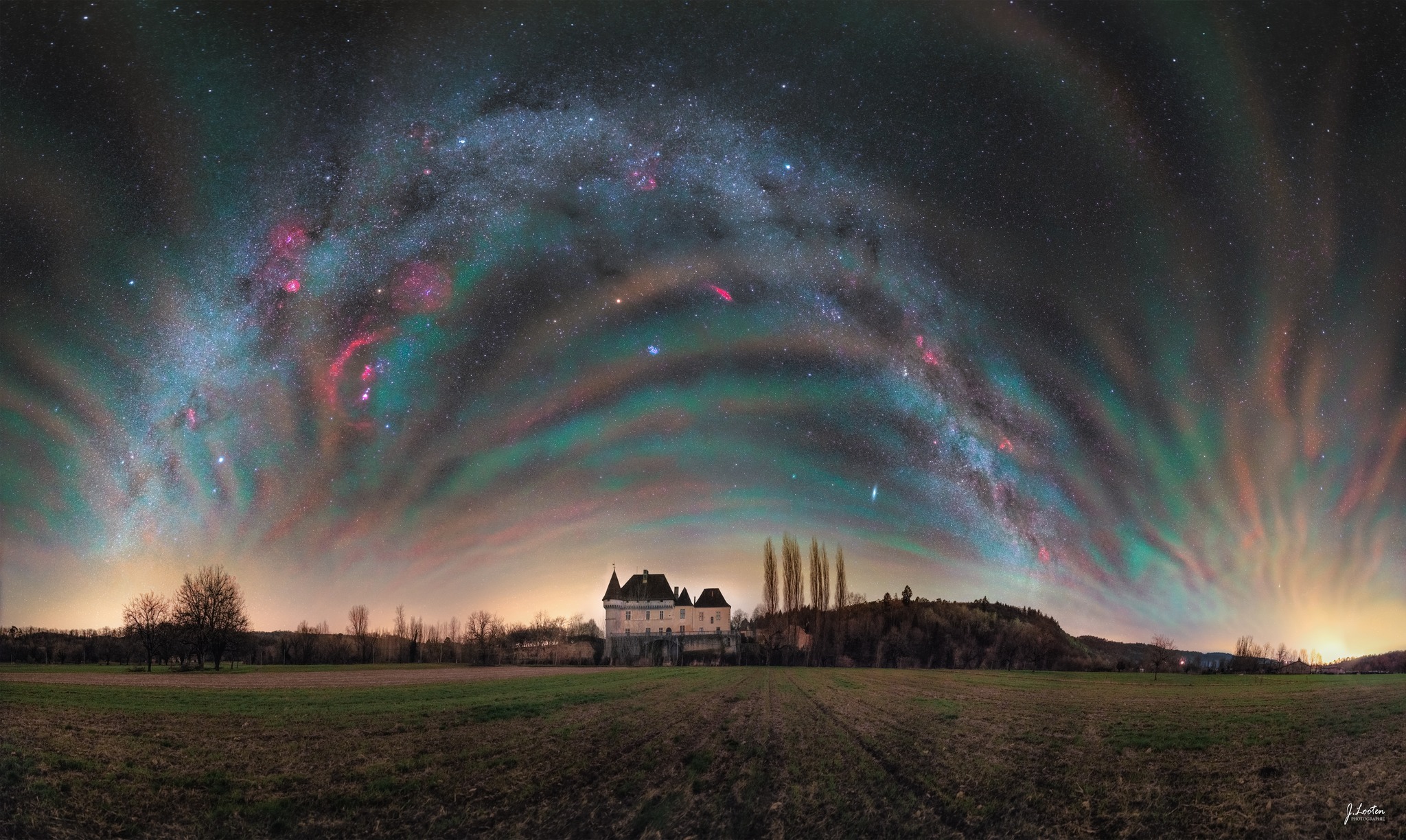
This unusual sky was both familiar and unfamiliar. The photographer's mission was to capture the arch of the familiar central band of our Milky Way Galaxy over a picturesque medieval manor. The surprise was that on this January evening, the foreground sky was found glowing in a beautiful but unfamiliar manner. The striped bands are called airglow and they result from air high in Earth's atmosphere being excited by the Sun's light and emitting a faint light of its own. The bands cross the entire sky -- their curved appearance is due to the extremely wide angle of the camera lens. In the foreground lies Château de Losse in southwest France. Other familiar sky delights dot the distant background including the bright white star Sirius, the orange planet Mars, the blue Pleiades star cluster, the red California Nebula, and, on the far right, the extended Andromeda Galaxy. The initial mission was also successful: across the top of the frame is the arching band of our Milky Way. What if: ChatGPT rewrote this text in the style of Shakespeare, Carl Sagan, or Scotty from Star Trek?
Este cielo inusual era a la vez familiar y desconocido. La misión del fotógrafo era capturar el arco de la banda central familiar de nuestra Galaxia Vía Láctea sobre un pintoresco castillo medieval. La sorpresa fue que, en esta noche de enero, el cielo delantero brillaba de una manera hermosa pero desconocida. Las bandas rayadas se llaman brillo atmosférico y se producen cuando el aire alto en la atmósfera terrestre se excita con la luz del Sol y emite una luz tenue propia. Las bandas cruzan todo el cielo — su apariencia curvada se debe al ángulo extremadamente amplio del objetivo de la cámara. En primer plano se encuentra el Château de Losse en el suroeste de Francia. Otros deleites familiares del cielo adornan el fondo distante, incluyendo la estrella blanca brillante Sirio, el planeta Marte de color naranja, el cúmulo estelar azul de las Pléyades, la nebulosa roja de California y, en el extremo derecho, la galaxia extendida de Andrómeda. La misión inicial también fue exitosa: a lo largo de la parte superior del marco se extiende el arco de nuestra Vía Láctea.