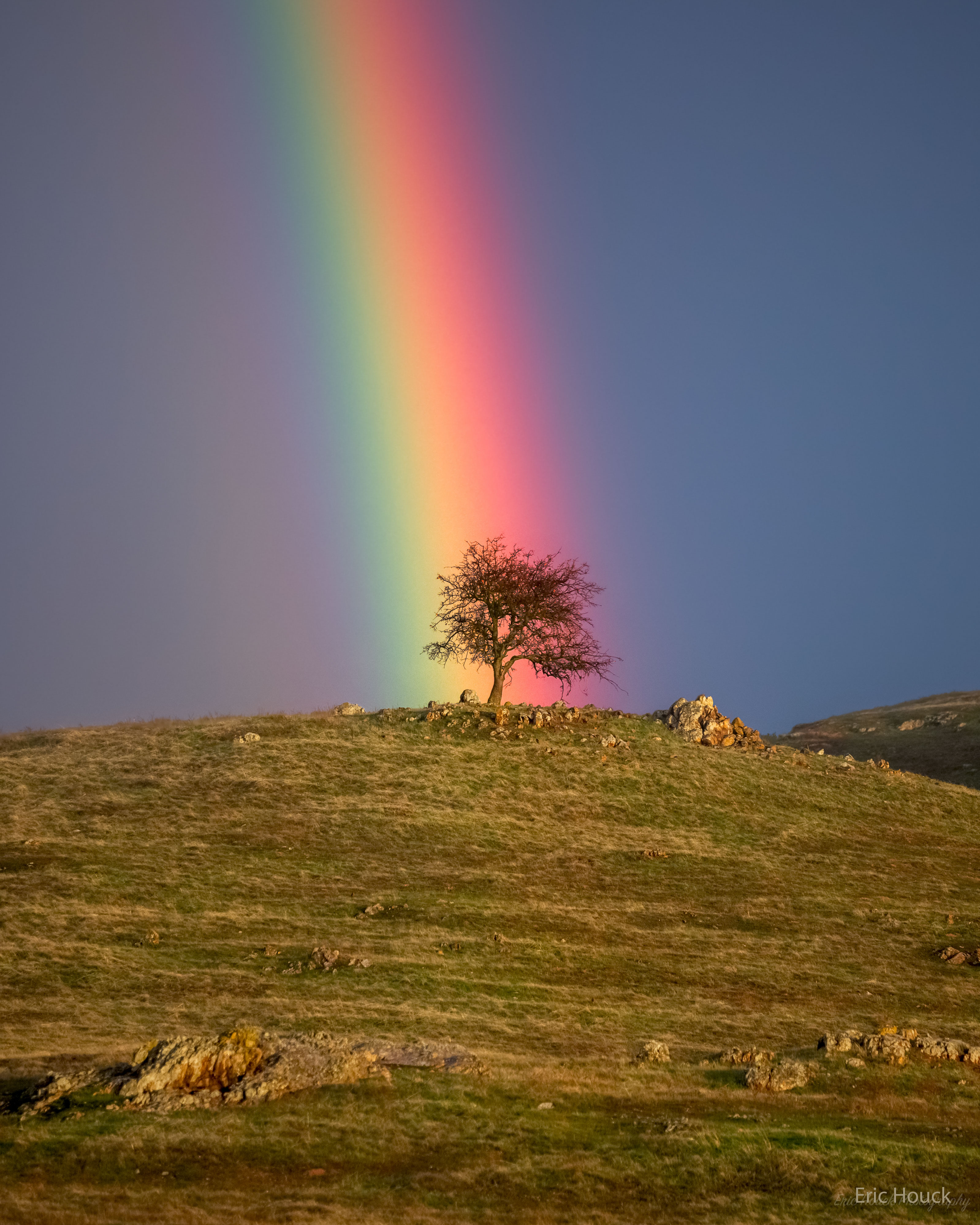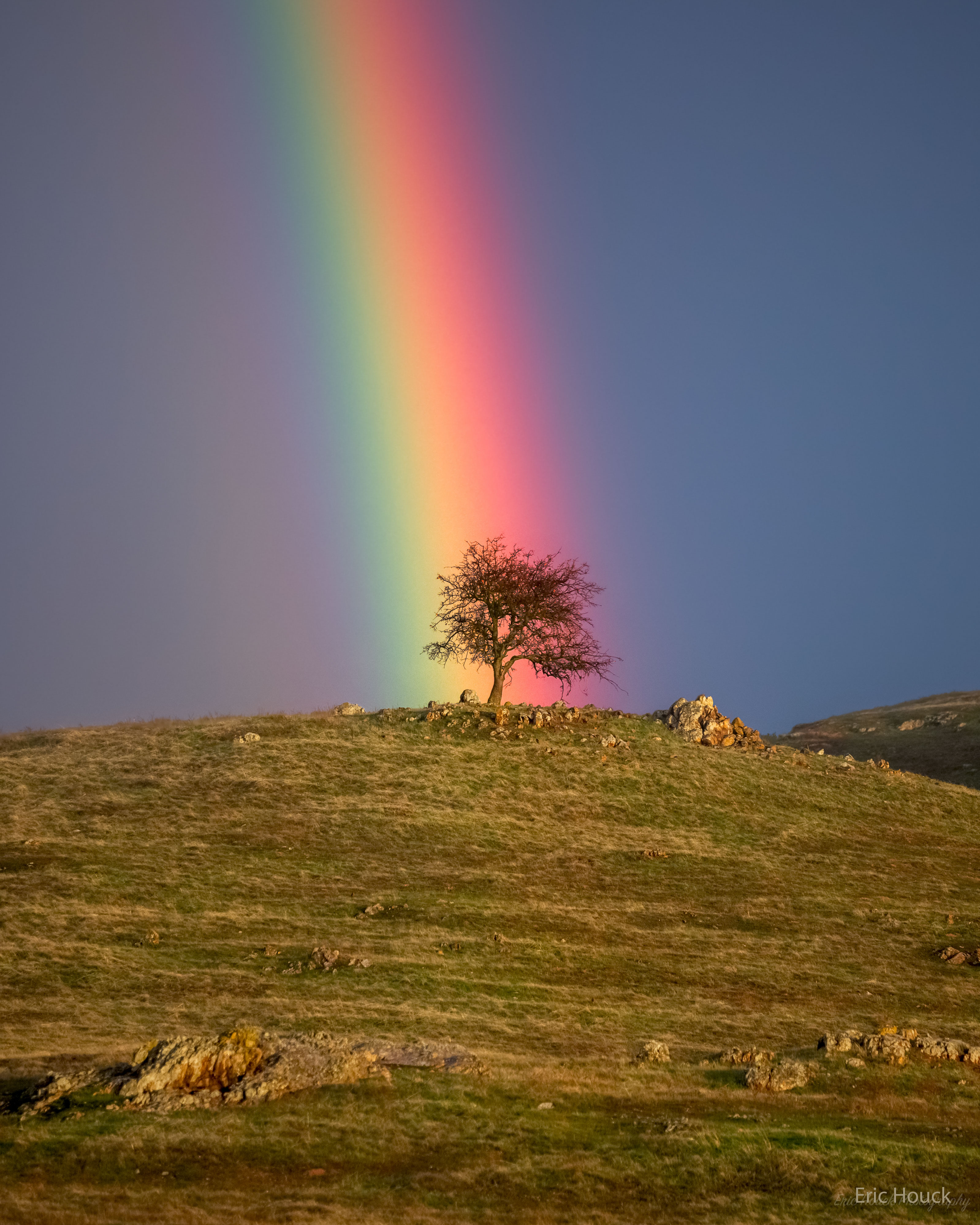
What lies at the end of a rainbow? Something different for everyone. For the photographer taking this picture, for example, one end of the rainbow ended at a tree. Others nearby, though, would likely see the rainbow end somewhere else. The reason is because a rainbow's position depends on the observer. The center of a rainbow always appears in the direction opposite the Sun, but that direction lines up differently on the horizon from different locations. This rainbow's arc indicates that its center is about 40 degrees to the left and slightly below the horizon, while the Sun is well behind the camera and just above the horizon. Reflections and refractions of sunlight from raindrops in a distant storm in the direction of the rainbow are what causes the colorful bands of light. This single exposure image was captured in early January near Knight's Ferry, California, USA.
¿Qué hay al final de un arcoíris? Algo diferente para cada persona. Para el fotógrafo que tomó esta imagen, por ejemplo, un extremo del arcoíris terminaba en un árbol. Otros cerca, sin embargo, probablemente verían que el arcoíris termina en otro lugar. La razón es porque la posición de un arcoíris depende del observador. El centro de un arcoíris siempre aparece en la dirección opuesta al Sol, pero esa dirección se alinea de manera diferente en el horizonte desde diferentes ubicaciones. El arco de este arcoíris indica que su centro está aproximadamente 40 grados a la izquierda y ligeramente por debajo del horizonte, mientras que el Sol está bien detrás de la cámara y apenas por encima del horizonte. Las reflexiones y refracciones de la luz solar de las gotas de lluvia en una tormenta distante en la dirección del arcoíris son lo que causan las bandas coloridas de luz. Esta imagen de una sola exposición fue capturada a principios de enero cerca de Knight's Ferry, California, EE. UU.