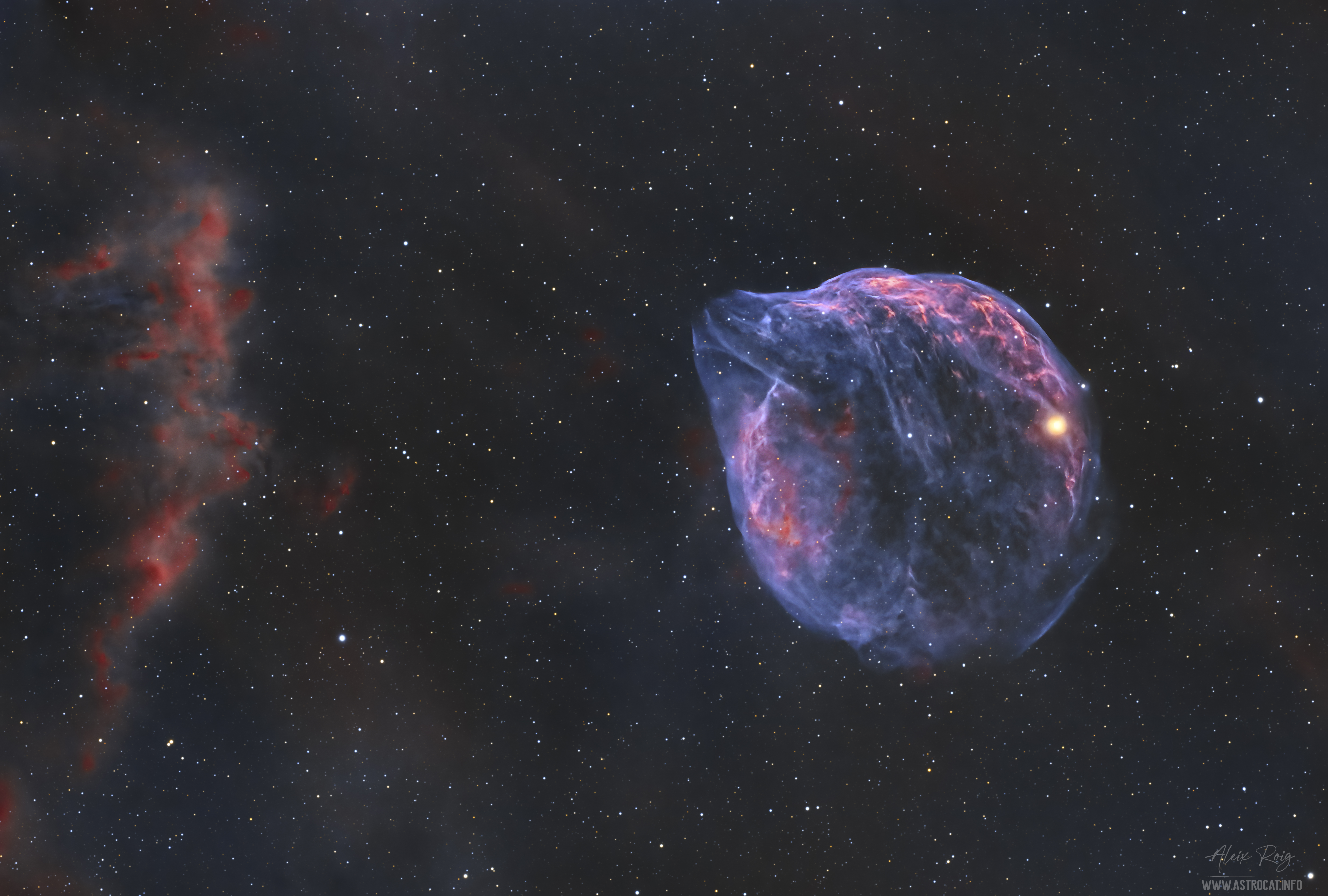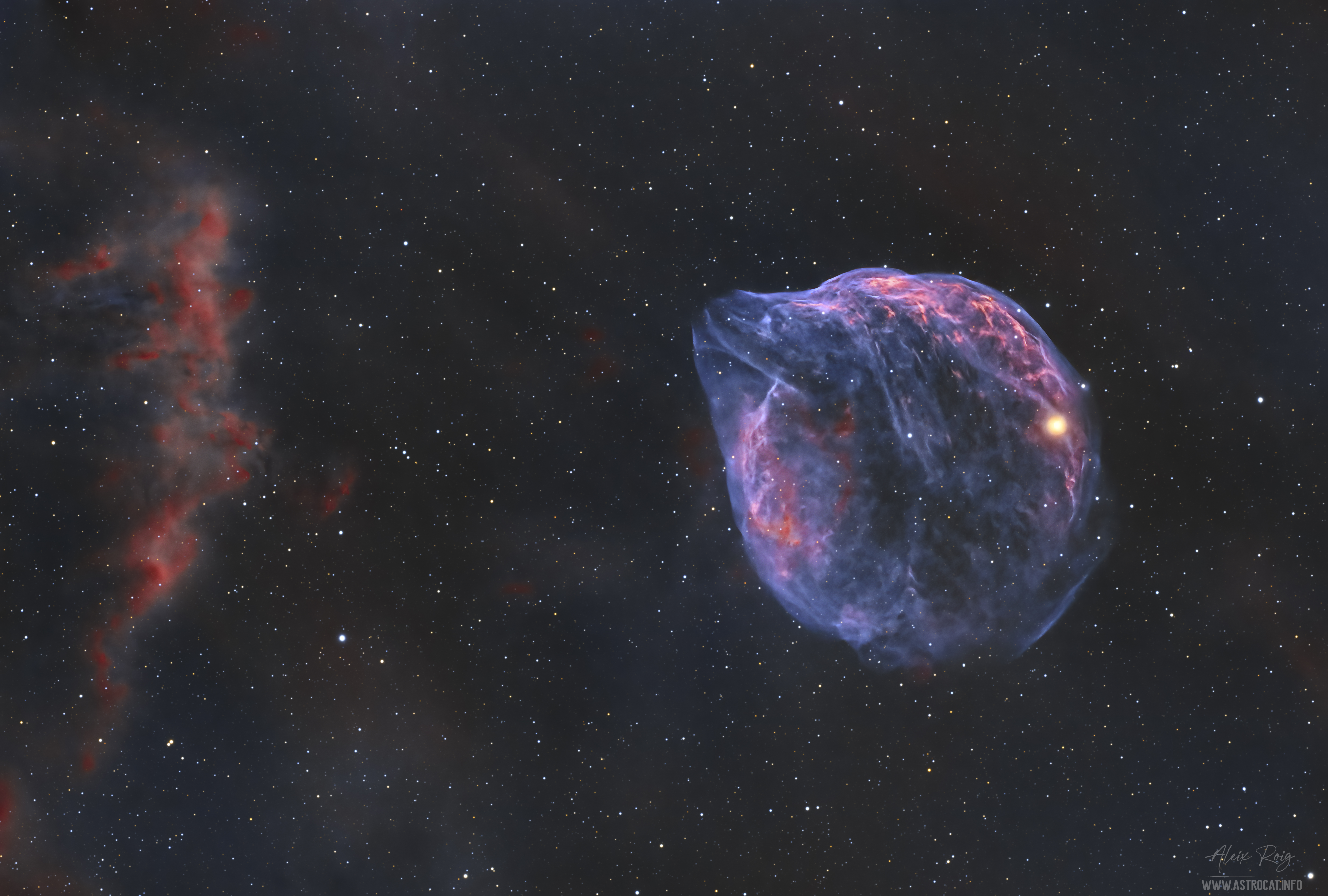
Which star created this bubble? It wasn't the bright star on the bubble's right. And it also wasn't a giant space dolphin. It was the star in the blue nebula's center, a famously energetic Wolf-Rayet star. Wolf-Rayet stars in general have over 20 times the mass of our Sun and expel fast particle winds that can create iconic looking nebulas. In this case, the resulting star bubble spans over 60 light years, is about 70,000 years old, and happens to look like the head of a dolphin. Named Sh2-308 and dubbed the Dolphin-Head Nebula, the gas ball lies about 5,000 light years away and covers as much sky as the full moon -- although it is much dimmer. The nearby red-tinged clouds on the left of the featured image may owe their glow and shape to energetic light emitted from the same Wolf-Rayet star.
¿Qué estrella creó esta burbuja? No fue la estrella brillante a la derecha de la burbuja. Tampoco fue un delfín espacial gigante. Fue la estrella en el centro de la nebulosa azul, una famosa estrella Wolf-Rayet de alta energía. En general, las estrellas Wolf-Rayet tienen más de 20 veces la masa de nuestro Sol y expulsan vientos rápidos de partículas que pueden crear nebulosas con apariencia icónica. En este caso, la burbuja estelar resultante tiene más de 60 años luz de diámetro, tiene aproximadamente 70 000 años de antigüedad y, curiosamente, tiene la apariencia de la cabeza de un delfín. Nombrada Sh2-308 y apodada la Nebulosa de la Cabeza de Delfín, esta bola de gas se encuentra a unos 5000 años luz de distancia y cubre tanto cielo como la luna llena —aunque es mucho más tenue. Las nubes teñidas de rojo cercanas a la izquierda de la imagen destacada podrían deber su brillo y forma a la luz energética emitida por la misma estrella Wolf-Rayet.