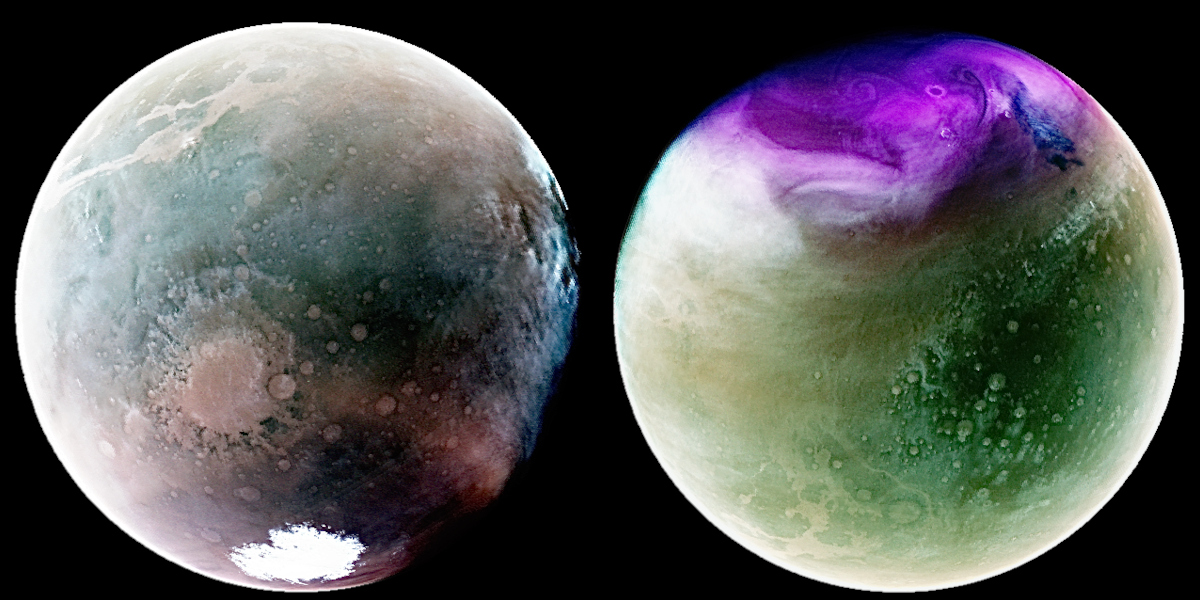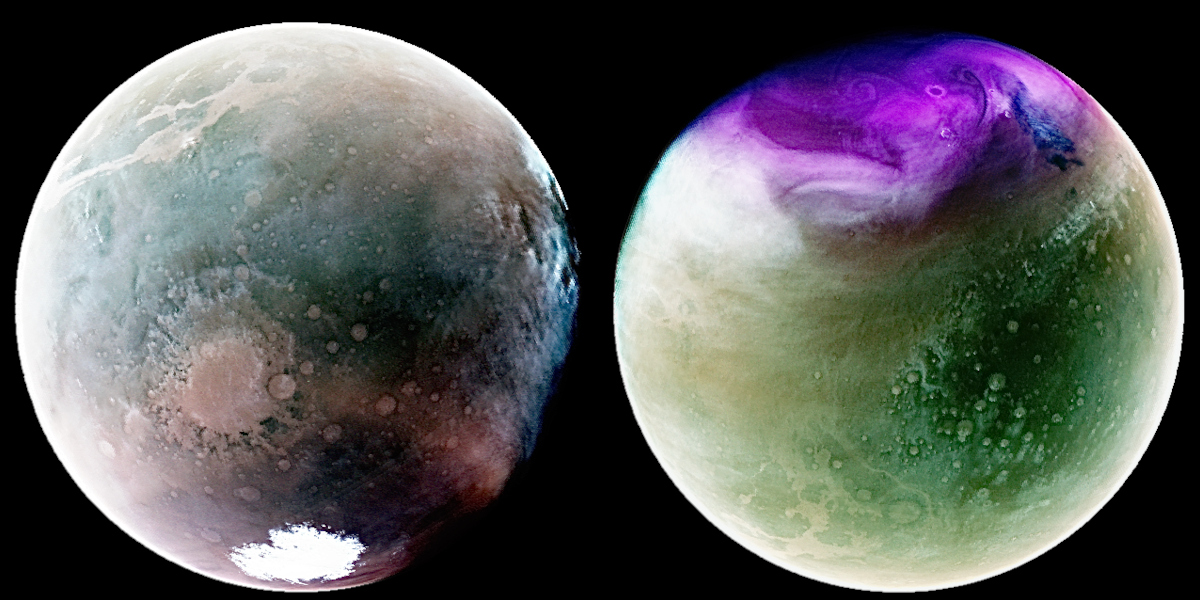
These two global views of Mars were captured at ultraviolet wavelengths, beyond the spectrum visible to human eyes. Recorded by the MAVEN spacecraft's Imaging Ultraviolet Spectrograph instrument in July 2022 (left) and January 2023, three otherwise invisible ultraviolet bands are mapped into red, green, and blue colors. That color scheme presents the Red Planet's surface features in shades of tan and green. Haze and clouds appear white or blue, while high altitude ozone takes on a dramatic purple hue. On the left, Mars' south polar ice cap is in brilliant white at the bottom but shrinking during the southern hemisphere's summer season. On the right, the northern hemisphere's polar region is seen shrouded in clouds and atmospheric ozone. Known to some as the Mars Atmosphere and Volatile EvolutioN spacecraft, MAVEN has been exploring Mars' tenuous upper atmosphere, ionosphere, and its interactions with the Sun and solar wind since 2014.
Estas dos vistas globales de Marte fueron capturadas en longitudes de onda ultravioleta, más allá del espectro visible para los ojos humanos. Registradas por el instrumento Imaging Ultraviolet Spectrograph a bordo de la nave espacial MAVEN en julio de 2022 (izquierda) y enero de 2023, tres bandas ultravioletas normalmente invisibles se mapean en los colores rojo, verde y azul. Ese esquema de color presenta las características de la superficie del Planeta Rojo en tonos de marrón y verde. La niebla y las nubes aparecen en blanco o azul, mientras que el ozono a altas altitudes toma un intenso tono púrpura. A la izquierda, el casquete polar sur de Marte aparece en blanco brillante en la parte inferior, pero se está reduciendo durante el verano en el hemisferio sur. A la derecha, la región polar del hemisferio norte se ve envuelta en nubes y ozono atmosférico. Conocida como la nave espacial Mars Atmosphere and Volatile EvolutioN, MAVEN ha estado explorando la tenue atmósfera superior de Marte, su ionosfera y sus interacciones con el Sol y el viento solar desde 2014.