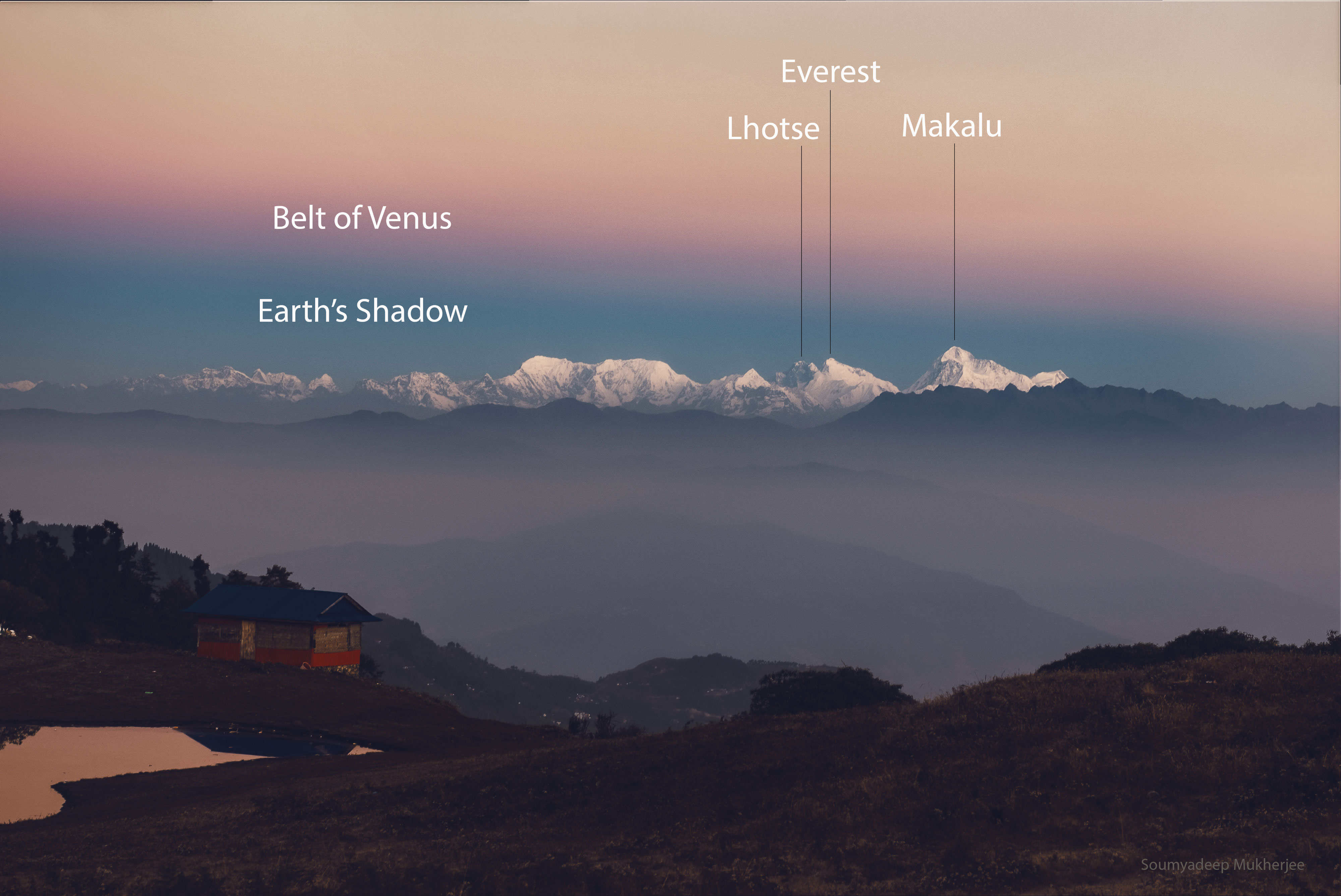
You've surely seen it, but you might not have noticed it. During a cloudless twilight, just before sunrise or after sunset, part of the atmosphere above the horizon appears slightly dark and off-color. Called the Belt of Venus, this transitional band between the dark eclipsed sky and the bright day sky can be seen most prominently in the direction opposite the Sun. Straight above, blue sky is normal sunlight reflecting off the atmosphere, while near the horizon the clear sky can appear more orange or red. In the Belt of Venus, the atmosphere reflects more light from the setting (or rising) Sun and so appears more red. Featured here, the Belt of Venus was photographed over several Himalayan mountains including, second from the right, Mount Everest, the tallest mountain on Earth. Although usually not mentioned, the belt is frequently caught by accident in other photographs.
Lo has visto con seguridad, pero quizás no lo has notado. Durante una crepúsculo despejado, justo antes del amanecer o después del atardecer, parte de la atmósfera por encima del horizonte aparece ligeramente oscura y descolorida. Llamada la Cintura de Venus, esta banda transicional entre el cielo oscuro eclipsado y el cielo brillante del día se ve con mayor claridad en la dirección opuesta al Sol. Rectamente encima, el cielo azul es la luz solar normal reflejada por la atmósfera, mientras que cerca del horizonte, el cielo despejado puede aparecer más naranja o rojo. En la Cintura de Venus, la atmósfera refleja más luz del Sol que se pone (o que se levanta) y por lo tanto aparece más roja. En la imagen destacada, la Cintura de Venus fue fotografiada sobre varias montañas de los Himalayas, incluyendo, la segunda desde la derecha, el Monte Everest, la montaña más alta de la Tierra. Aunque normalmente no se menciona, la cintura es frecuentemente capturada accidentalmente en otras fotografías.