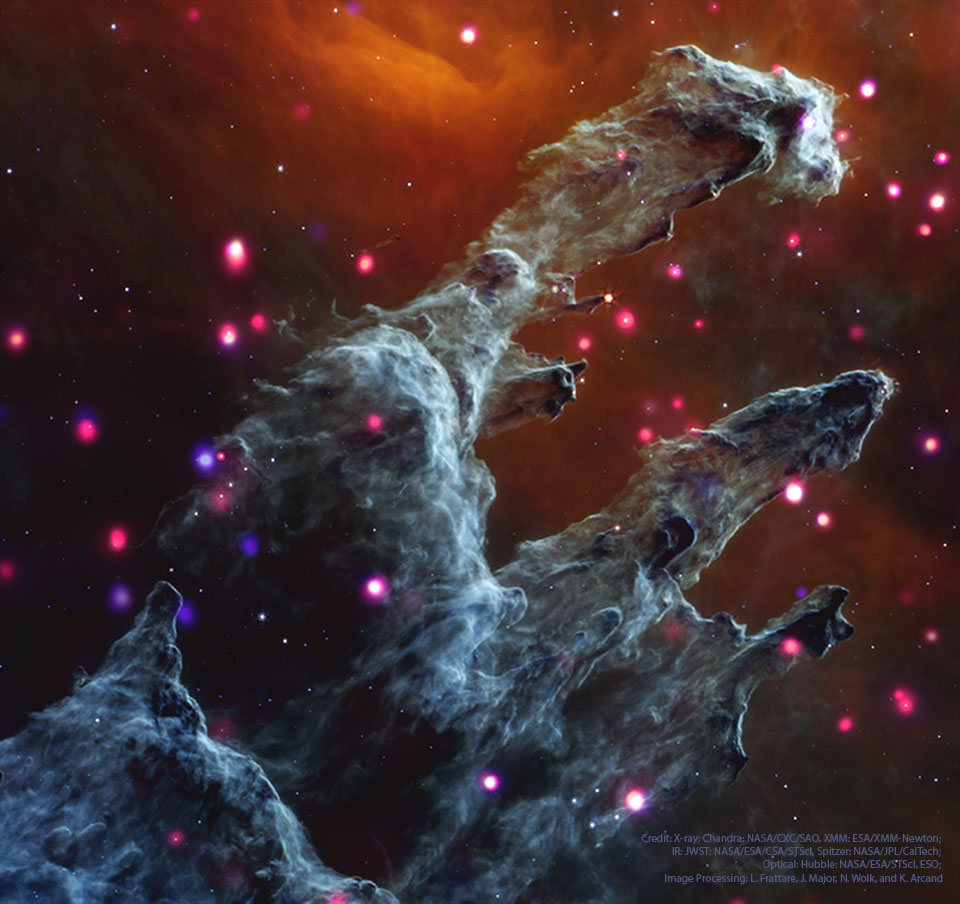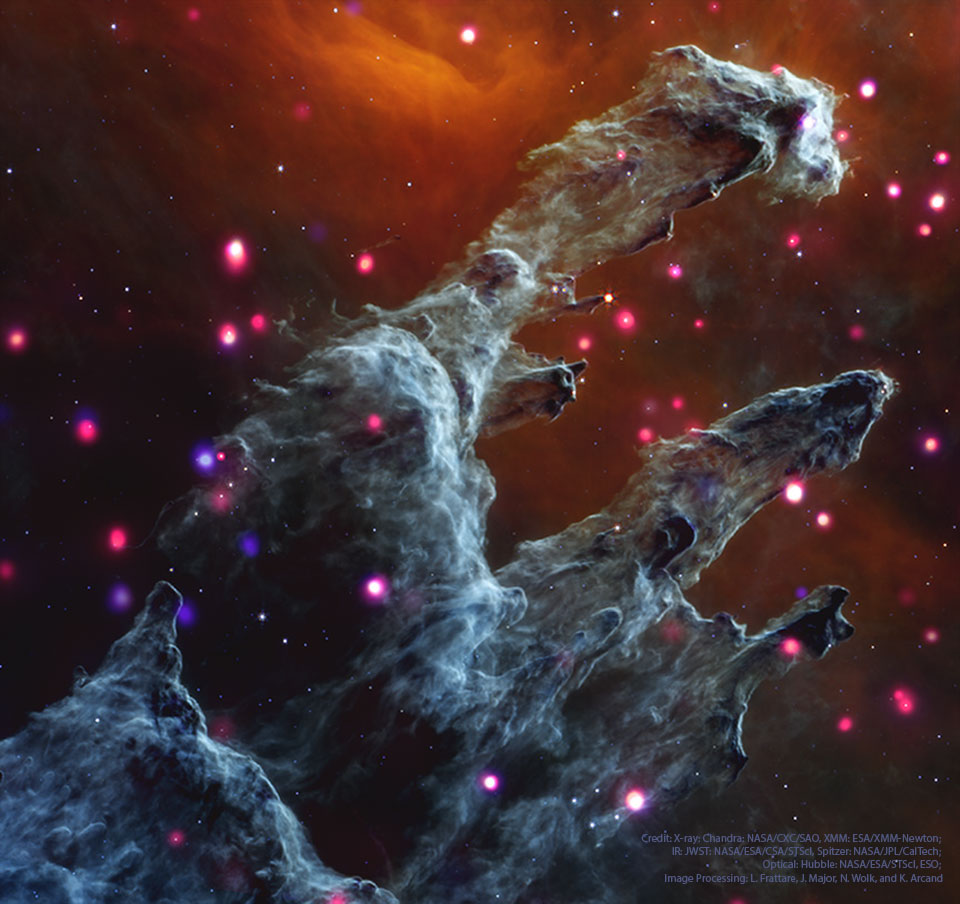
What do the famous Eagle Nebula star pillars look like in X-ray light? To find out, NASA's orbiting Chandra X-ray Observatory peered in and through these interstellar mountains of star formation. It was found that in M16 the dust pillars themselves do not emit many X-rays, but a lot of small-but-bright X-ray sources became evident. These sources are shown as bright dots on the featured image which is a composite of exposures from Chandra (X-rays), XMM (X-rays), JWST (infrared), Spitzer (infrared), Hubble (visible), and the VLT (visible). What stars produce these X-rays remains a topic of research, but some are hypothesized to be hot, recently-formed, low-mass stars, while others are thought to be hot, older, high-mass stars. These X-ray hot stars are scattered around the frame -- the previously identified Evaporating Gaseous Globules (EGGS) seen in visible light are not currently hot enough to emit X-rays.
¿Cómo se ven las famosas columnas estelares de la Nebulosa del Águila en luz de rayos X? Para averiguarlo, la observación orbital Chandra de la NASA miró hacia dentro y a través de estas montañas interestelares de formación estelar. Se descubrió que en M16, las columnas de polvo en sí mismas no emiten muchos rayos X, pero se evidenciaron muchas fuentes pequeñas pero brillantes de rayos X. Estas fuentes se muestran como puntos brillantes en la imagen destacada, que es un compuesto de exposiciones de Chandra (rayos X), XMM (rayos X), JWST (infrarrojo), Spitzer (infrarrojo), Hubble (visible) y el VLT (visible). ¿Qué estrellas producen estos rayos X sigue siendo un tema de investigación, pero se hipotetiza que algunas son estrellas calientes, recientemente formadas y de baja masa, mientras que otras se consideran estrellas calientes, más antiguas y de alta masa. Estas estrellas calientes en rayos X están dispersas por todo el marco; los EGGS (Globulos Gaseosos Evaporándose) identificados previamente, vistos en luz visible, no son actualmente lo suficientemente calientes como para emitir rayos X.