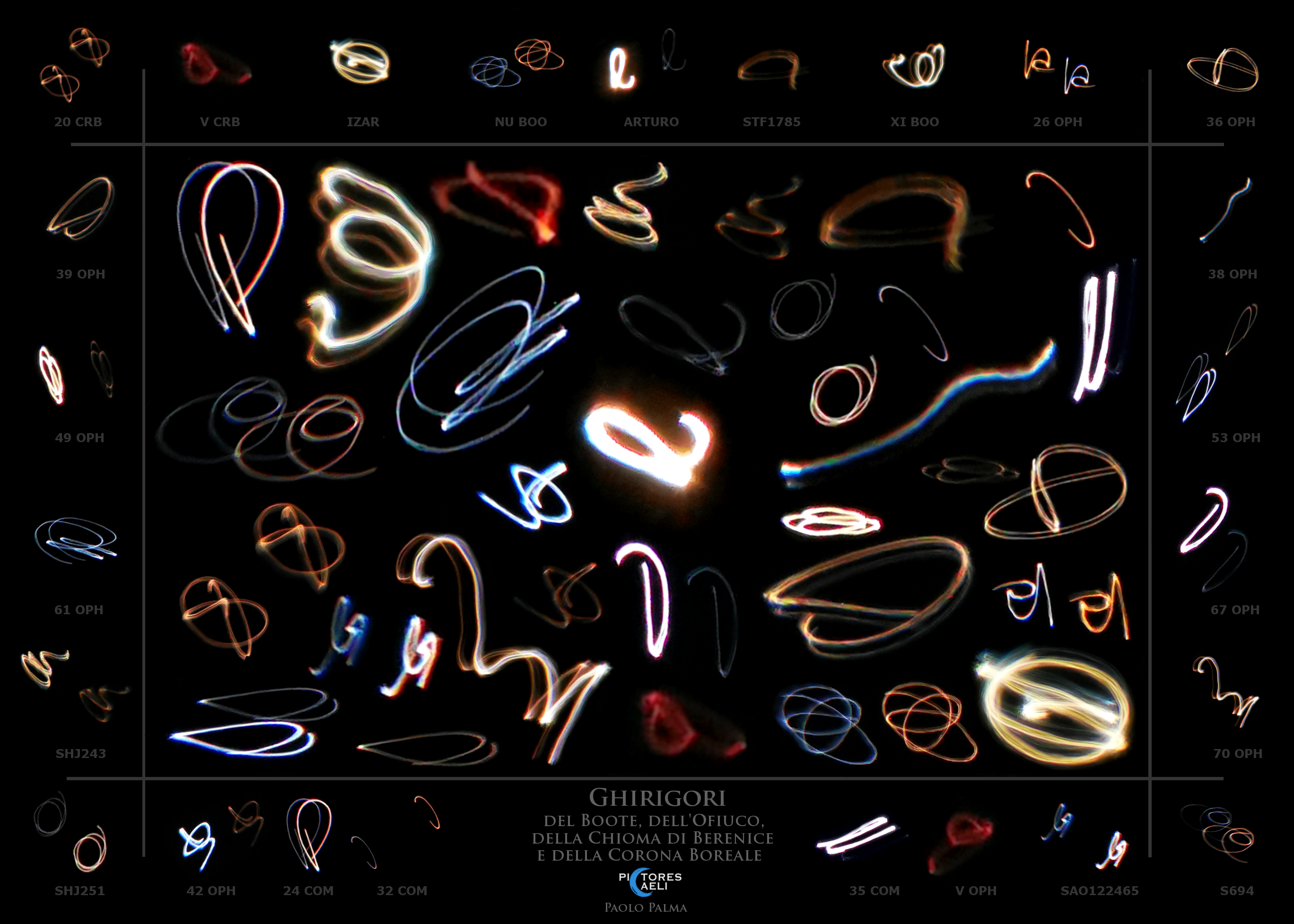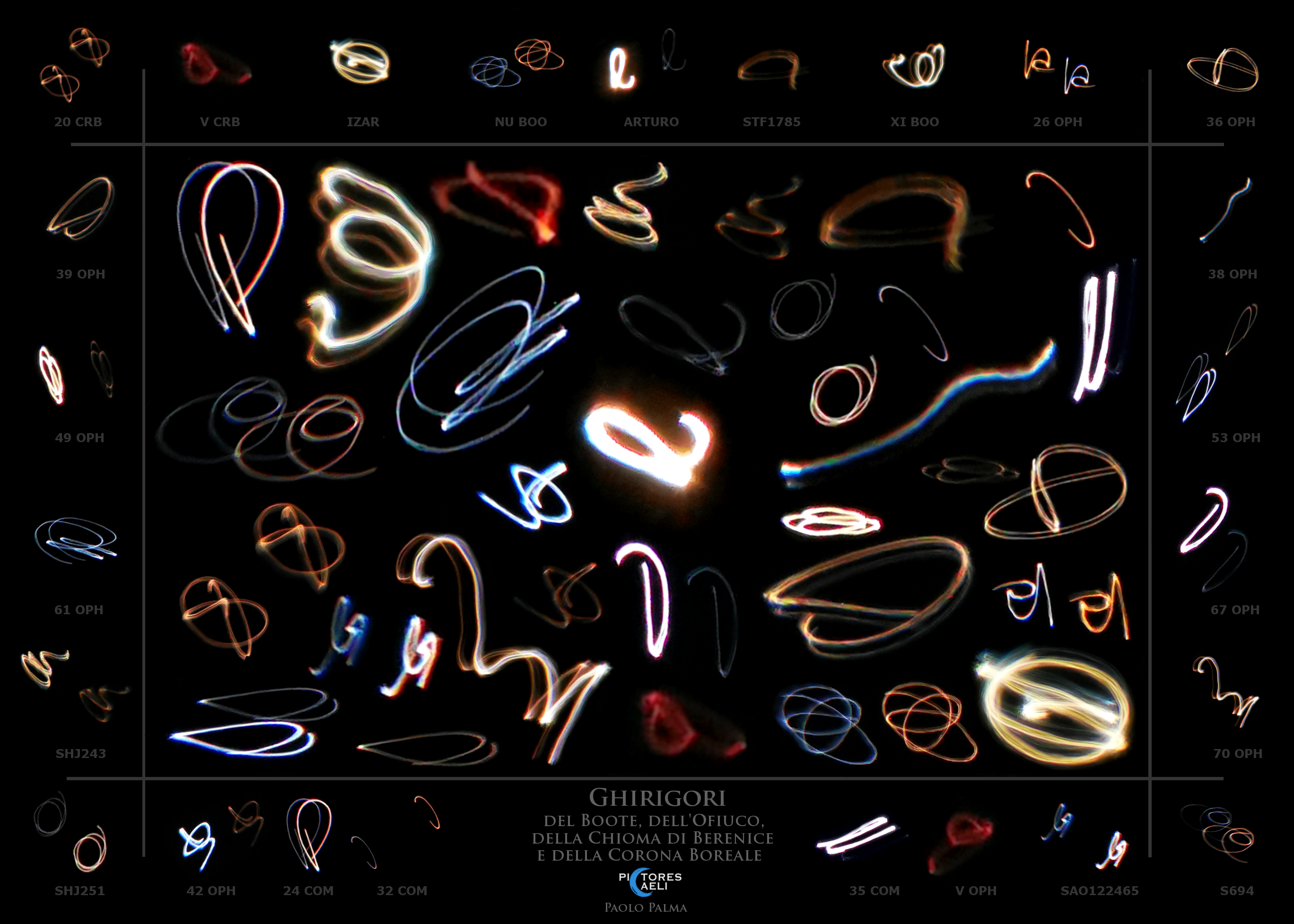
It's fun to scribble on the canvas of the sky. You can use a creative photographic technique to cause the light of point-like stars to dance across a digital image by tapping lightly on the telescope while making an exposure. The result will be a squiggly line traced by the star (or two squiggles traced by binary stars) that can reveal the star's color. Colorful lines, dubbed Ghirigori, made from stars found in the northern sky constellations Bootes, Corona Borealis, Ophiucus, and Coma Berenices, are captured in this artistic mosaic. The 25 stars creating the varied and colorful squiggles are identified around the border. Of course, temperature determines the color of a star. While whitish stars tend to be close to the Sun's temperature, stars with bluer hues are hotter, and yellow and red colors are cooler than the Sun. Weekend Watch: Perseid Meteor Shower
Es divertido dibujar en el lienzo del cielo. Puedes usar una técnica fotográfica creativa para hacer que la luz de estrellas puntuales se mueva a través de una imagen digital golpeando suavemente el telescopio mientras se realiza la exposición. El resultado será una línea ondulada trazada por la estrella (o dos ondulaciones trazadas por estrellas binarias) que pueden revelar el color de la estrella. Líneas coloridas, bautizadas como Ghirigori, creadas a partir de estrellas encontradas en las constelaciones del cielo norte Bootes, Corona Borealis, Ophiucus y Coma Berenices, se capturan en esta mosaico artístico. Las 25 estrellas que crean las ondulaciones variadas y coloridas se identifican alrededor del borde. Por supuesto, la temperatura determina el color de una estrella. Mientras que las estrellas de color blanco tienden a estar cerca de la temperatura del Sol, las estrellas con tonos azules son más calientes, y los colores amarillo y rojo son más fríos que el Sol.