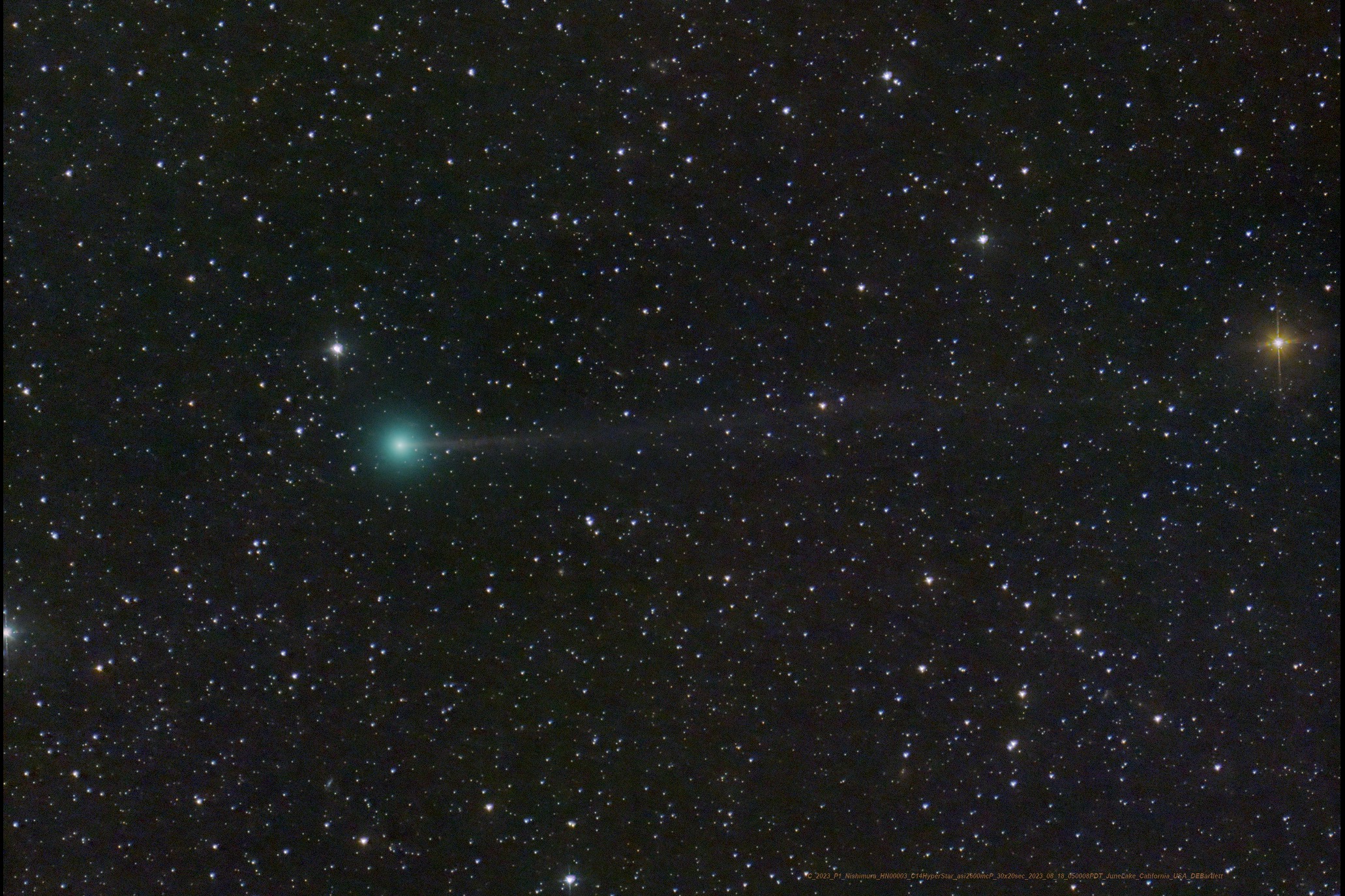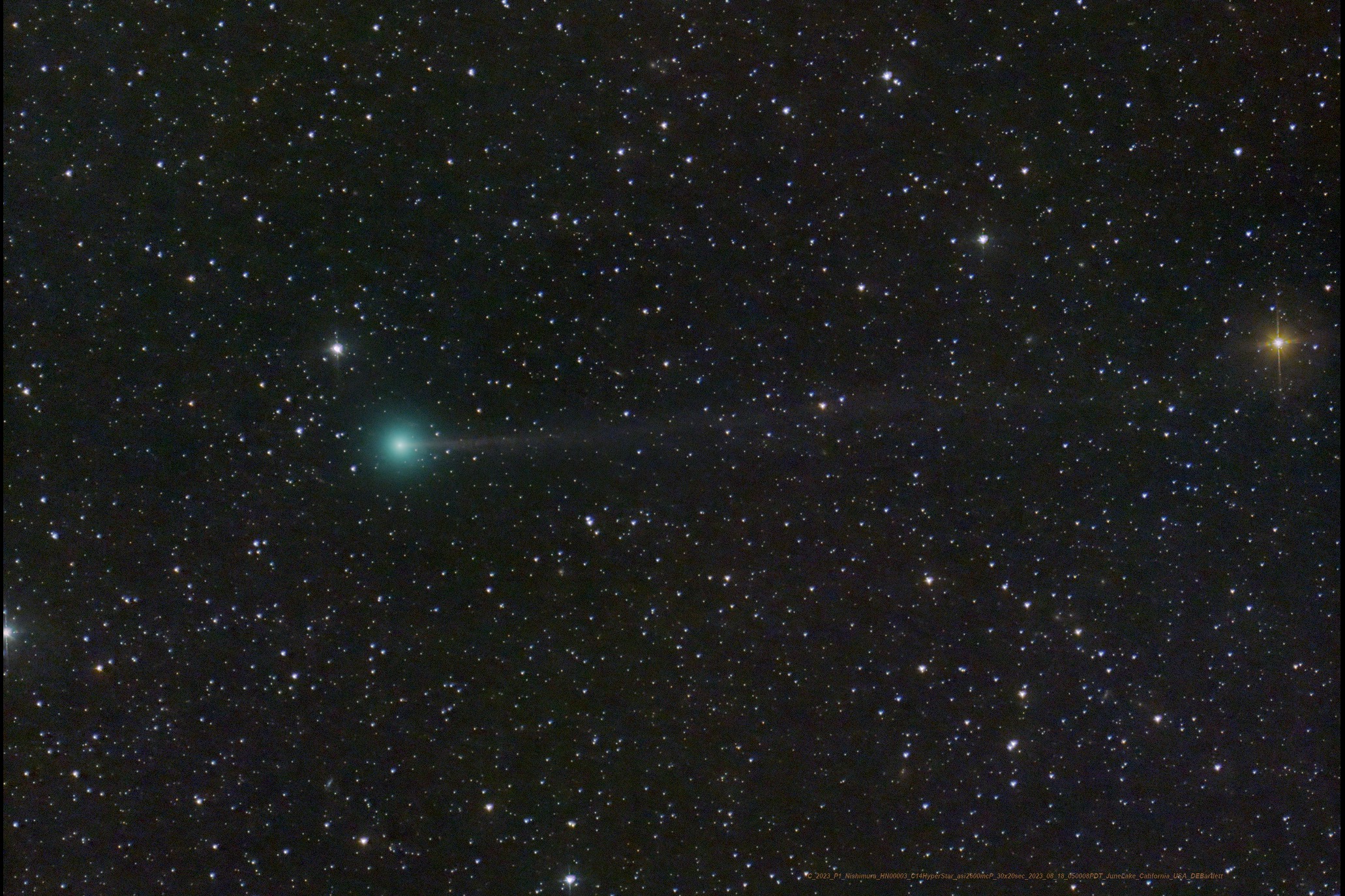
Will Comet Nishimura become visible to the unaided eye? Given the unpredictability of comets, no one can say for sure, but it currently seems like a good bet. The comet was discovered only ten days ago by Hideo Nishimura during 30-second exposures with a standard digital camera. Since then, C/2023 P1 Nishimura has increased in brightness and its path across the inner Solar System determined. As the comet dives toward the Sun, it will surely continue to intensify and possibly become a naked-eye object in early September. A problem is that the comet will also be angularly near the Sun, so it will only be possible to see it near sunset or sunrise. The comet will get so close to the Sun -- inside the orbit of planet Mercury -- that its nucleus may break up. Pictured, Comet Nishimura was imaged three days ago from June Lake, California, USA while sporting a green coma and a thin tail.
¿El cometa Nishimura será visible a simple vista? Dada la imprevisibilidad de los cometas, nadie puede afirmarlo con certeza, pero actualmente parece una buena posibilidad. El cometa fue descubierto hace solo diez días por Hideo Nishimura durante exposiciones de 30 segundos con una cámara digital estándar. Desde entonces, C/2023 P1 Nishimura ha aumentado de brillo y se ha determinado su trayectoria a través del sistema solar interior. A medida que el cometa se precipite hacia el Sol, seguramente continuará intensificándose y podría convertirse en un objeto visible a simple vista a principios de septiembre. Un problema es que el cometa también estará angularmente cerca del Sol, por lo que solo será posible verlo cerca del atardecer o del amanecer. El cometa se acercará tanto al Sol — dentro de la órbita del planeta Mercurio — que su núcleo podría desintegrarse. En la imagen, el cometa Nishimura fue fotografiado hace tres días desde June Lake, California, EE. UU., mientras mostraba una coma verde y una cola delgada.