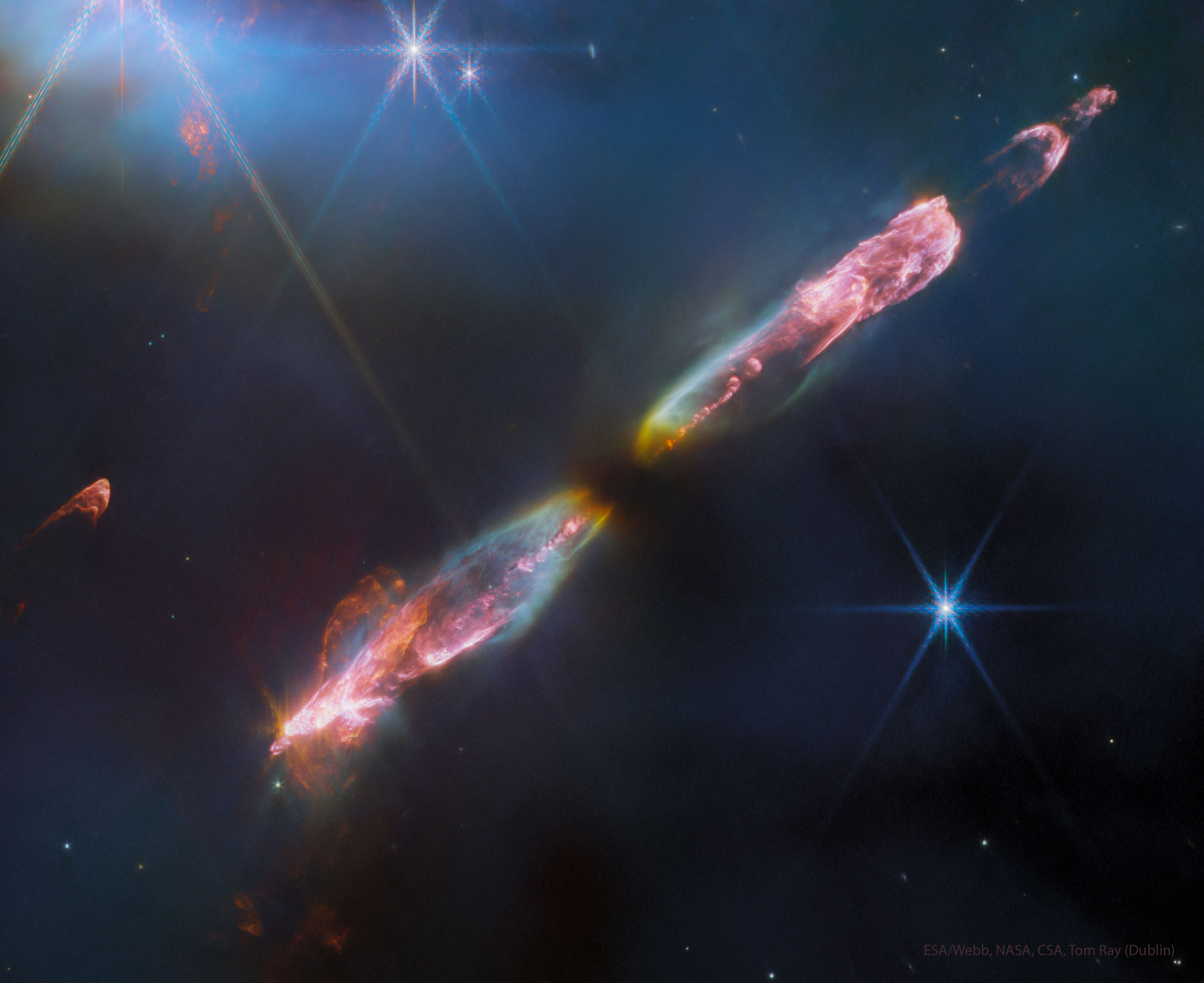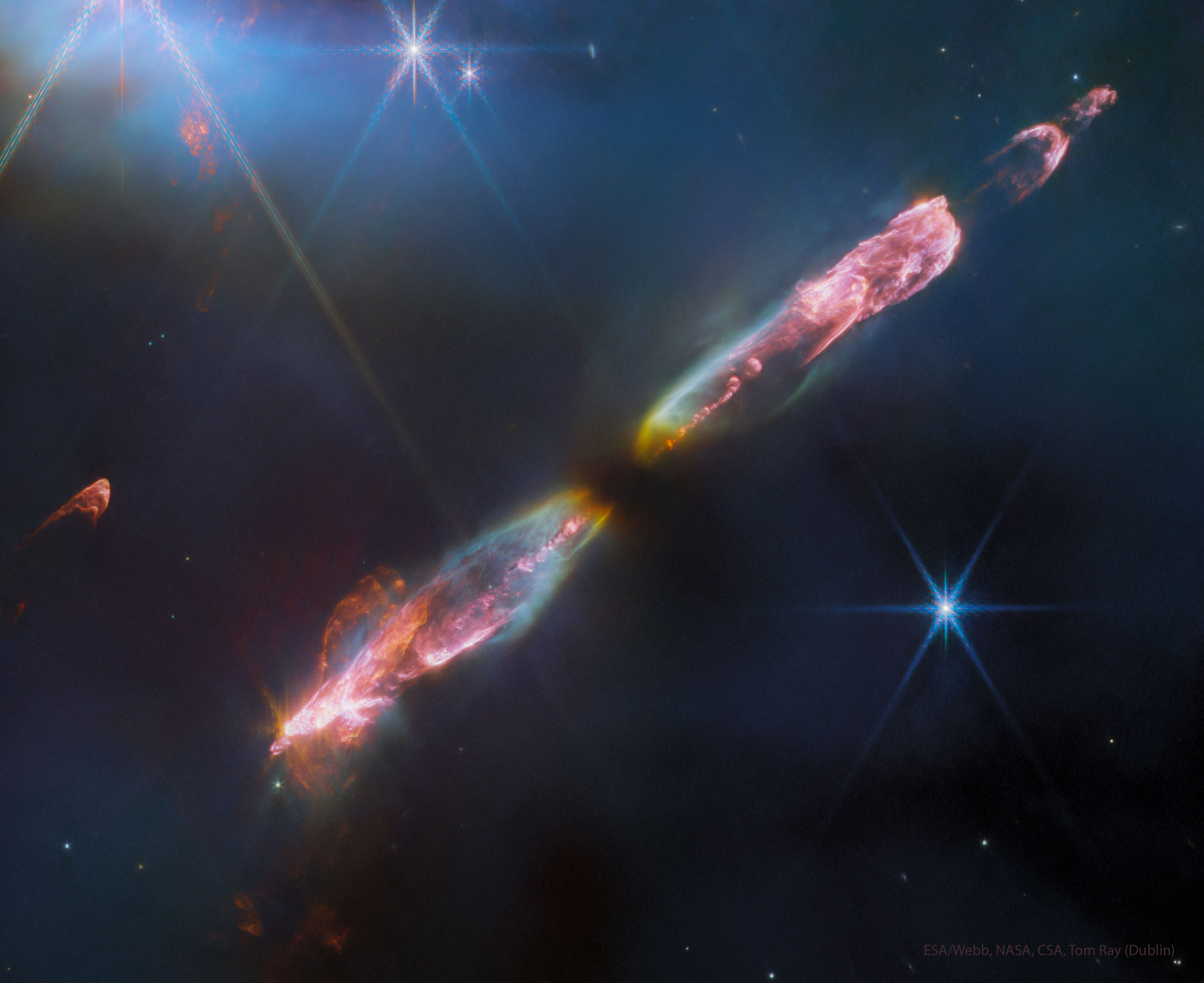
Do stars always create jets as they form? No one is sure. As a gas cloud gravitationally contracts, it forms a disk that can spin too fast to continue contracting into a protostar. Theorists hypothesize that this spin can be reduced by expelling jets. This speculation coincides with known Herbig-Haro (HH) objects, young stellar objects seen to emit jets -- sometimes in spectacular fashion. Pictured is Herbig-Haro 211, a young star in formation recently imaged by the Webb Space Telescope (JWST) in infrared light and in great detail. Along with the two narrow beams of particles, red shock waves can be seen as the outflows impact existing interstellar gas. The jets of HH 211 will likely change shape as they brighten and fade over the next 100,000 years, as research into the details of star formation continues.
¿Las estrellas siempre crean chorros mientras se forman? Nadie está seguro. Cuando una nube de gas se contrae gravitacionalmente, forma un disco que puede girar demasiado rápido como para continuar contrayéndose en una protoestrella. Los teóricos hipotetizan que este giro puede reducirse expulsando chorros. Esta especulación coincide con los objetos Herbig-Haro (HH) conocidos, objetos estelares jóvenes que se ven emitir chorros, a veces de manera espectacular. Se muestra Herbig-Haro 211, una joven estrella en formación recientemente fotografiada por el Telescopio Espacial James Webb (JWST) en luz infrarroja y con gran detalle. Junto con los dos estrechos haces de partículas, se pueden ver ondas de choque rojas cuando los chorros impactan el gas interestelar existente. Los chorros de HH 211 probablemente cambien de forma a medida que se acentúen y desaparezcan durante los próximos 100 000 años, a medida que continúe la investigación sobre los detalles de la formación estelar.