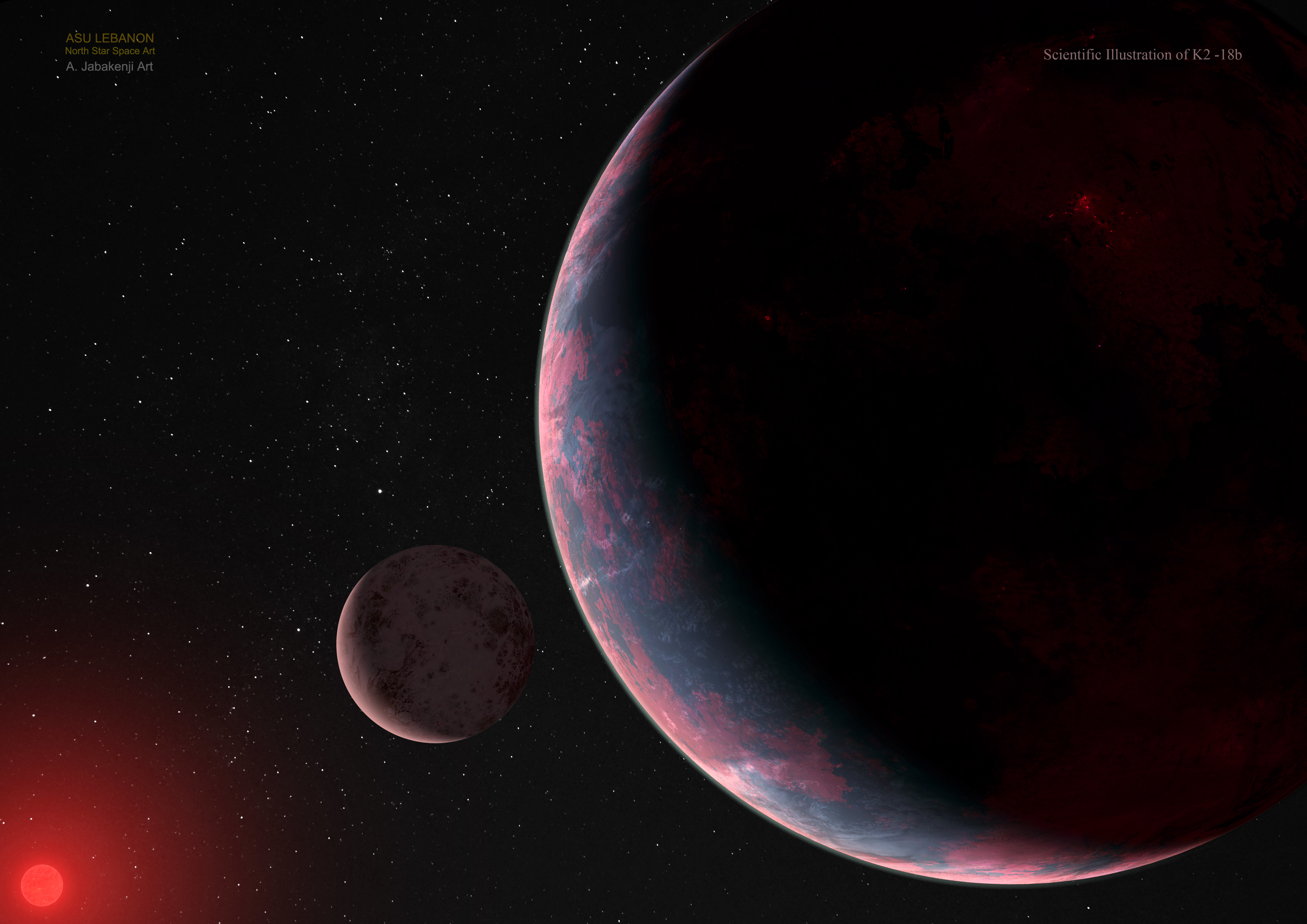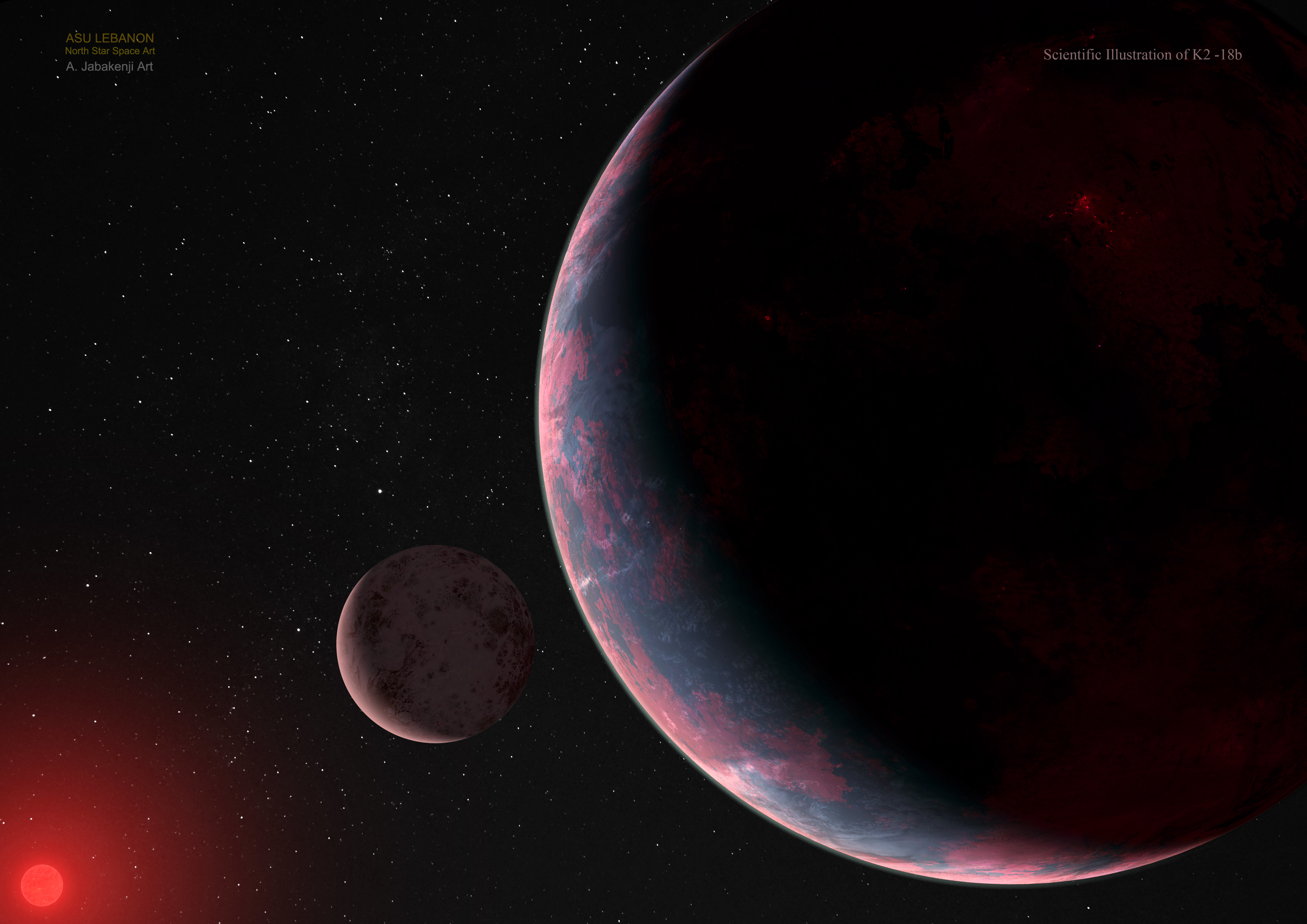
Where else might life exist? One of humanity's great outstanding questions, locating planets where extrasolar life might survive took a step forward in 2019 with the discovery of a significant amount of water vapor in the atmosphere of distant exoplanet K2-18b. The planet and its parent star, K2-18, lie about 124 light years away toward the constellation of the Lion (Leo). The exoplanet is significantly larger and more massive than our Earth, but orbits in the habitable zone of its home star. K2-18, although more red than our Sun, shines in K2-18b's sky with a brightness similar to the Sun in Earth's sky. The 2019 discovery of atmospheric water was made in data from three space telescopes: Hubble, Spitzer, and Kepler, by noting the absorption of water-vapor colors when the planet moved in front of the star. Now in 2023, further observations by the Webb Space Telescope in infrared light have uncovered evidence of other life-indicating molecules -- including methane. The featured illustration imagines exoplanet K2-18b on the far right orbited by a moon (center), which together orbit a red dwarf star depicted on the lower left.
¿Dónde más podría existir vida? Una de las grandes preguntas pendientes de la humanidad, localizar planetas donde la vida extrasolar podría sobrevivir dio un paso adelante en 2019 con el descubrimiento de una cantidad significativa de vapor de agua en la atmósfera del exoplaneta distante K2-18b. El planeta y su estrella madre, K2-18, se encuentran a unos 124 años luz en dirección a la constelación del León (Leo). El exoplaneta es significativamente más grande y masivo que la Tierra, pero orbita en la zona habitable de su estrella. Aunque K2-18 es más rojiza que nuestro Sol, brilla en el cielo de K2-18b con una luminosidad similar a la del Sol en el cielo terrestre. El descubrimiento de 2019 del vapor de agua en la atmósfera se realizó en datos de tres telescopios espaciales: Hubble, Spitzer y Kepler, al observar la absorción de colores del vapor de agua cuando el planeta pasaba frente a la estrella. Ahora, en 2023, observaciones adicionales realizadas por el Telescopio Espacial James Webb en luz infrarroja han revelado evidencia de otras moléculas indicativas de vida, incluyendo metano. La ilustración destacada imagina al exoplaneta K2-18b en la parte inferior derecha, orbitado por una luna (centro), las cuales juntas orbitan una estrella enana roja representada en la parte inferior izquierda.