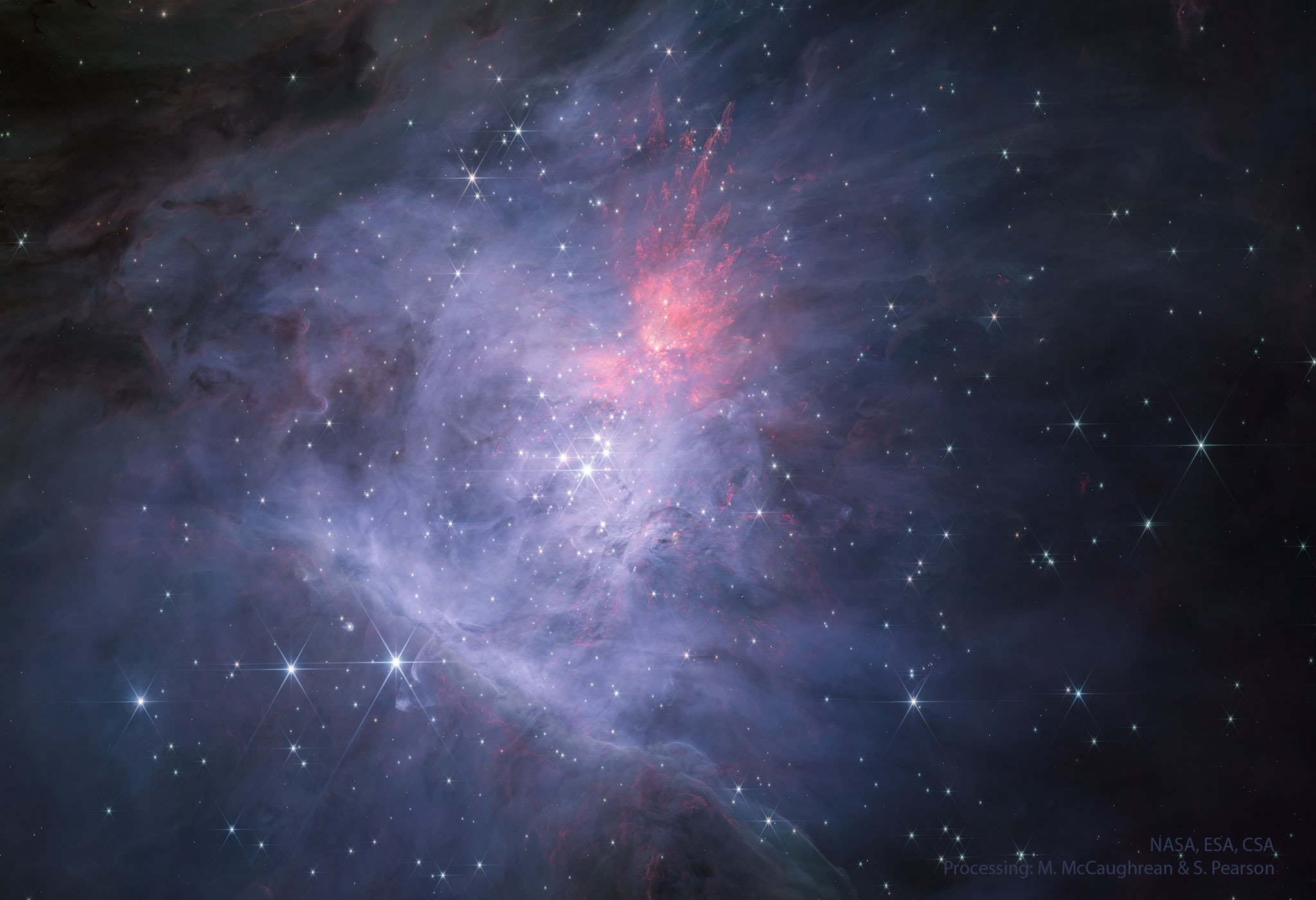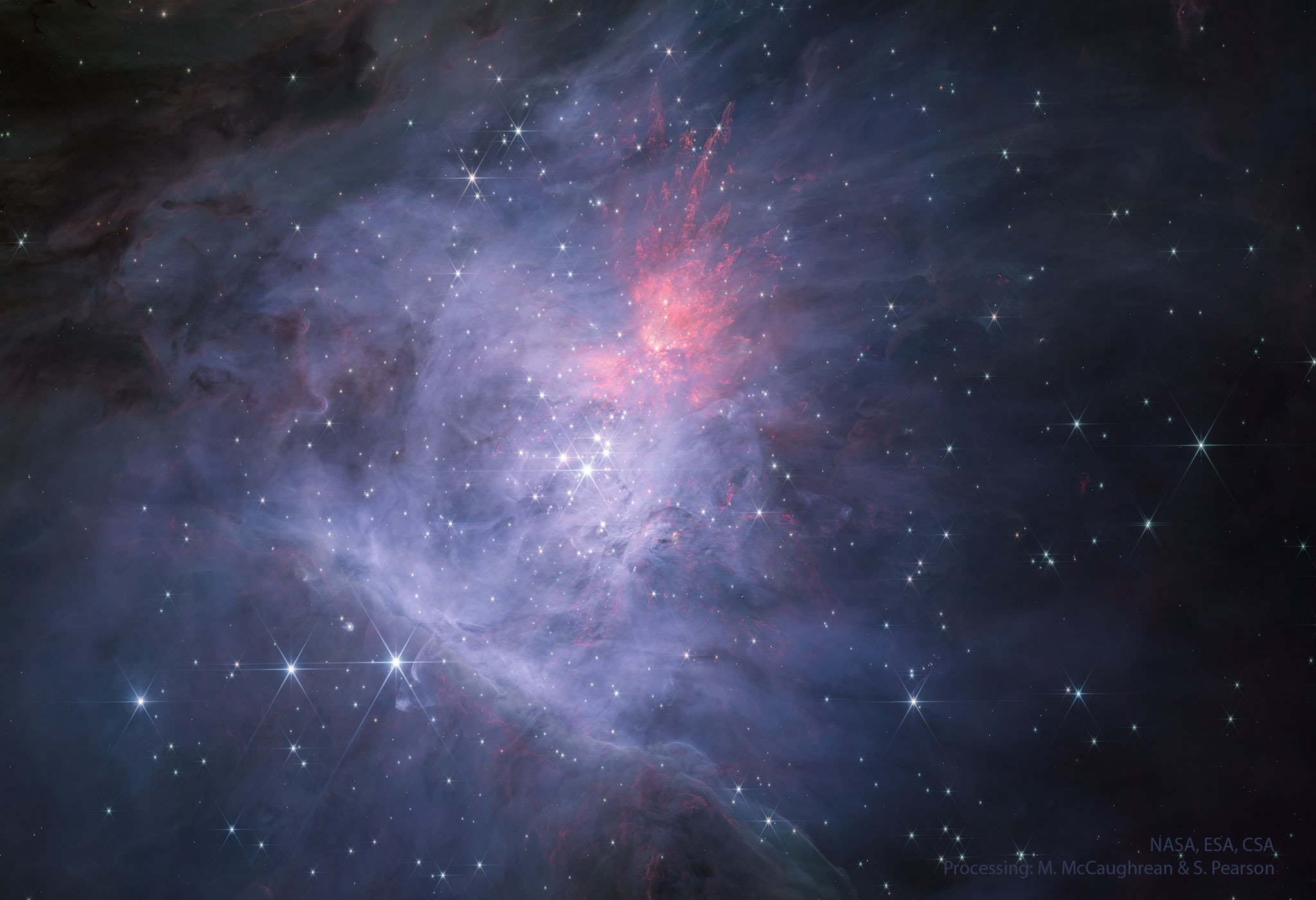
The Great Nebula in Orion has hidden stars. To the unaided eye in visible light, it appears as a small fuzzy patch in the constellation of Orion. But this image was taken by the Webb Space Telescope in a representative-color composite of red and very near infrared light. It confirms with impressive detail that the Orion Nebula is a busy neighborhood of young stars, hot gas, and dark dust. The rollover image shows the same image in representative colors further into the near infrared. The power behind much of the Orion Nebula (M42) is the Trapezium - a cluster of bright stars near the nebula's center. The diffuse and filamentary glow surrounding the bright stars is mostly heated interstellar dust. Detailed inspection of these images shows an unexpectedly large number of Jupiter-Mass Binary Objects (JuMBOs), pairs of Jupiter-mass objects which might give a clue to how stars are forming. The whole Orion Nebula cloud complex, which includes the Horsehead Nebula, will slowly disperse over the next few million years. APOD editor to speak: in Houghton, Michigan on Thursday, October 12 at 6 pm
El Gran Nebulosa de Orión tiene estrellas ocultas. Para el ojo no entrenado en luz visible, aparece como un pequeño parche borroso en la constelación de Orión. Pero esta imagen fue tomada por el Telescopio Espacial Webb en una composición de color representativo de luz roja y muy cercana al infrarrojo. Confirma con un impresionante detalle que la Nebulosa de Orión es un vecindario activo de estrellas jóvenes, gas caliente y polvo oscuro. La imagen al pasar el cursor muestra la misma imagen en colores representativos más allá del infrarrojo cercano. La fuente de energía detrás de gran parte de la Nebulosa de Orión (M42) es el Trapecio, un grupo de estrellas brillantes cerca del centro de la nebulosa. El brillo difuso y filamentario que rodea a las estrellas brillantes es principalmente polvo interestelar calentado. Una inspección detallada de estas imágenes muestra un número inesperadamente grande de Objetos Binarios de Masa Joviana (JuMBOs), pares de objetos de masa joviana que podrían dar una pista sobre cómo se forman las estrellas. Toda la nube compleja de la Nebulosa de Orión, que incluye la Nebulosa Caballo de Tronco, se dispersará lentamente durante los próximos millones de años.