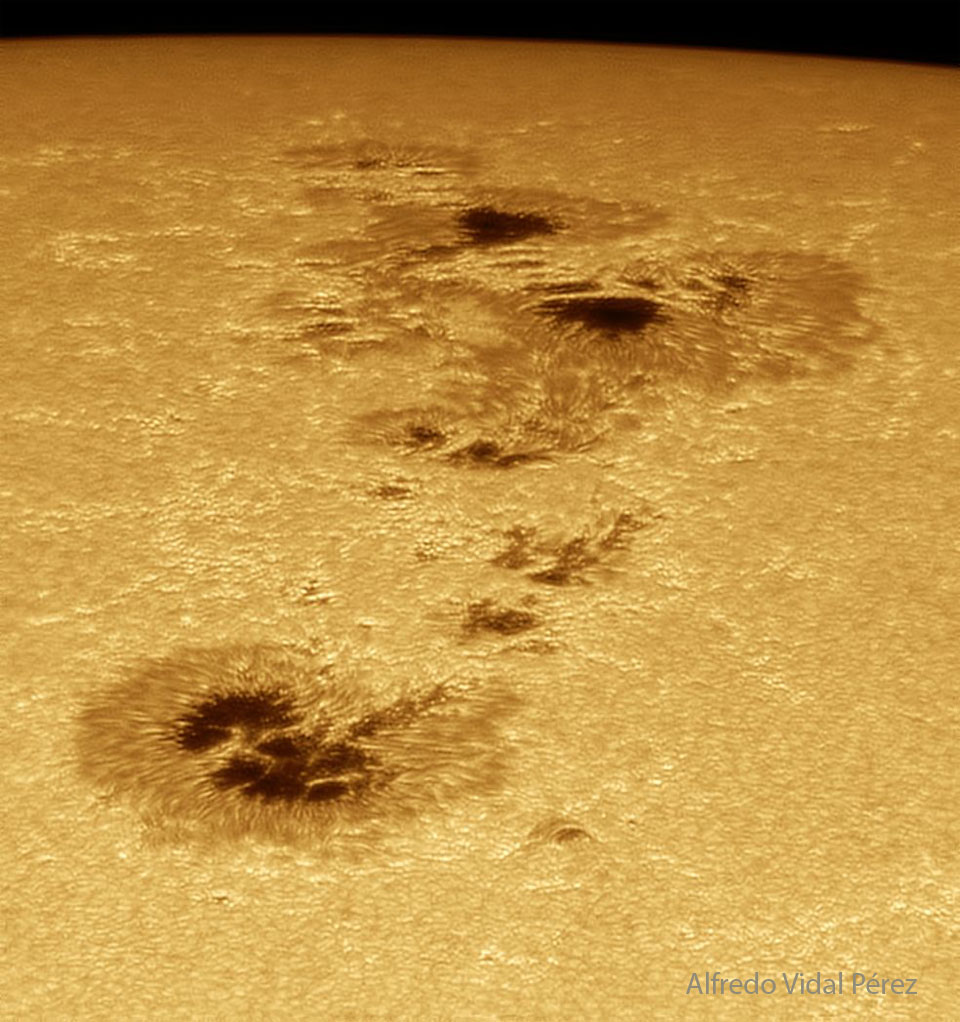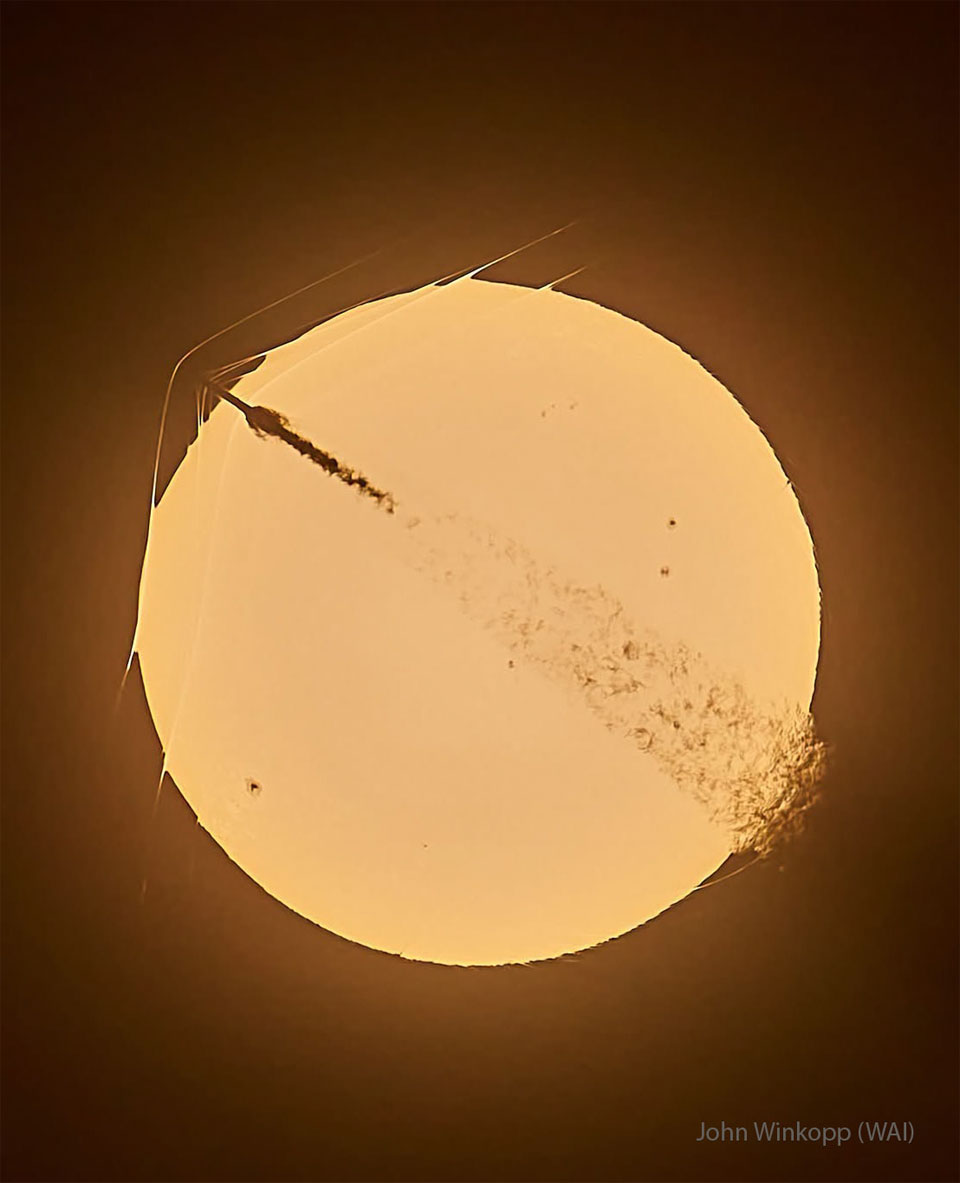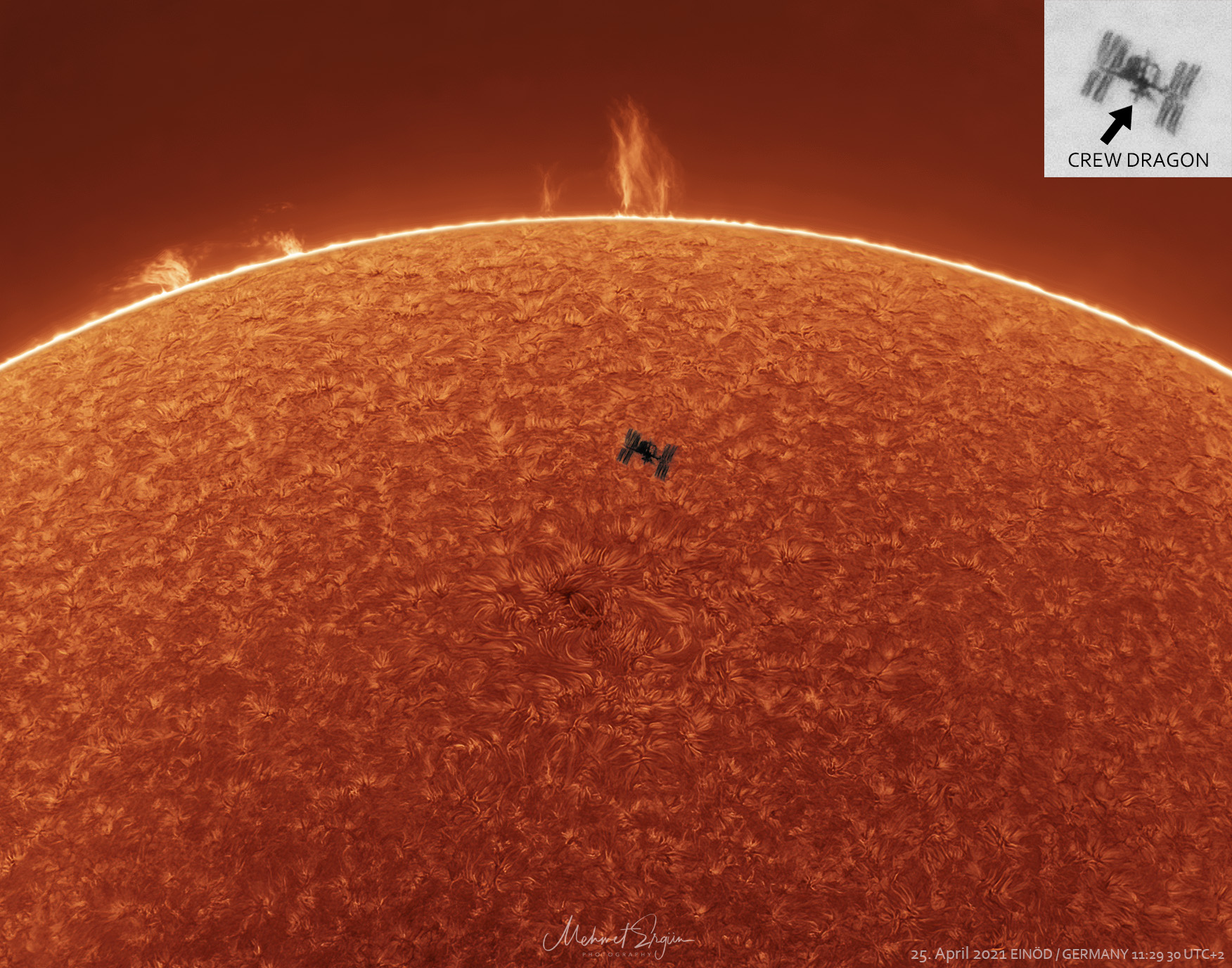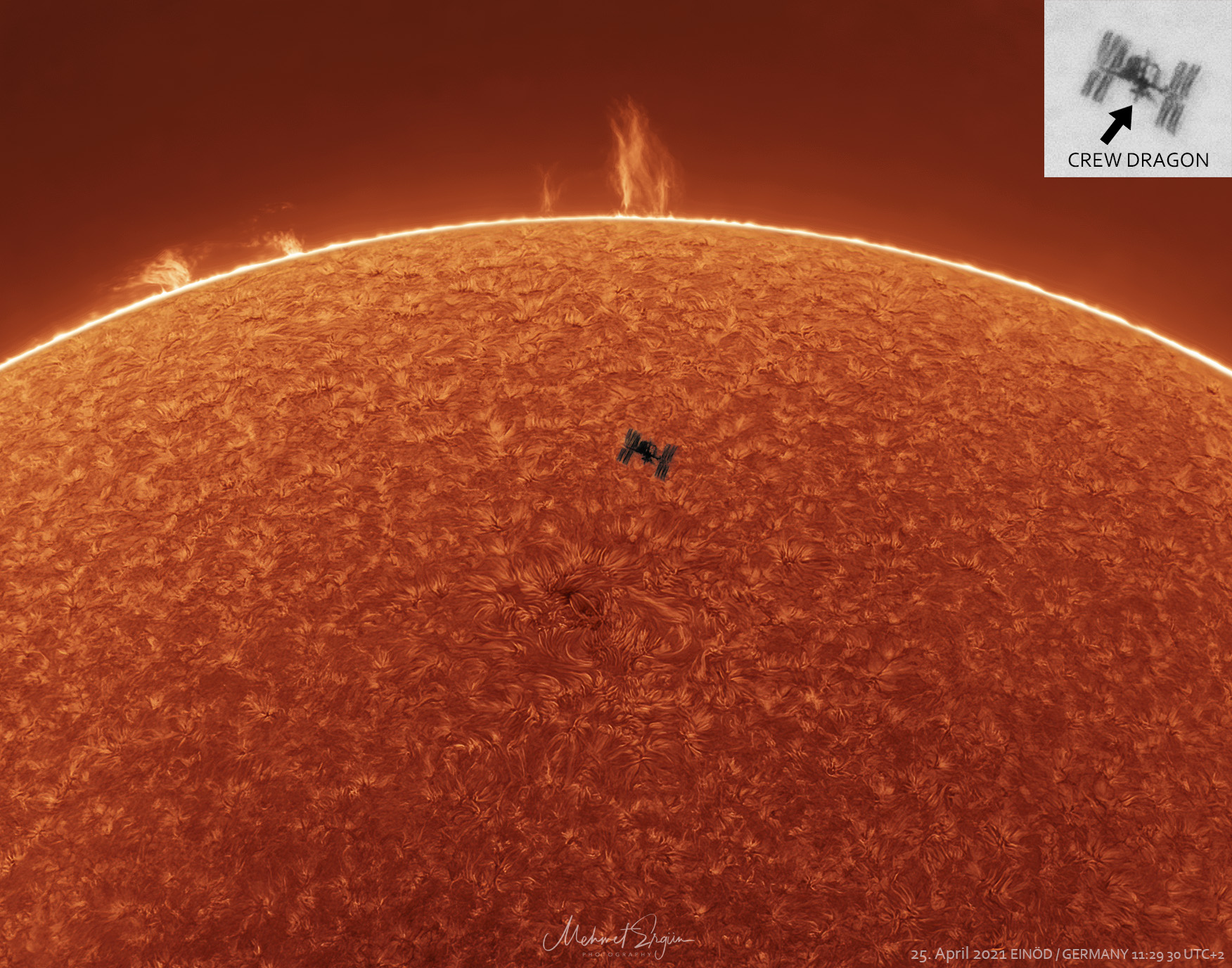
That's no sunspot. It's the International Space Station (ISS) caught passing in front of the Sun. Sunspots, individually, have a dark central umbra, a lighter surrounding penumbra, and no Dragon capsules attached. By contrast, the ISS is a complex and multi-spired mechanism, one of the largest and most complicated spacecraft ever created by humanity. Also, sunspots circle the Sun, whereas the ISS orbits the Earth. Transiting the Sun is not very unusual for the ISS, which orbits the Earth about every 90 minutes, but getting one's location, timing and equipment just right for a great image is rare. The featured picture combined three images all taken in 2021 from the same location and at nearly the same time. One image -- overexposed -- captured the faint prominences seen across the top of the Sun, a second image -- underexposed -- captured the complex texture of the Sun's chromosphere, while the third image -- the hardest to get -- captured the space station as it shot across the Sun in a fraction of a second. Close inspection of the space station's silhouette even reveals a docked Dragon Crew capsule. Follow APOD on Instagram in: Arabic, English, Persian, Portuguese, and Taiwanese
Eso no es un manchón solar. Es la Estación Espacial Internacional (ISS) captada pasando frente al Sol. Los manchones solares individuales tienen una umbra central oscura, una penumbra más clara que la rodea, y no tienen cápsulas Dragon unidas. En contraste, la ISS es un mecanismo complejo y de múltiples estructuras, una de las naves espaciales más grandes y complejas jamás creadas por la humanidad. Además, los manchones solares giran alrededor del Sol, mientras que la ISS orbita la Tierra. Transitar frente al Sol no es muy inusual para la ISS, que orbita la Tierra aproximadamente cada 90 minutos, pero lograr la ubicación, el momento y el equipo adecuados para una imagen destacada es raro. La imagen destacada combina tres fotografías tomadas todas en 2021 desde el mismo lugar y casi al mismo tiempo. Una imagen, sobreexposta, capturó las débiles prominencias visibles en la parte superior del Sol; una segunda imagen, subexposta, capturó la compleja textura de la cromosfera solar; y una tercera imagen, la más difícil de obtener, capturó la estación espacial mientras cruzaba el Sol en una fracción de segundo. Una inspección cuidadosa del contorno de la estación espacial incluso revela una cápsula Dragon Crew acoplada.