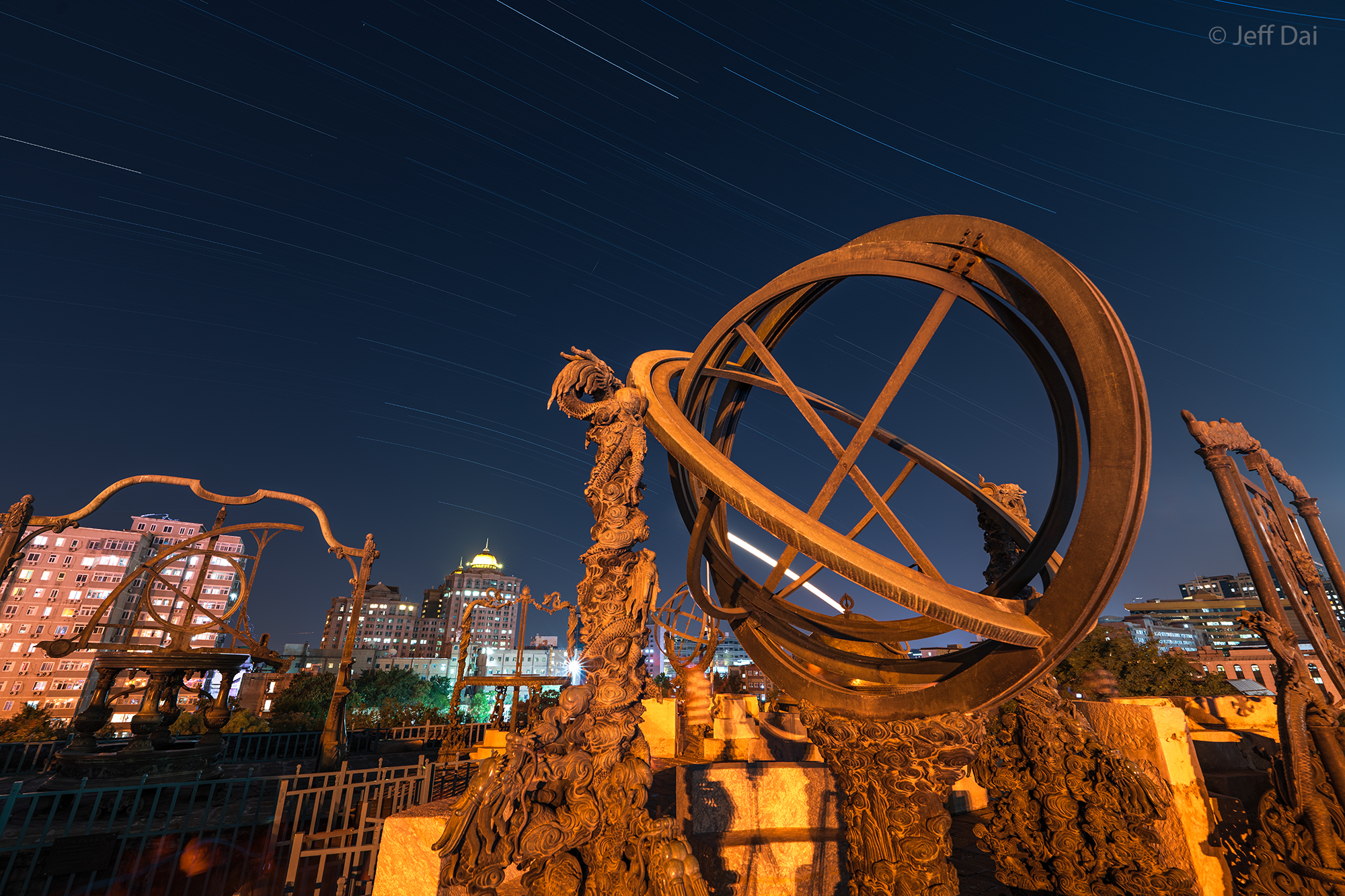
You can take a subway ride to visit this observatory in Beijing, China but you won't find any telescopes there. Starting in the 1400s astronomers erected devices at the Beijing Ancient Observatory site to enable them to accurately measure and track the positions of naked-eye stars and planets. Some of the large, ornate astronomical instruments are still standing. You can even see stars from the star observation platform today, but now only the very brightest celestial beacons are visible against the city lights. In this time series of exposures from a camera fixed to a tripod to record graceful arcing startrails, the brightest trail is actually the Moon. Its broad arc is seen behind the ancient observatory's brass armillary sphere. Compare this picture from the Beijing Ancient Observatory taken in September 2023 to one taken in 1895.
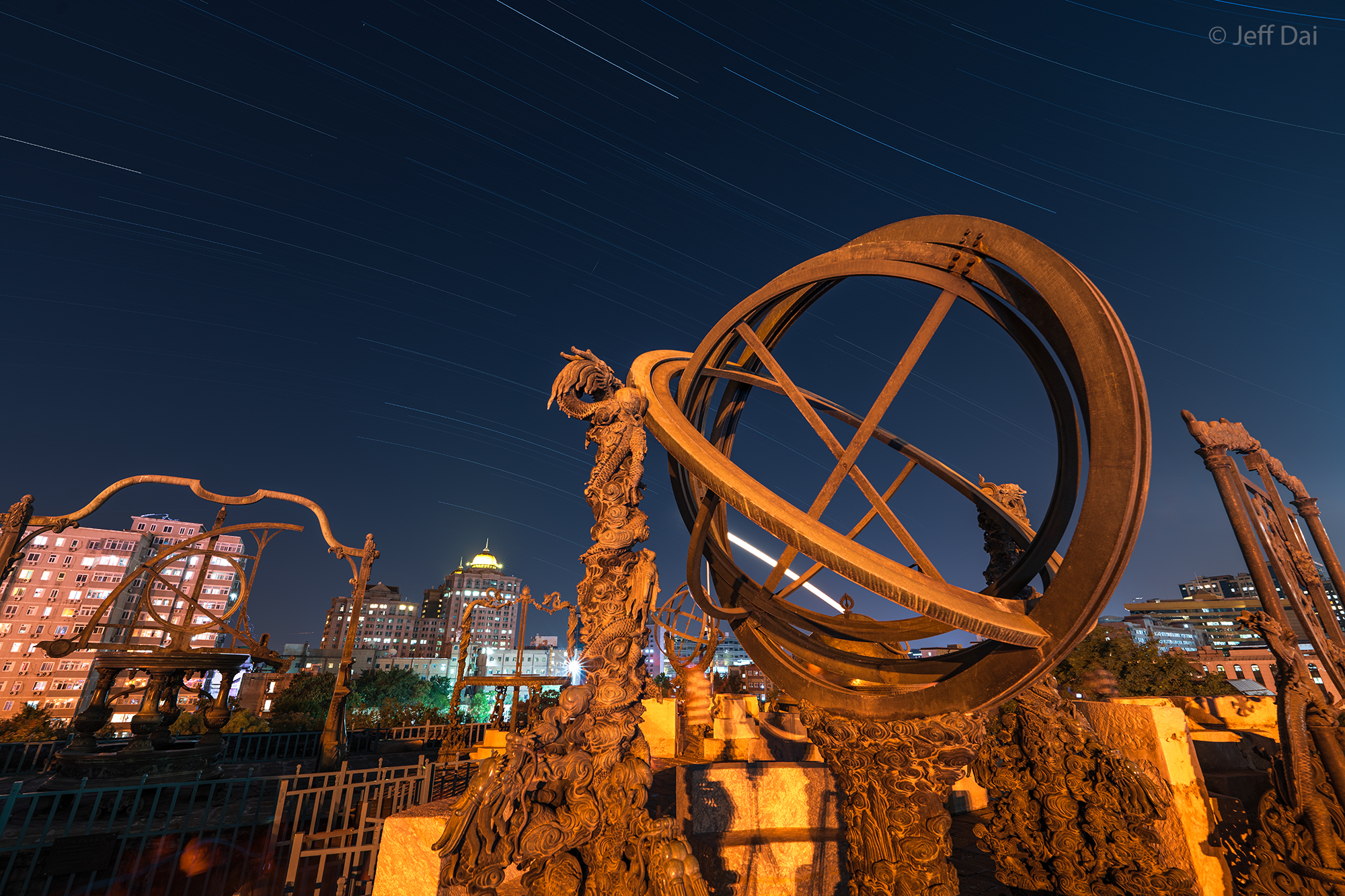
Puedes tomar un viaje en metro para visitar este observatorio en Beijing, China, pero allí no encontrarás telescopios. A partir del siglo XV, los astrónomos construyeron dispositivos en el sitio del Observatorio Antiguo de Beijing para poder medir y seguir con precisión las posiciones de las estrellas y planetas visibles a simple vista. Algunos de los grandes instrumentos astronómicos decorativos aún permanecen en pie. Hoy en día incluso se pueden observar estrellas desde la plataforma de observación de estrellas, pero ahora solo las más brillantes son visibles frente a la luz de la ciudad. En esta serie de exposiciones tomadas con una cámara fija a un trípode para registrar los elegantes rastros arqueados de las estrellas, el rastro más brillante es en realidad el de la Luna. Su amplia curva se ve detrás de la esfera armilar de bronce del antiguo observatorio. Compare esta imagen tomada en septiembre de 2023 con otra tomada en 1895.