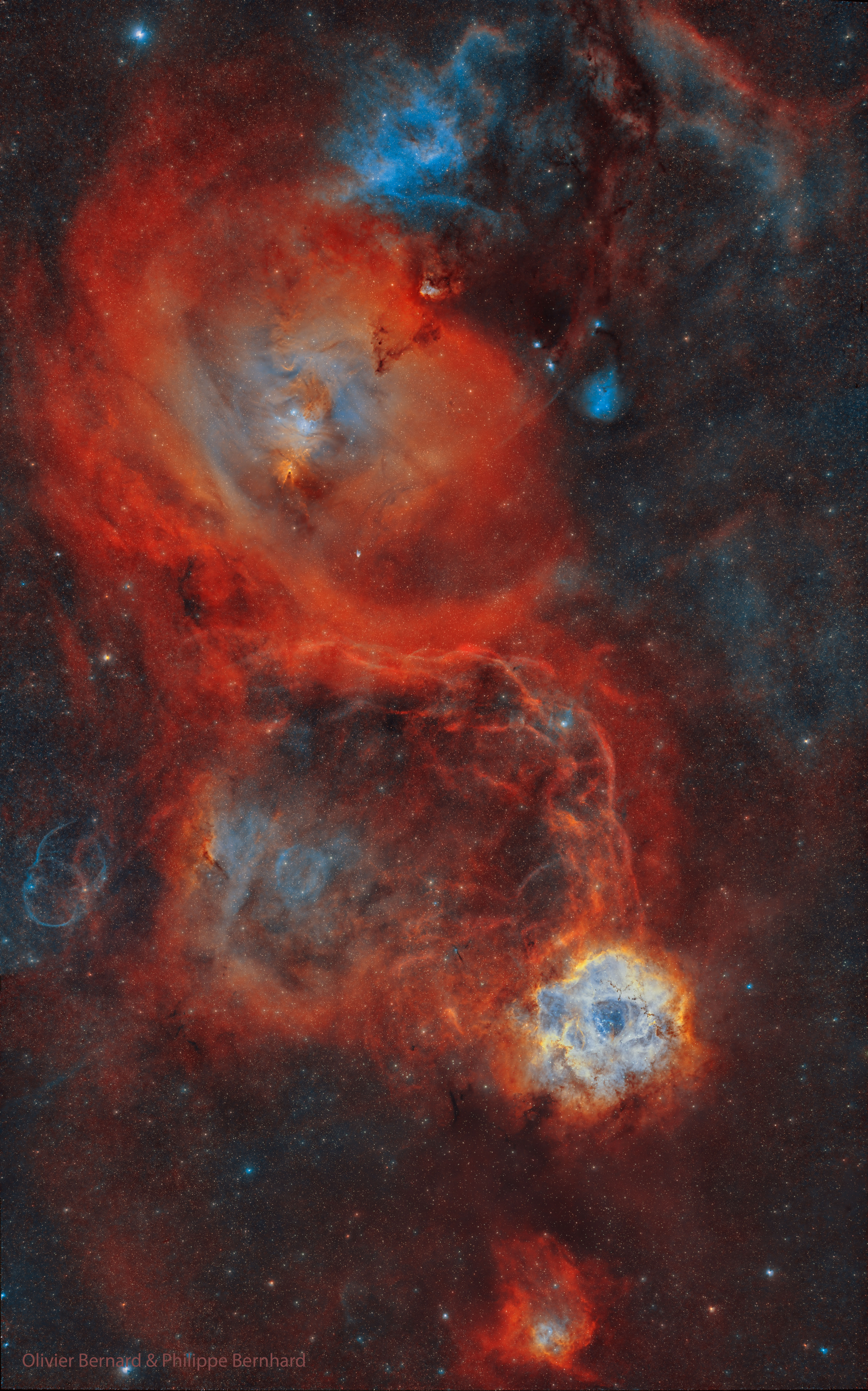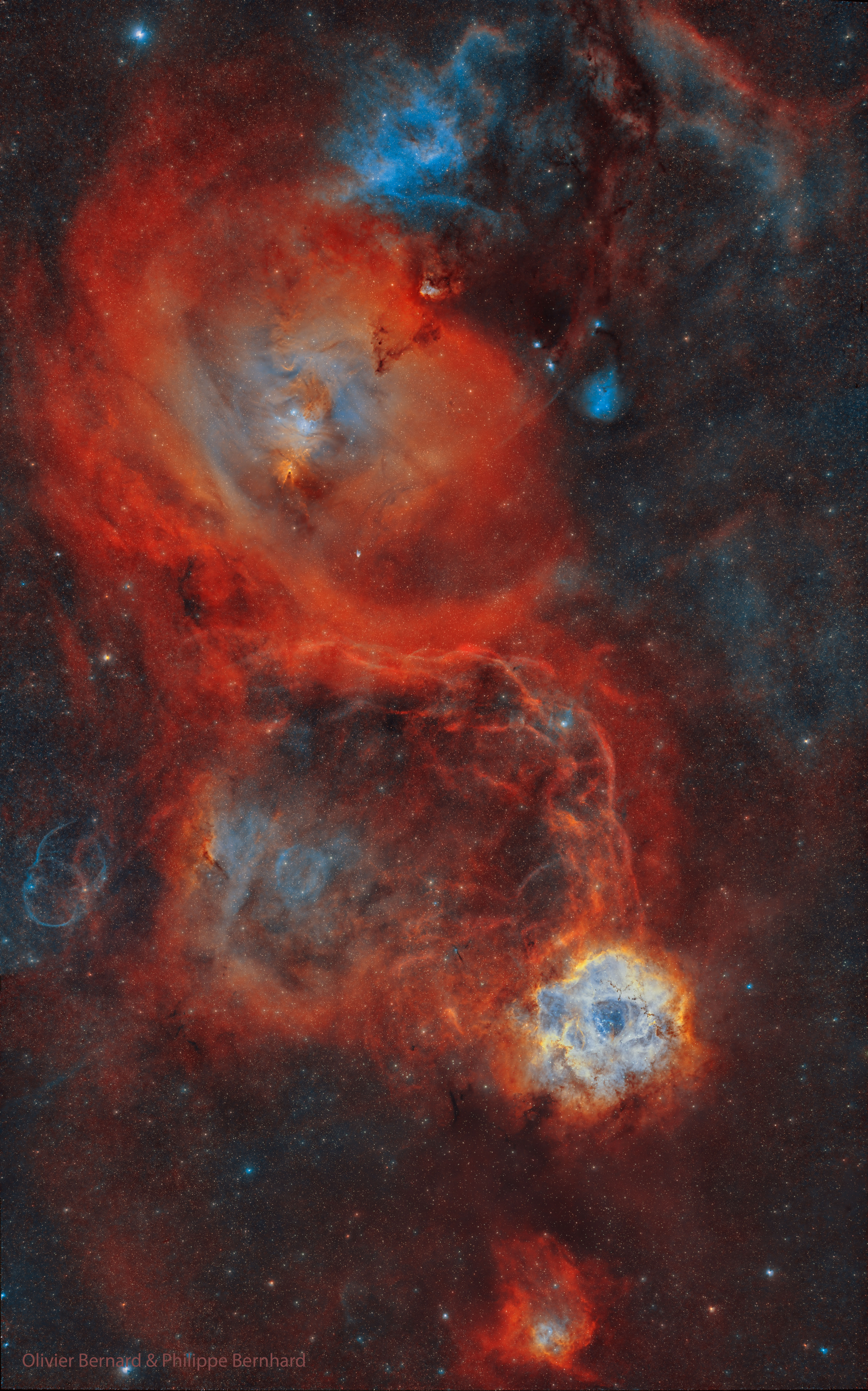
Can you find the Rosette Nebula? The large, red, and flowery-looking nebula on the upper left may seem the obvious choice, but that is actually just diffuse hydrogen emission surrounding the Cone and Fox Fur Nebulas. The famous Rosette Nebula is really located on the lower right and connected to the other nebulas by irregular filaments. Because the featured image of Rosetta's field is so wide and deep, it seems to contain other flowers. Designated NGC 2237, the center of the Rosette nebula is populated by the bright blue stars of open cluster NGC 2244, whose winds and energetic light are evacuating the nebula's center. The Rosette Nebula is about 5,000 light years distant and, just by itself, spans about three times the diameter of a full moon. This flowery field can be found toward the constellation of the Unicorn (Monoceros).
¿Puedes encontrar la Nebulosa Roseta? La gran nebulosa rojiza y de apariencia floral en la esquina superior izquierda podría parecer la elección obvia, pero en realidad solo es una emisión difusa de hidrógeno que rodea a las Nebulosas del Cono y del Pelaje de Zorro. La famosa Nebulosa Roseta se encuentra realmente en la esquina inferior derecha y está conectada a las otras nebulosas mediante filamentos irregulares. Debido a que la imagen del campo de Rosetta es tan amplia y profunda, parece contener otras flores. Designada como NGC 2237, el centro de la nebulosa Roseta alberga las brillantes estrellas azules del cúmulo abierto NGC 2244, cuyos vientos y luz energética están evacuando el centro de la nebulosa. La Nebulosa Roseta se encuentra a unos 5000 años luz de distancia y, por sí sola, abarca aproximadamente tres veces el diámetro de una luna llena. Este campo floral se encuentra en dirección a la constelación del Unicornio (Monoceros).