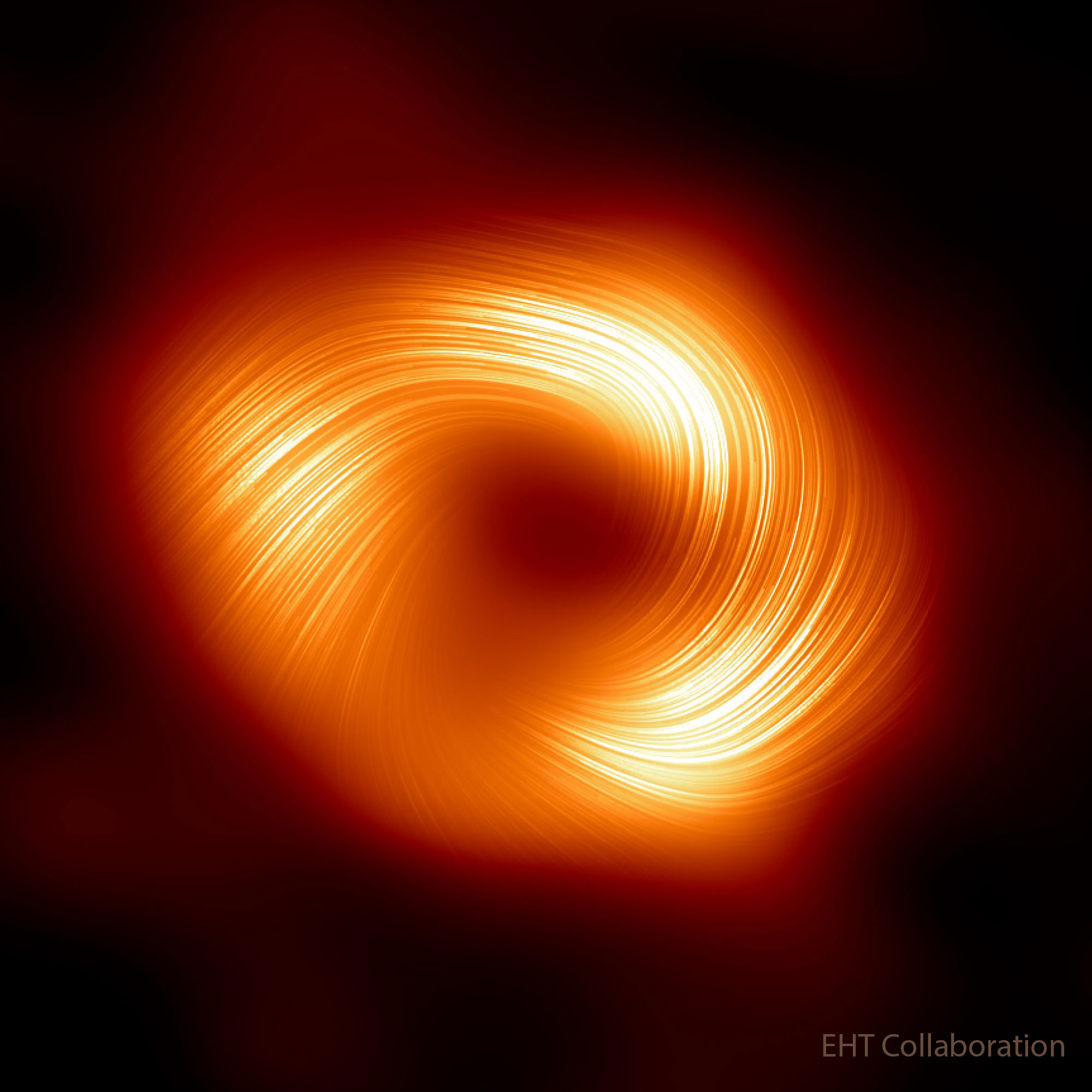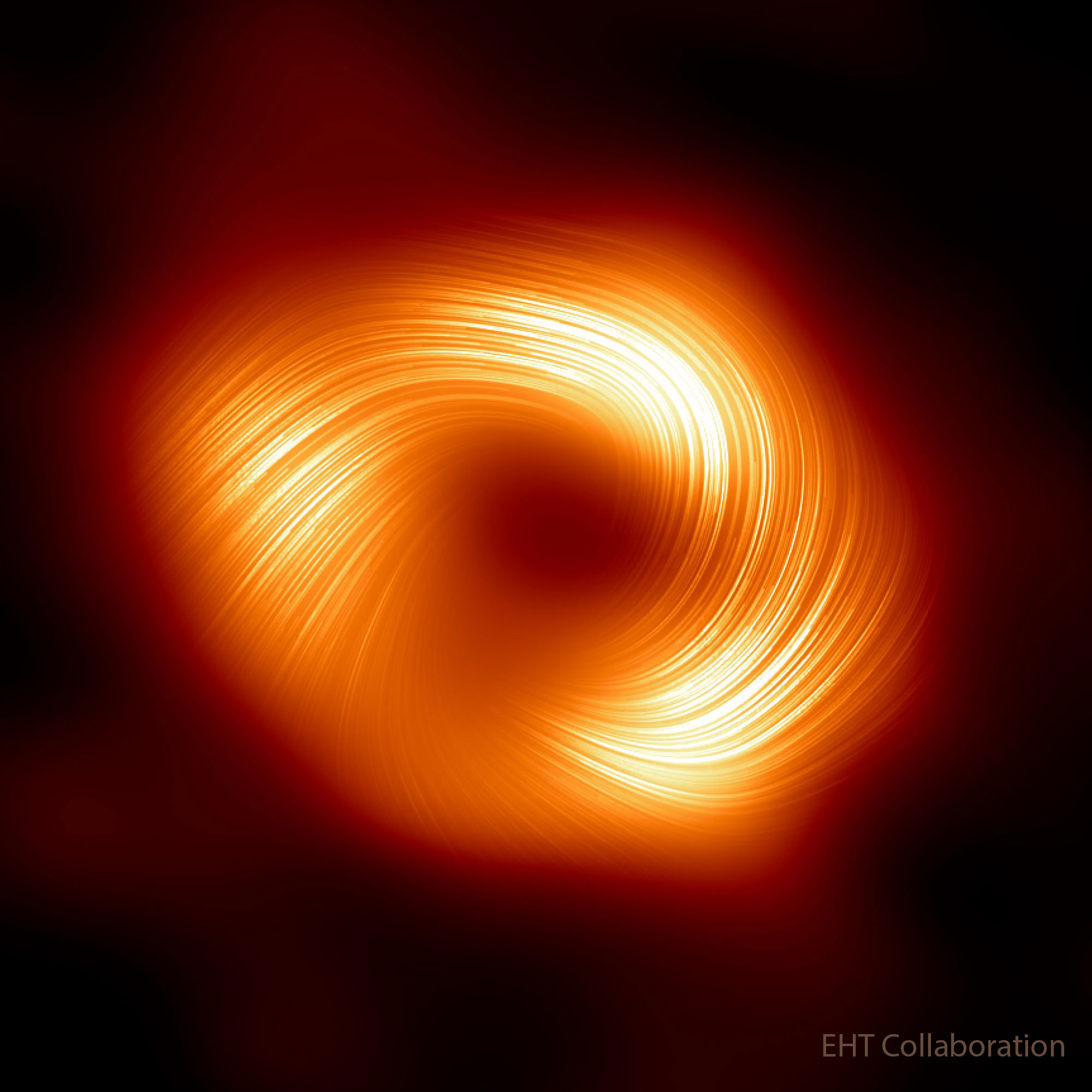
What's happening to the big black hole in the center of our galaxy? It is sucking in matter from a swirling disk -- a disk that is magnetized, it has now been confirmed. Specifically, the black hole's accretion disk has recently been seen to emit polarized light, radiation frequently associated with a magnetized source. Pictured here is a close-up of Sgr A*, our Galaxy's central black hole, taken by radio telescopes around the world participating in the Event Horizon Telescope (EHT) Collaboration. Superposed are illustrative curved lines indicating polarized light likely emitted from swirling magnetized gas that will soon fall into the 4+ million solar mass central black hole. The central part of this image is likely dark because little light-emitting gas is visible between us and the dark event horizon of the black hole. Continued EHT monitoring of this and M87's central black hole may yield new clues about the gravity of black holes and how infalling matter creates disks and jets. NASA Predicts: Moon to Get in Way of Sun
¿Qué está sucediendo con el gran agujero negro en el centro de nuestra galaxia? Está absorbiendo materia de un disco giratorio — un disco que ahora se ha confirmado que está magnetizado. Específicamente, el disco de acreción del agujero negro ha emitido recientemente luz polarizada, una radiación frecuentemente asociada con una fuente magnetizada. En la imagen se muestra un acercamiento a Sgr A*, el agujero negro central de nuestra galaxia, tomado por telescopios de radio de todo el mundo que participan en la Colaboración del Telescopio del Horizonte de Sucesos (EHT, por sus siglas en inglés). Superpuestas están líneas curvas ilustrativas que indican luz polarizada probablemente emitida por gas magnetizado giratorio que pronto caerá en el agujero negro central de más de 4 millones de masas solares. La parte central de esta imagen probablemente sea oscura porque poco gas emisor de luz es visible entre nosotros y el oscuro horizonte de sucesos del agujero negro. La vigilancia continua del EHT sobre este y el agujero negro central de M87 podría revelar nuevas pistas sobre la gravedad de los agujeros negros y cómo la materia que cae crea discos y chorros.