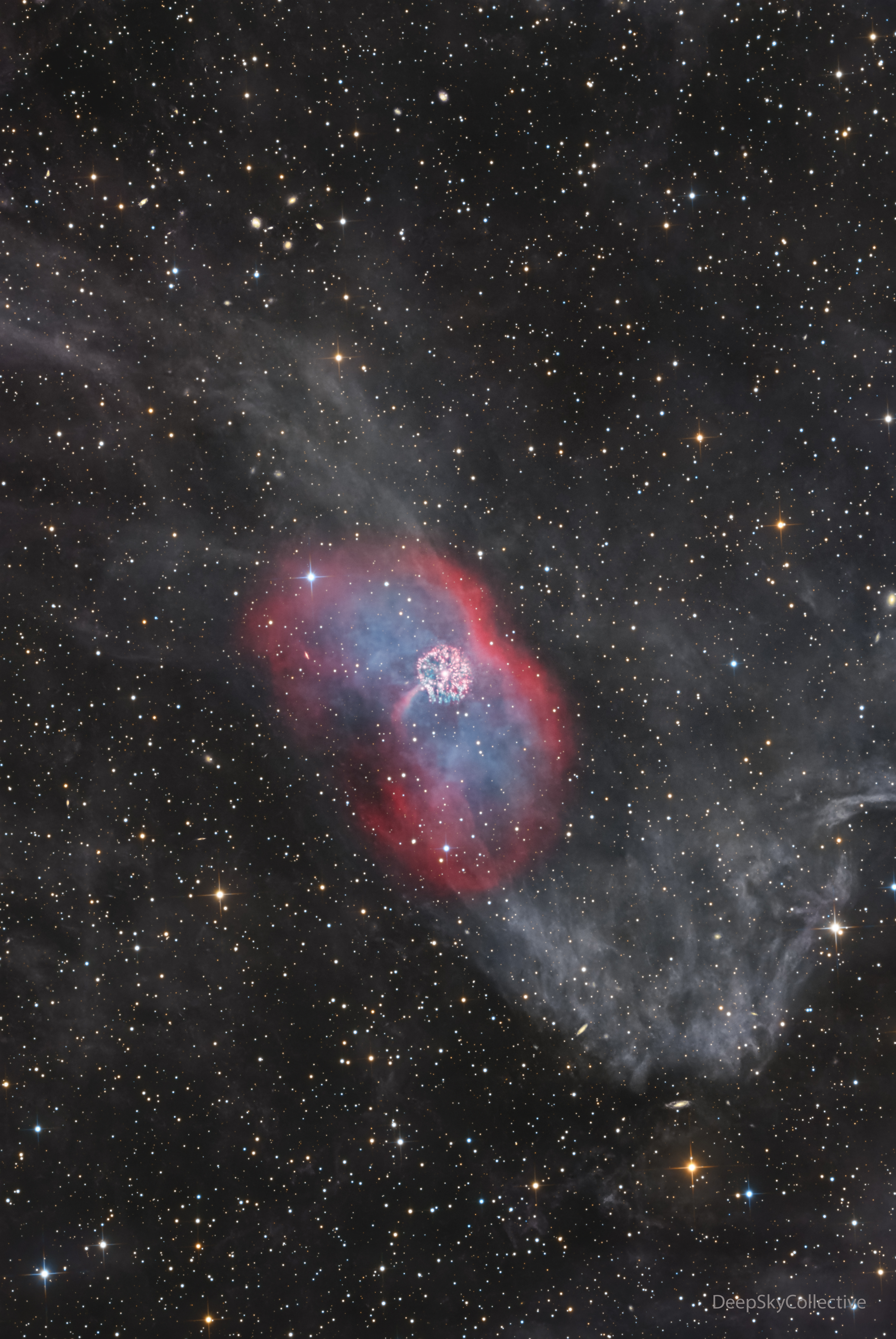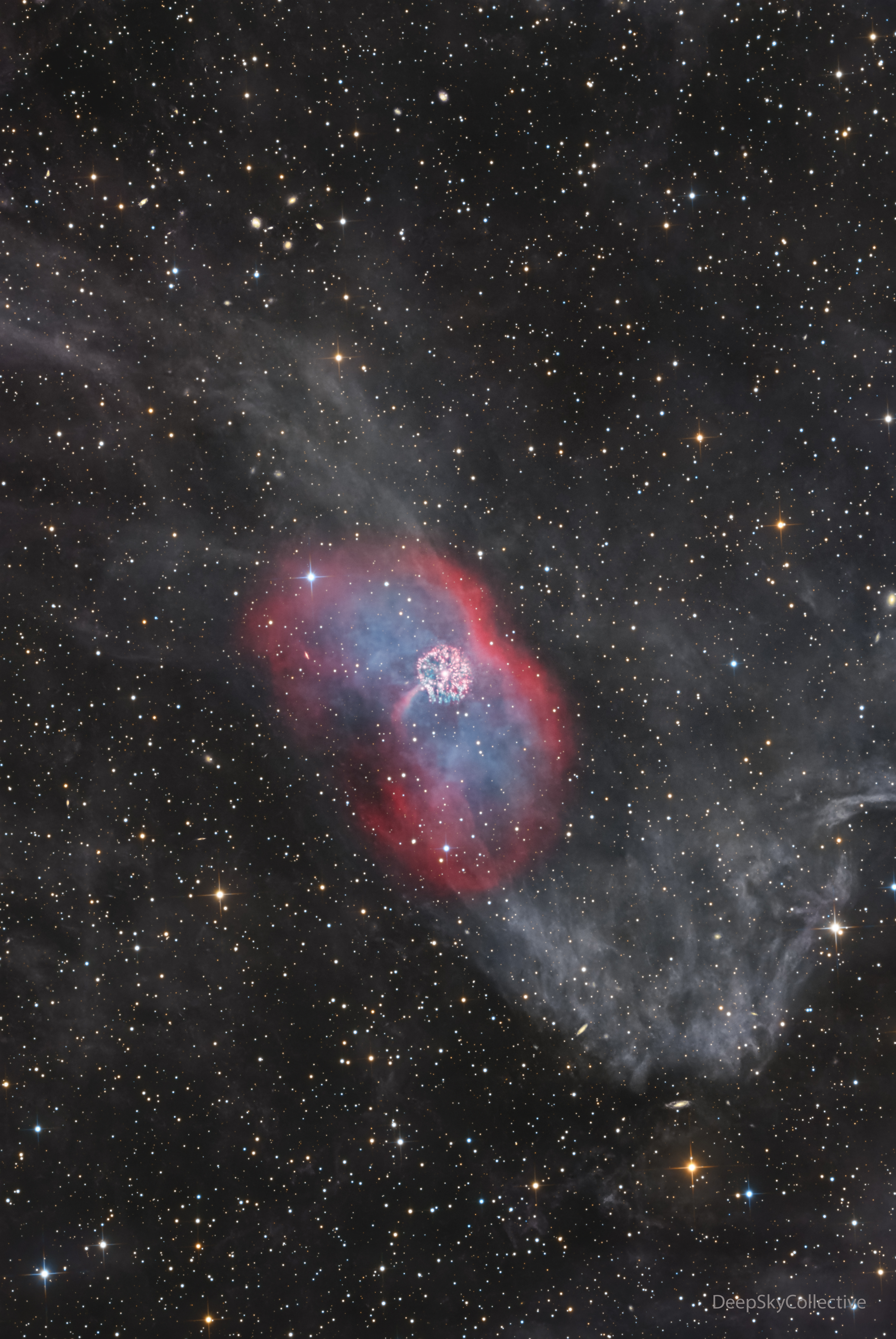
The star system GK Per is known to be associated with only two of the three nebulas pictured. At 1500 light years distant, Nova Persei 1901 (GK Persei) was the second closest nova yet recorded. At the very center is a white dwarf star, the surviving core of a former Sun-like star. It is surrounded by the circular Firework nebula, gas that was ejected by a thermonuclear explosion on the white dwarf's surface -- a nova -- as recorded in 1901. The red glowing gas surrounding the Firework nebula is the atmosphere that used to surround the central star. This gas was expelled before the nova and appears as a diffuse planetary nebula. The faint gray gas running across is interstellar cirrus that seems to be just passing through coincidently. In 1901, GK Per's nova became brighter than Betelgeuse. Similarly, star system T CrB is expected to erupt in a nova later this year, but we don't know exactly when nor how bright it will become.
El sistema estelar GK Per se sabe que está asociado solo con dos de las tres nebulosas mostradas. A 1500 años luz de distancia, la Nova Persei 1901 (GK Persei) fue la segunda nova más cercana registrada hasta la fecha. En el centro exacto se encuentra una enana blanca, el núcleo sobreviviente de una estrella anterior similar al Sol. Está rodeada por la nebulosa Firework (Nebulosa Firework), un gas eyectado por una explosión termonuclear en la superficie de la enana blanca — una nova — tal como se registró en 1901. El gas rojizo que rodea la nebulosa Firework es la atmósfera que solía rodear a la estrella central. Este gas fue expulsado antes de la nova y aparece como una nebulosa planetaria difusa. El gas grisáceo y tenue que cruza la imagen es cirrus interestelar que parece estar simplemente pasando por casualidad. En 1901, la nova de GK Per se volvió más brillante que Betelgeuse. De manera similar, se espera que el sistema estelar T CrB entre en erupción como una nova más tarde este año, pero no sabemos exactamente cuándo ni qué tan brillante se volverá.