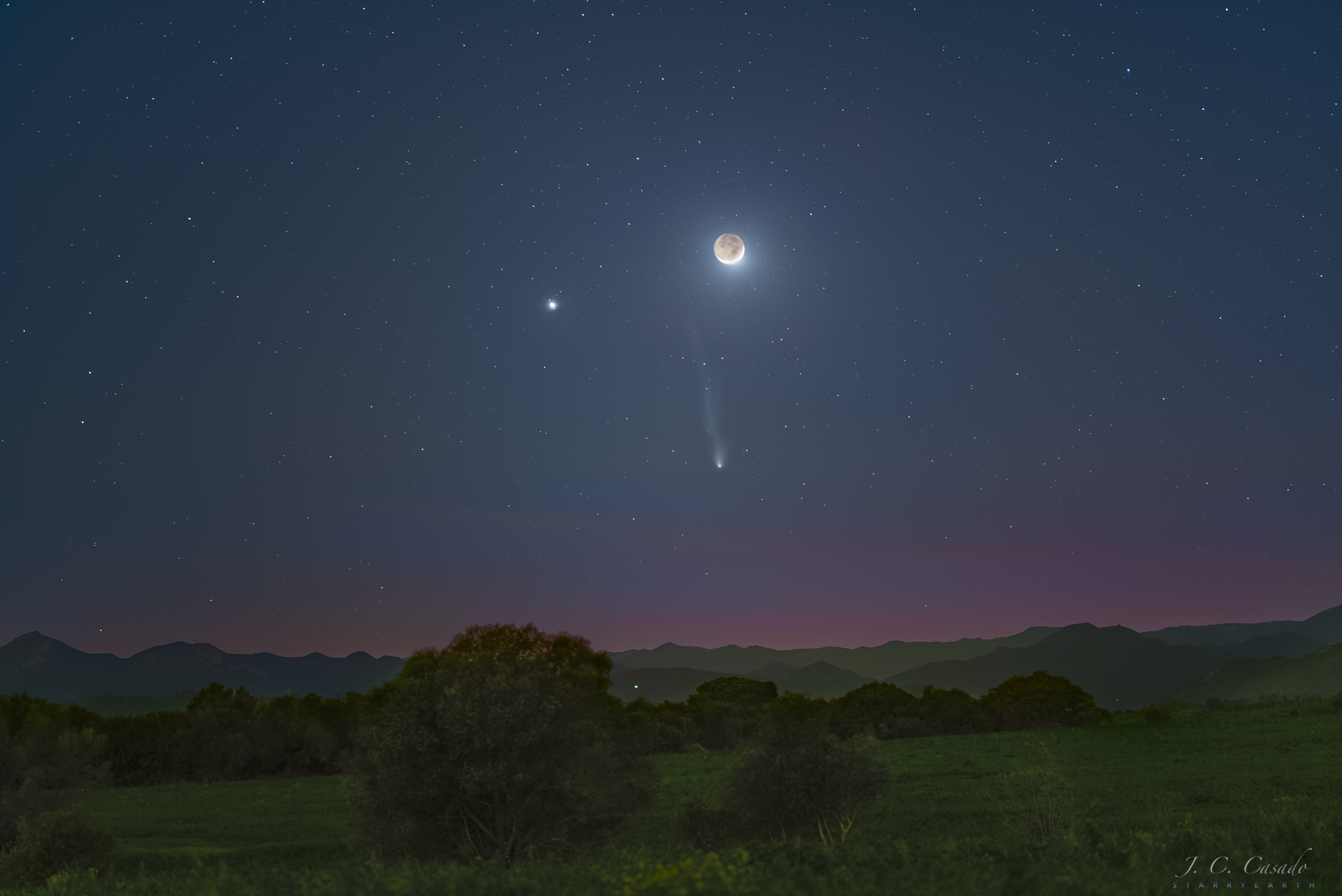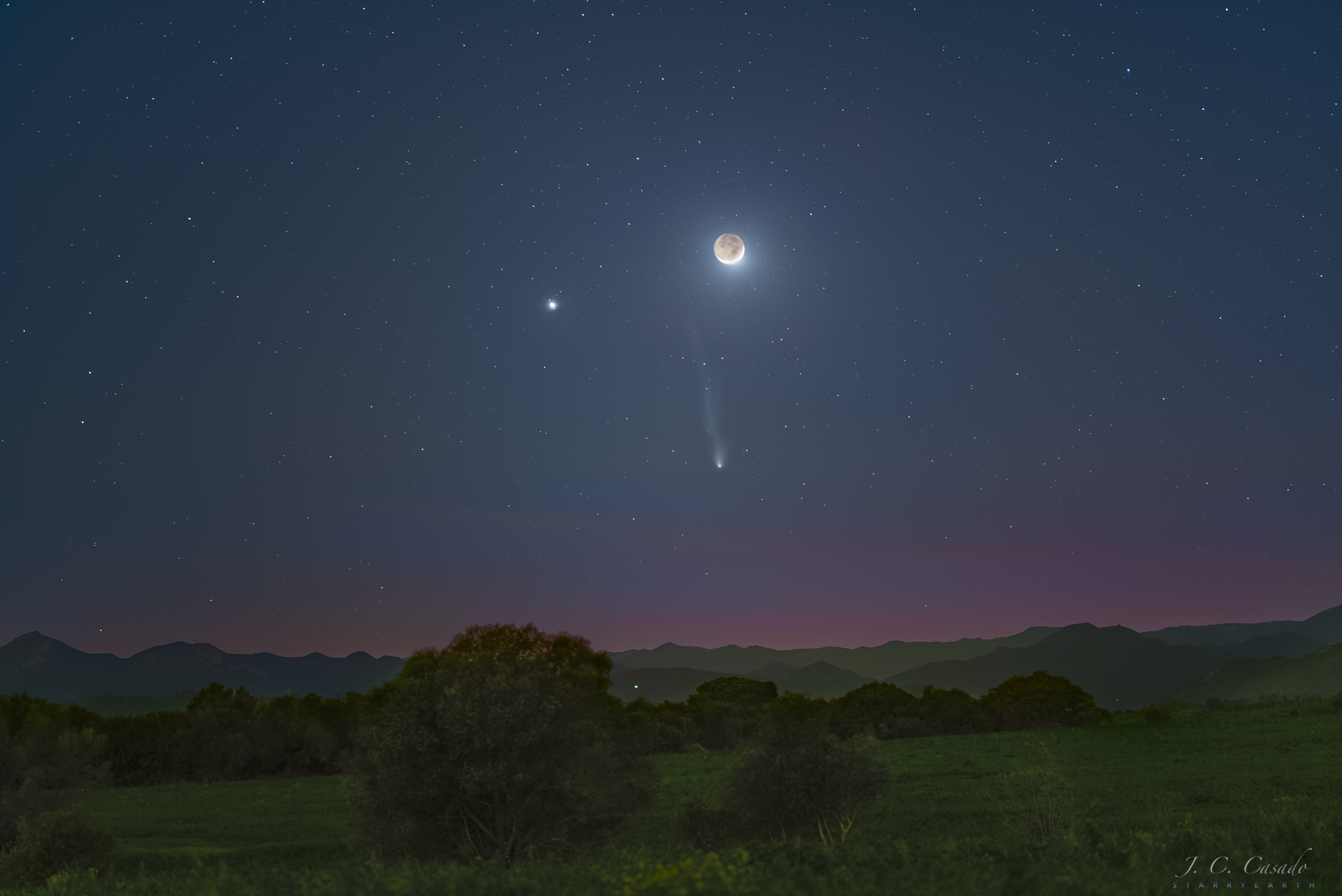
Three bright objects satisfied seasoned stargazers of the western sky just after sunset earlier this month. The most familiar was the Moon, seen on the upper left in a crescent phase. The rest of the Moon was faintly visible by sunlight first reflected by the Earth. The bright planet Jupiter, the largest planet in the Solar System, is seen to the upper left. Most unusual was Comet 12P/Pons-Brooks, below the Moon and showing a stubby dust tail on the right but an impressive ion tail extending upwards. The featured image, a composite of several images taken consecutively at the same location and with the same camera, was taken near the village of Llers, in Spain's Girona province. Comet Pons-Brooks passed its closest to the Sun last week and is now dimming as it moves into southern skies and returns to the outer Solar System. Almost Hyperspace: Random APOD Generator
Crédito: NASA, CGRO SSC Tres objetos brillantes satisficieron a los observadores experimentados del cielo occidental poco después de la puesta de sol hace unas semanas. El más familiar fue la Luna, visible en la parte superior izquierda en fase creciente. El resto de la Luna era débilmente visible gracias a la luz solar reflejada primero por la Tierra. El brillante planeta Júpiter, el planeta más grande del Sistema Solar, se ve en la parte superior izquierda. Lo más inusual fue el cometa 12P/Pons-Brooks, ubicado debajo de la Luna y mostrando una cola de polvo corta a la derecha, pero una cola de iones impresionante que se extiende hacia arriba. La imagen destacada, un compuesto de varias imágenes tomadas consecutivamente en el mismo lugar y con la misma cámara, fue capturada cerca del pueblo de Llers, en la provincia de Gerona, España. El cometa Pons-Brooks alcanzó su punto más cercano al Sol la semana pasada y ahora se está atenuando a medida que se mueve hacia el hemisferio sur y regresa al Sistema Solar exterior.