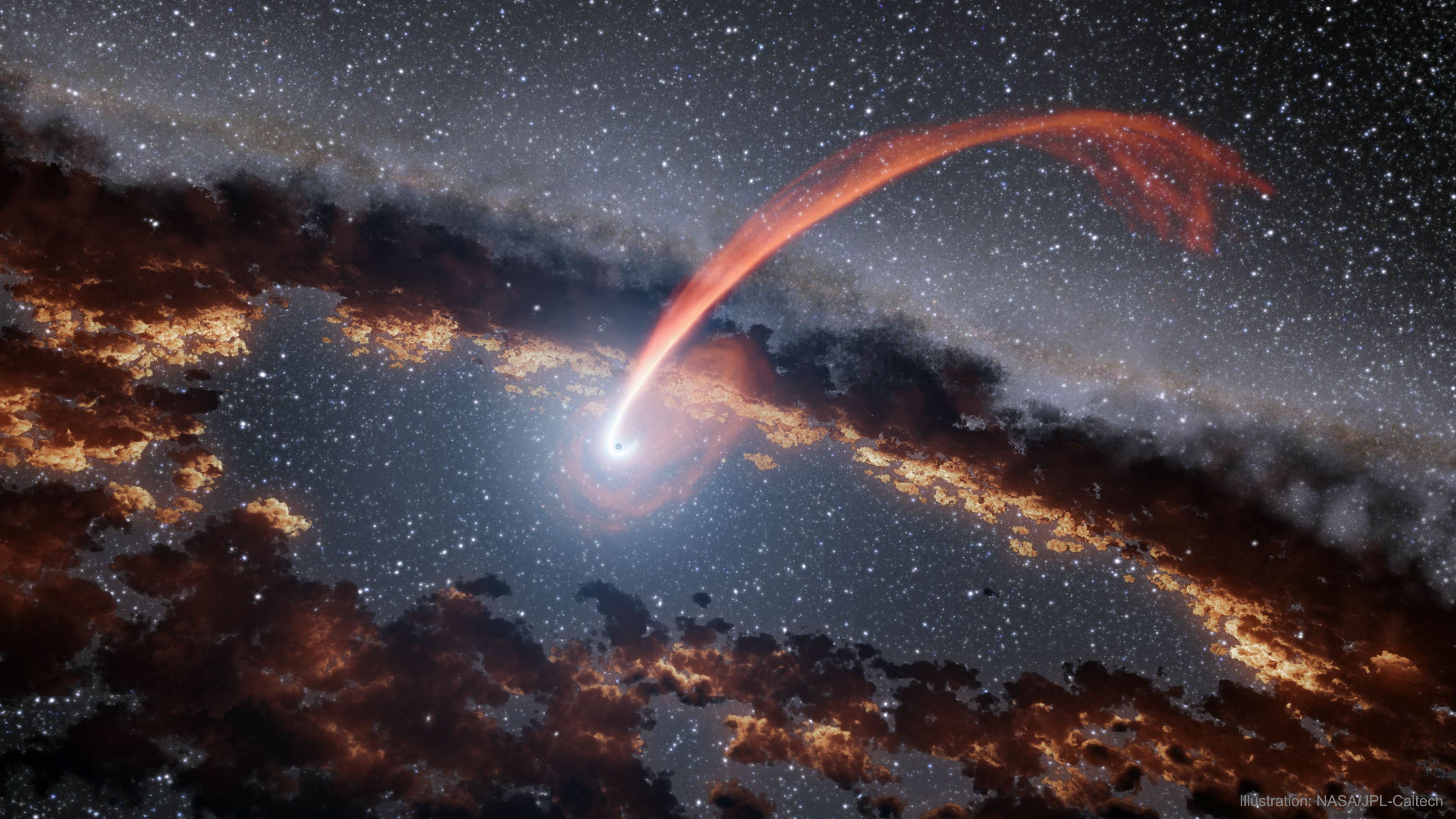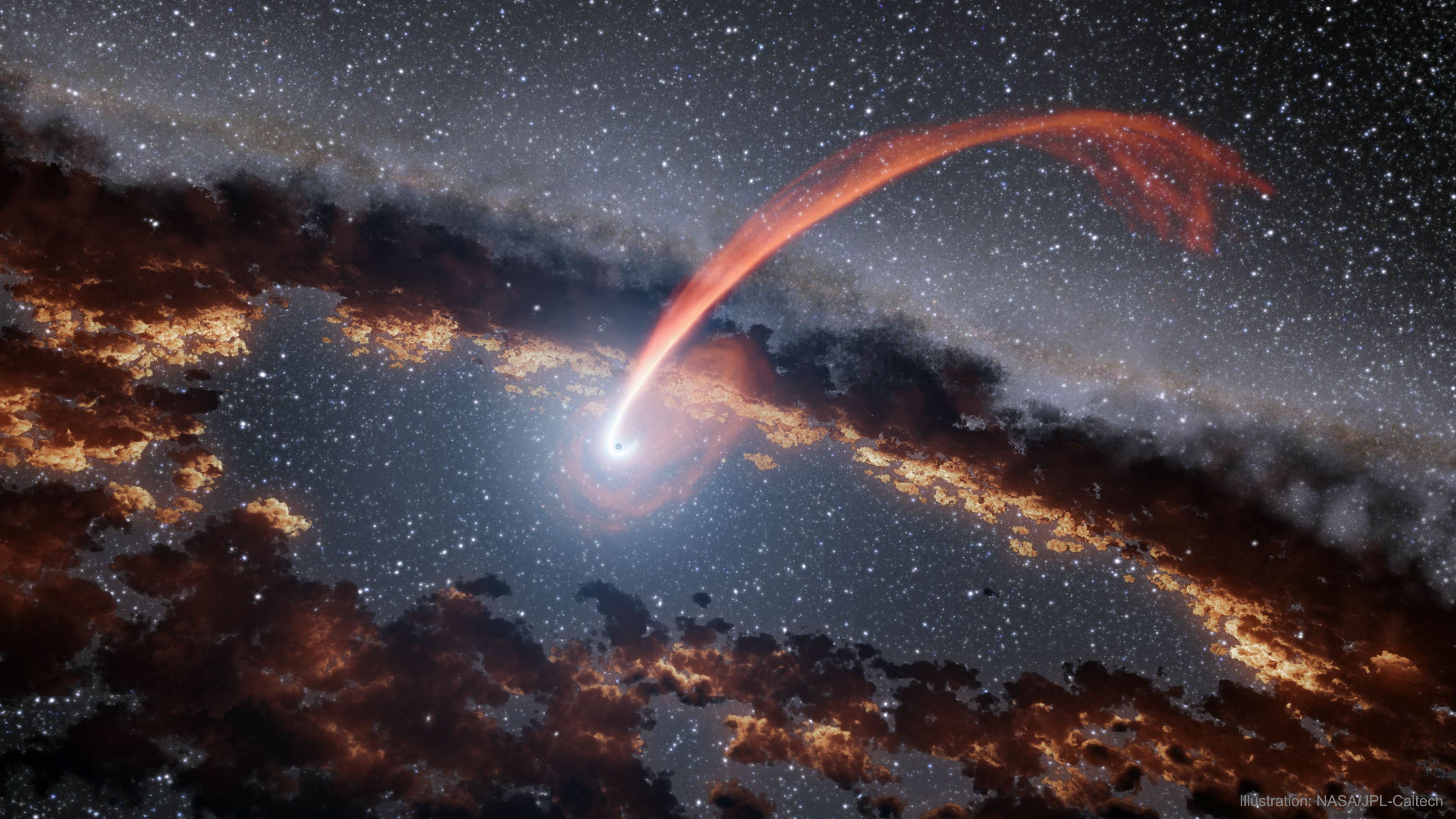
What happens to a star that goes near a black hole? If the star directly impacts a massive black hole, then the star falls in completely -- and everything vanishes. More likely, though, the star goes close enough to have the black hole's gravity pull away its outer layers, or disrupt, the star. Then, most of the star's gas does not fall into the black hole. These stellar tidal disruption events can be as bright as a supernova, and an increasing amount of them are being discovered by automated sky surveys. In the featured artist's illustration, a star has just passed a massive black hole and sheds gas that continues to orbit. The inner edge of a disk of gas and dust surrounding the black hole is heated by the disruption event and may glow long after the star is gone. Hole New Worlds: It's Black Hole Week at NASA!
¿Qué le sucede a una estrella que se acerca a un agujero negro? Si la estrella impacta directamente un agujero negro masivo, entonces la estrella cae completamente dentro de él — y todo desaparece. Sin embargo, es más probable que la estrella se acerque lo suficiente como para que la gravedad del agujero negro arranque sus capas externas, o desestabilice, la estrella. Entonces, la mayor parte del gas de la estrella no cae dentro del agujero negro. Estos eventos de desestabilización por mareas estelares pueden ser tan brillantes como una supernova, y un número cada vez mayor de ellos se está descubriendo gracias a encuestas automáticas del cielo. En la ilustración artística destacada, una estrella acaba de pasar junto a un agujero negro masivo y libera gas que continúa orbitando. El borde interior de un disco de gas y polvo que rodea el agujero negro se calienta por el evento de desestabilización y puede brillar durante mucho tiempo después de que la estrella haya desaparecido.