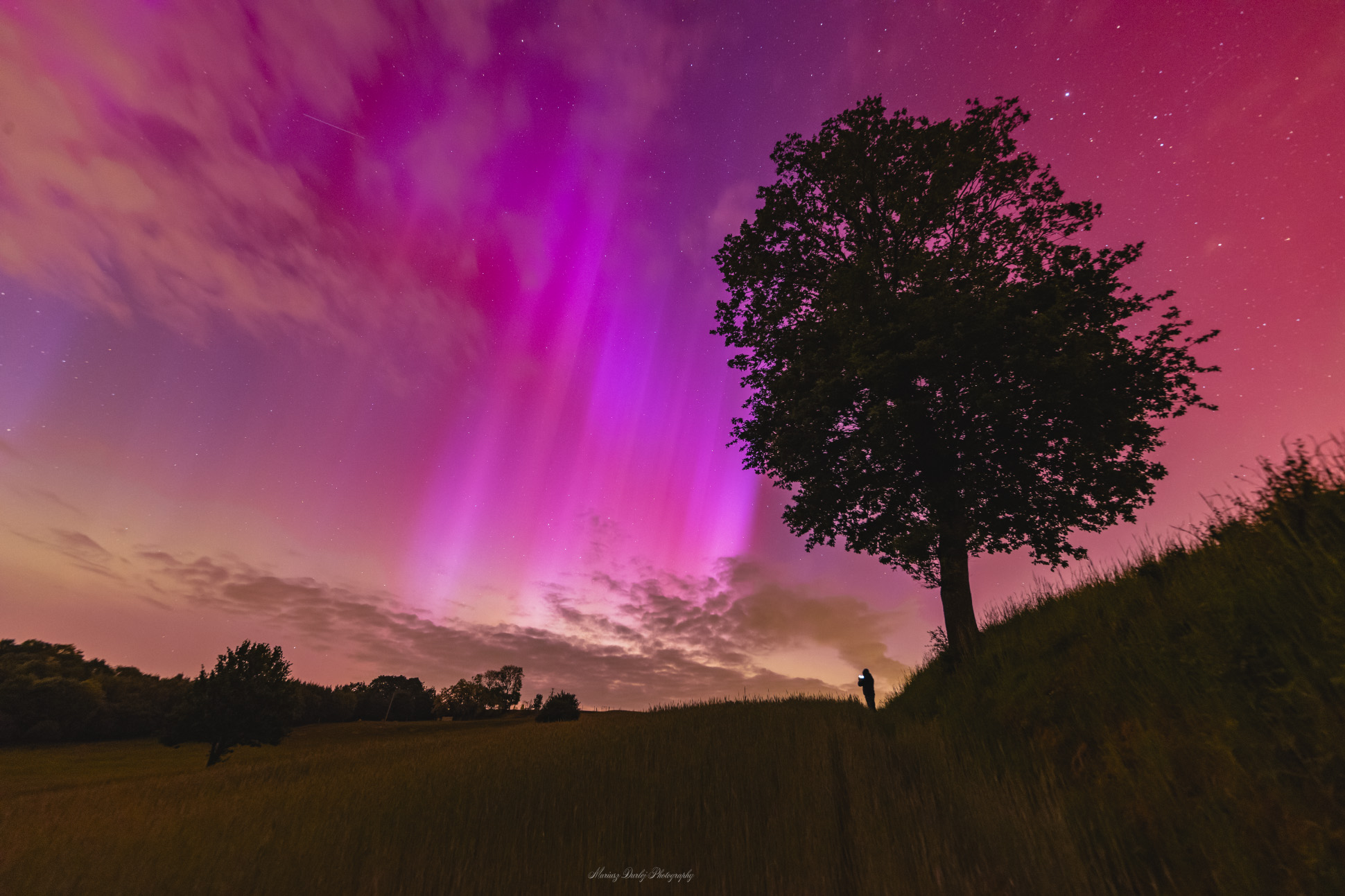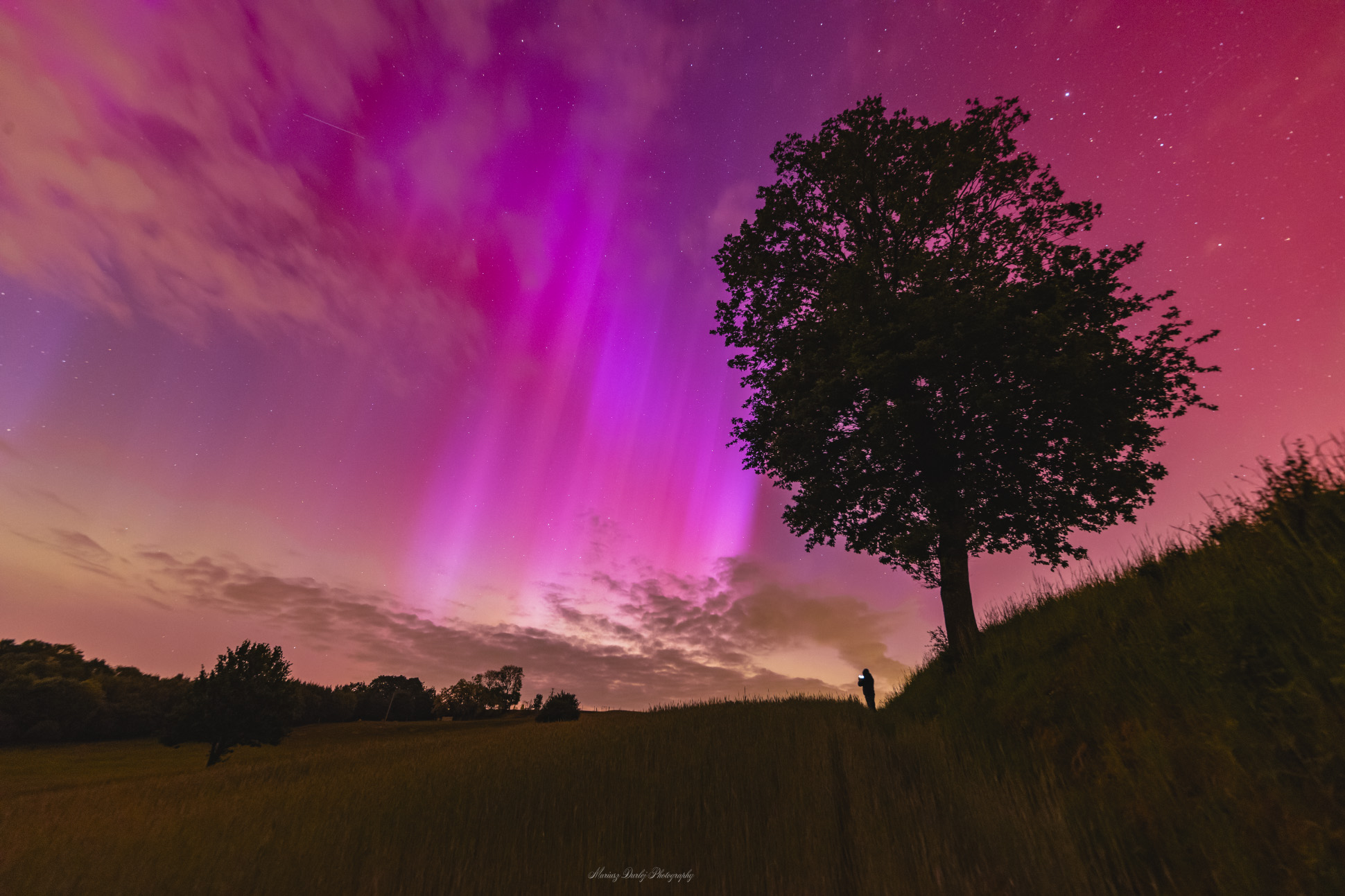
Northern lights don't usually reach this far south. Magnetic chaos in the Sun's huge Active Region 3664, however, produced a surface explosion that sent a burst of electrons, protons, and more massive, charged nuclei into the Solar System. A few days later, that coronal mass ejection (CME) impacted the Earth and triggered auroras that are being reported unusually far from our planet's north and south poles. The free sky show might not be over -- the sunspot rich AR3664 has ejected even more CMEs that might also impact the Earth tonight or tomorrow. That active region is now near the Sun's edge, though, and will soon be rotating away from the Earth. Pictured, a red and rayed aurora was captured in a single 6-second exposure from Racibórz, Poland early last night. The photographer's friend, seeing an aurora for the first time, is visible in the distance also taking images of the beautifully colorful nighttime sky. Gallery: Global Aurora from Solar Active Region 3664
Las luces del norte normalmente no llegan tan al sur. Sin embargo, el caos magnético en la gran Región Activa 3664 del Sol produjo una explosión superficial que envió una explosión de electrones, protones y núcleos cargados más masivos al Sistema Solar. Unos días después, esa eyección de masa coronal (CME, por sus siglas en inglés) impactó la Tierra y provocó auroras que se reportan inusualmente lejos de los polos norte y sur de nuestro planeta. El espectáculo gratuito del cielo podría no haber terminado: la región activa AR3664, rica en manchas solares, ha eyectado aún más CMEs que también podrían impactar la Tierra esta noche o mañana. Sin embargo, esa región activa ahora está cerca del borde del Sol y pronto se alejará de la Tierra al rotar. En la imagen, una aurora rojiza y radiante fue capturada en una única exposición de 6 segundos desde Racibórz, Polonia, temprano anoche. El amigo del fotógrafo, viendo una aurora por primera vez, también es visible en la distancia tomando imágenes del hermoso cielo nocturno de colores.