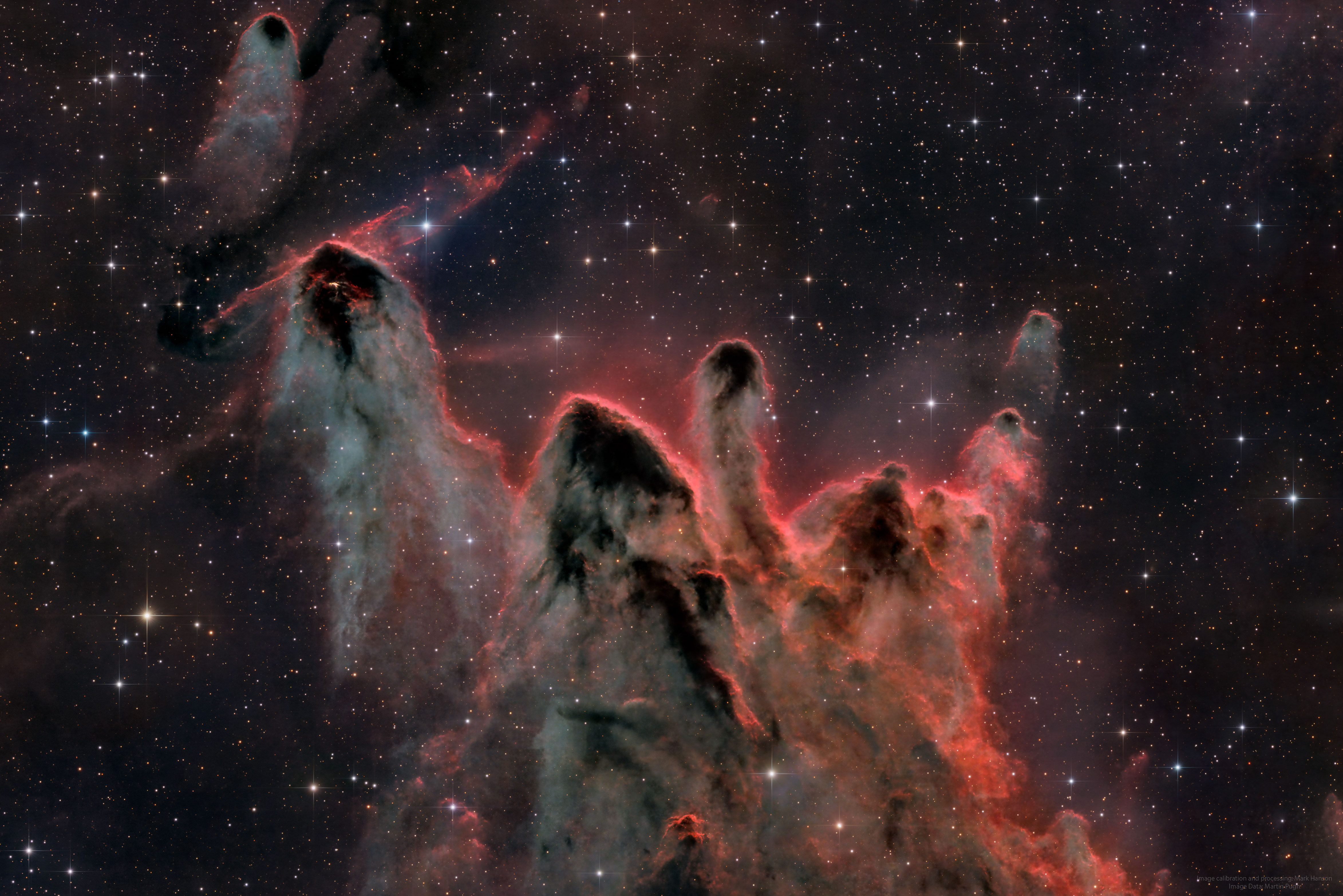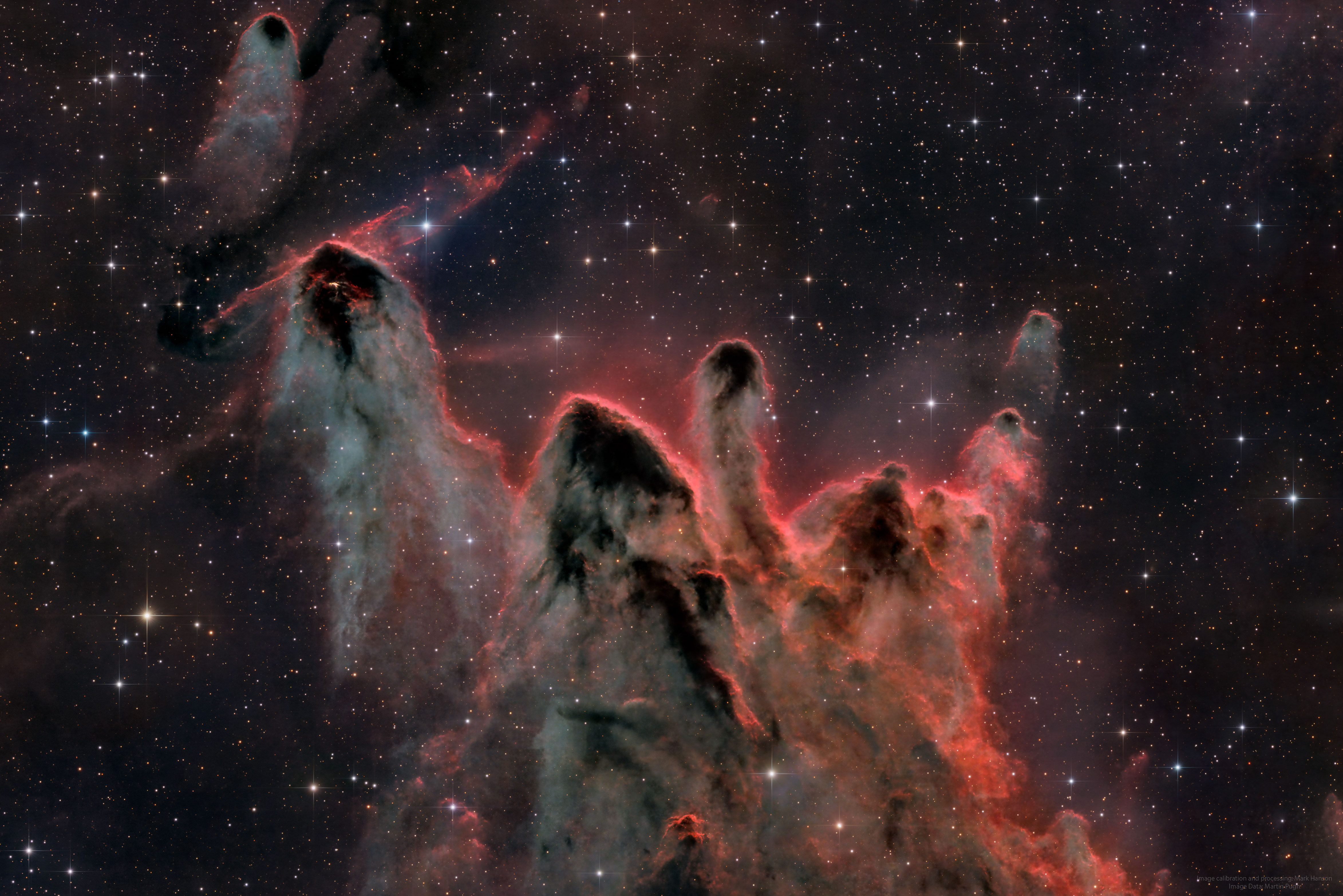
What are these unusual interstellar structures? Bright-rimmed, flowing shapes gather near the center of this rich starfield toward the borders of the nautical southern constellations Pupis and Vela. Composed of interstellar gas and dust, the grouping of light-year sized cometary globules is about 1300 light-years distant. Energetic ultraviolet light from nearby hot stars has molded the globules and ionized their bright rims. The globules also stream away from the Vela supernova remnant which may have influenced their swept-back shapes. Within them, cores of cold gas and dust are likely collapsing to form low mass stars, whose formation will ultimately cause the globules to disperse. In fact, cometary globule CG 30 (on the upper left) sports a small reddish glow near its head, a telltale sign of energetic jets from a star in the early stages of formation.
¿Qué son estas estructuras interestelares inusuales? Formas brillantes y en movimiento se agrupan cerca del centro de este rico campo estelar hacia las fronteras de las constelaciones australes náuticas Pupis y Vela. Compuestos por gas y polvo interestelar, el grupo de globulos cometa de tamaño de año luz se encuentra a unos 1300 años luz de distancia. La luz ultravioleta energética de estrellas calientes cercanas ha moldeado los globulos e ionizado sus bordes brillantes. Los globulos también se alejan del remanente de supernova Vela, que podría haber influido en sus formas recogidas hacia atrás. Dentro de ellos, núcleos de gas y polvo fríos probablemente se estén colapsando para formar estrellas de baja masa, cuya formación finalmente causará la dispersión de los globulos. De hecho, el globulo cometa CG 30 (en la parte superior izquierda) muestra un pequeño brillo rojizo cerca de su cabeza, una señal reveladora de chorros energéticos de una estrella en etapas iniciales de formación.