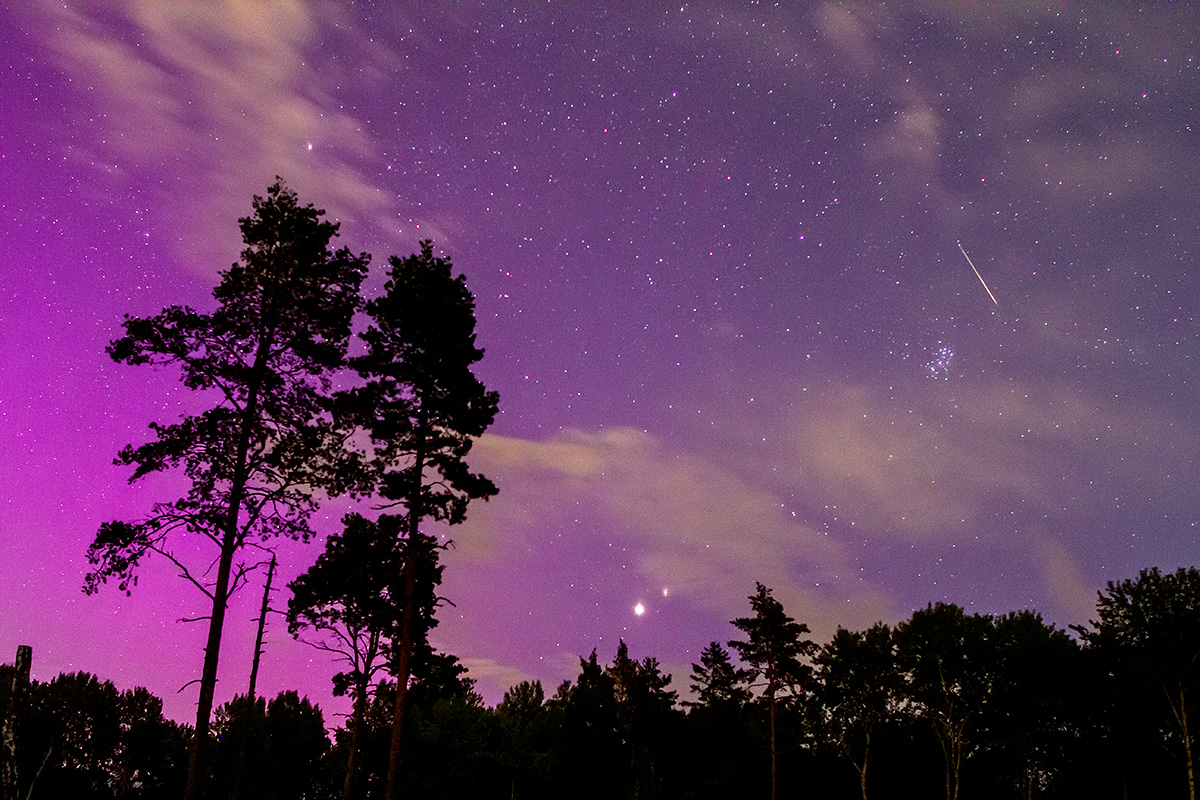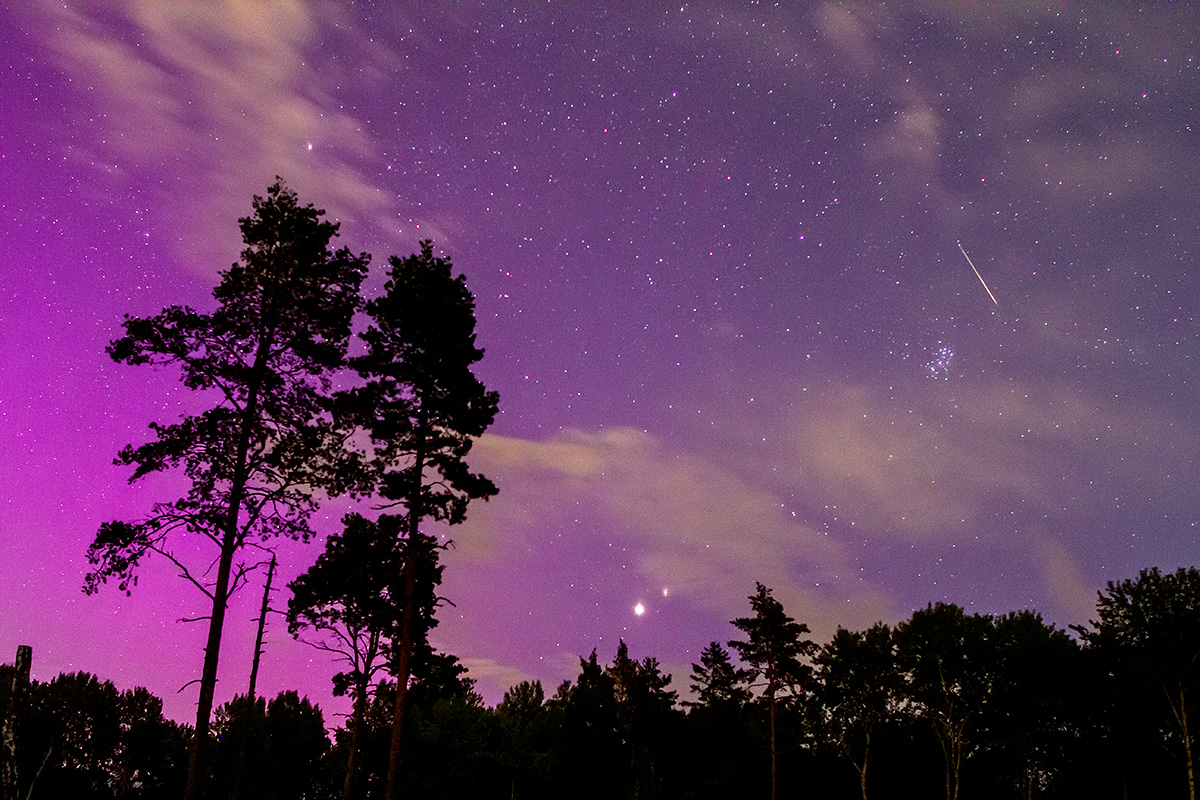
Bright Mars and even brighter Jupiter are in close conjunction just above the pine trees in this post-midnight skyscape from Vallentuna, Sweden. Taken on August 12 during a geomagnetic storm, the snapshot records the glow of aurora borealis or northern lights, beaming from the left side of the frame. Of course on that date Perseid meteors rained through planet Earth's skies, grains of dust from the shower's parent, periodic comet Swift-Tuttle. The meteor streak at the upper right is a Perseid plowing through the atmosphere at about 60 kilometers per second. Also well-known in Earth's night sky, the bright Pleiades star cluster shines below the Perseid meteor streak. In Greek myth, the Pleiades were seven daughters of the astronomical titan Atlas and sea-nymph Pleione. The Pleiades and their parents' names are given to the cluster's nine brightest stars. Gallery: Perseid Meteor Shower 2024 and Aurorae
Marte brillante y aún más brillante Júpiter están en conjunción cercana justo por encima de los pinos en este paisaje nocturno tomado después de la medianoche en Vallentuna, Suecia. Tomado el 12 de agosto durante una tormenta geomagnética, la instantánea registra el resplandor de la aurora boreal o luces del norte, que se proyecta desde el lado izquierdo del marco. Por supuesto, ese día las lluvias de meteoros Perseidas atravesaron los cielos de la Tierra, granos de polvo provenientes del cometa Swift-Tuttle, padre de la lluvia. La raya del meteorito en la parte superior derecha es un Perseid que atraviesa la atmósfera a unos 60 kilómetros por segundo. También bien conocido en el cielo nocturno de la Tierra, el brillante cúmulo estelar de las Pléyades brilla debajo de la raya del meteorito Perseid. En la mitología griega, las Pléyades eran siete hijas del titán astronómico Atlas y la ninfa marina Pleione. Los nombres de las Pléyades y de sus padres se dan a las nueve estrellas más brillantes del cúmulo.