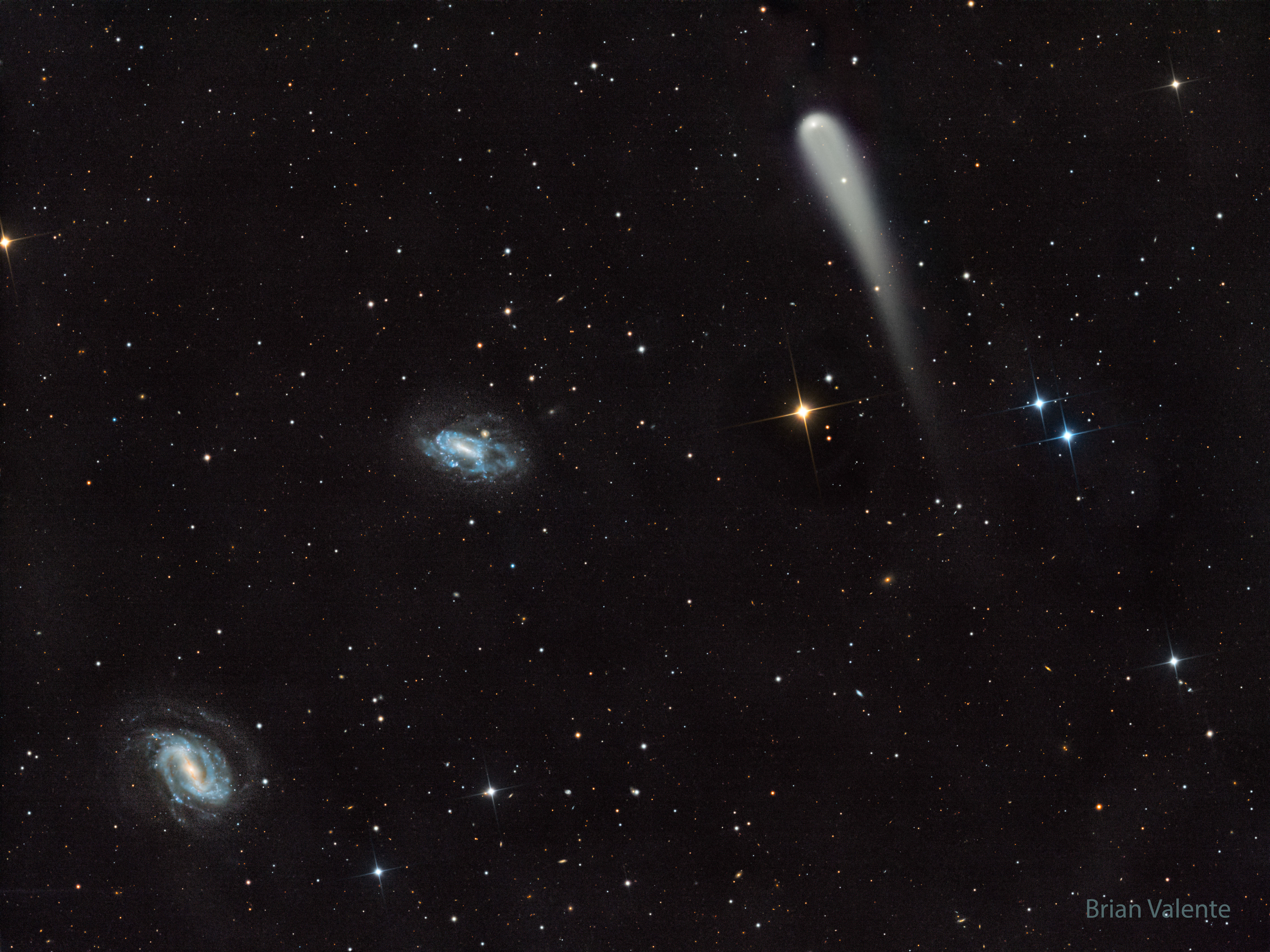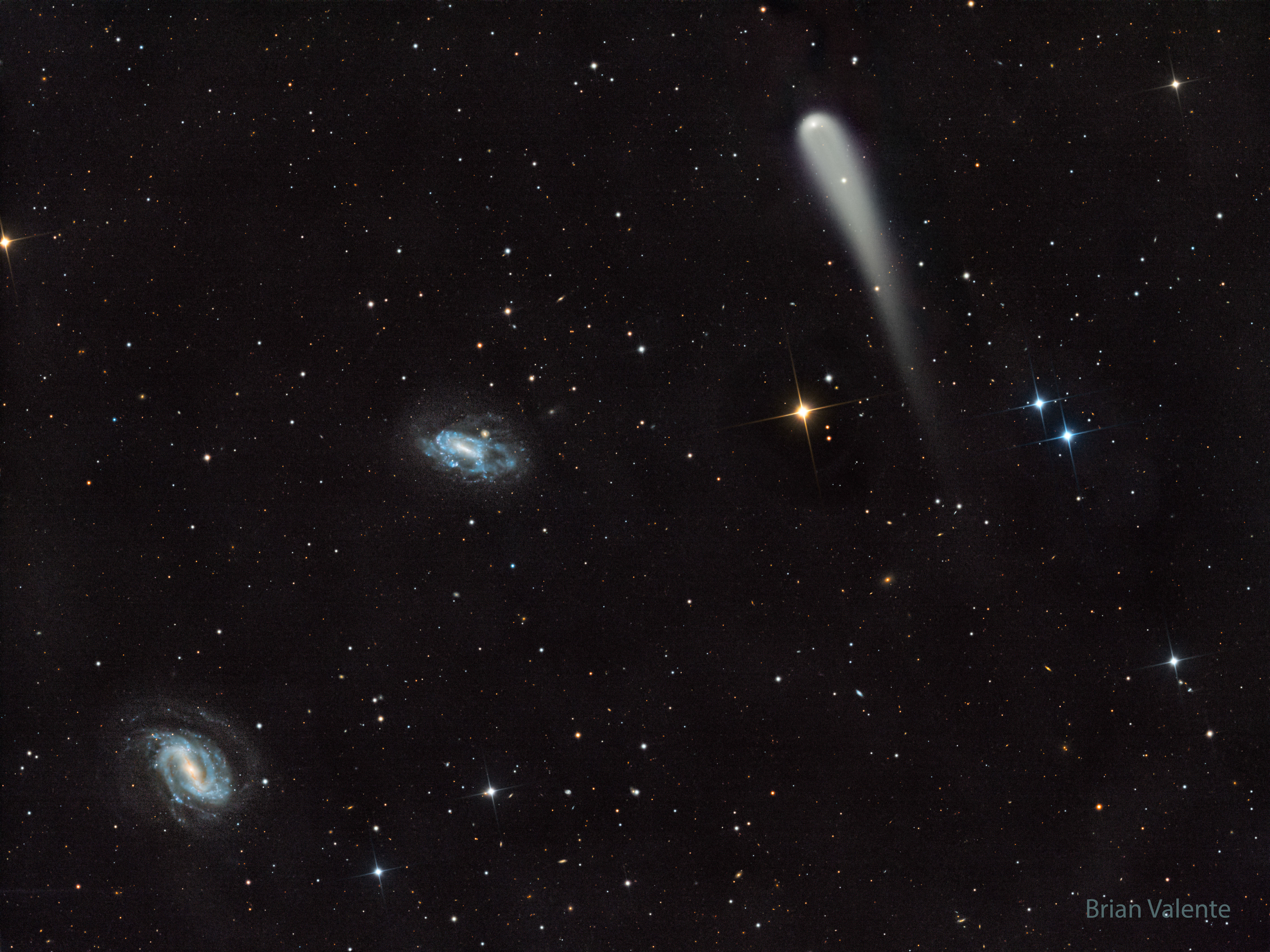
What will happen as this already bright comet approaches? Optimistic predictions have Comet C/2023 A3 (Tsuchinshan–ATLAS) briefly becoming easily visible to the unaided eye -- although the future brightness of comets are notoriously hard to predict, and this comet may even break up in warming sunlight. What is certain is that the comet is now unexpectedly bright and is on track to pass its closest to the Sun (0.39 AU) later this week and closest to the Earth (0.47 AU) early next month. The featured image was taken in late May as Comet Tsuchinshan–ATLAS, discovered only last year, passed nearly in front of two distant galaxies. The comet can now be found with binoculars in the early morning sky rising just before the Sun, while over the next few weeks it will brighten as it moves to the early evening sky. Your Sky Surprise: What picture did APOD feature on your birthday? (post 1995)
¿Qué ocurrirá a medida que este cometa ya brillante se acerca? Predicciones optimistas sugieren que el cometa C/2023 A3 (Tsuchinshan–ATLAS) podría volverse brevemente visible a simple vista. Sin embargo, es bien sabido que predecir la brillantez futura de los cometas es extremadamente difícil, y este cometa podría incluso desintegrarse bajo la luz solar creciente. Lo que sí es seguro es que el cometa ahora es inesperadamente brillante y está en camino de pasar a su distancia más cercana del Sol (0,39 UA) a finales de esta semana y a su distancia más cercana de la Tierra (0,47 UA) a principios del próximo mes. La imagen destacada fue tomada a finales de mayo cuando el cometa Tsuchinshan–ATLAS, descubierto apenas el año pasado, pasó casi frente a dos galaxias distantes. Actualmente, el cometa puede observarse con binoculares en el cielo matutino, apareciendo justo antes del amanecer, y en las próximas semanas se hará más brillante a medida que pase al cielo vespertino. Tu sorpresa celeste: ¿Qué imagen destacó APOD en tu cumpleaños? (desde 1995)