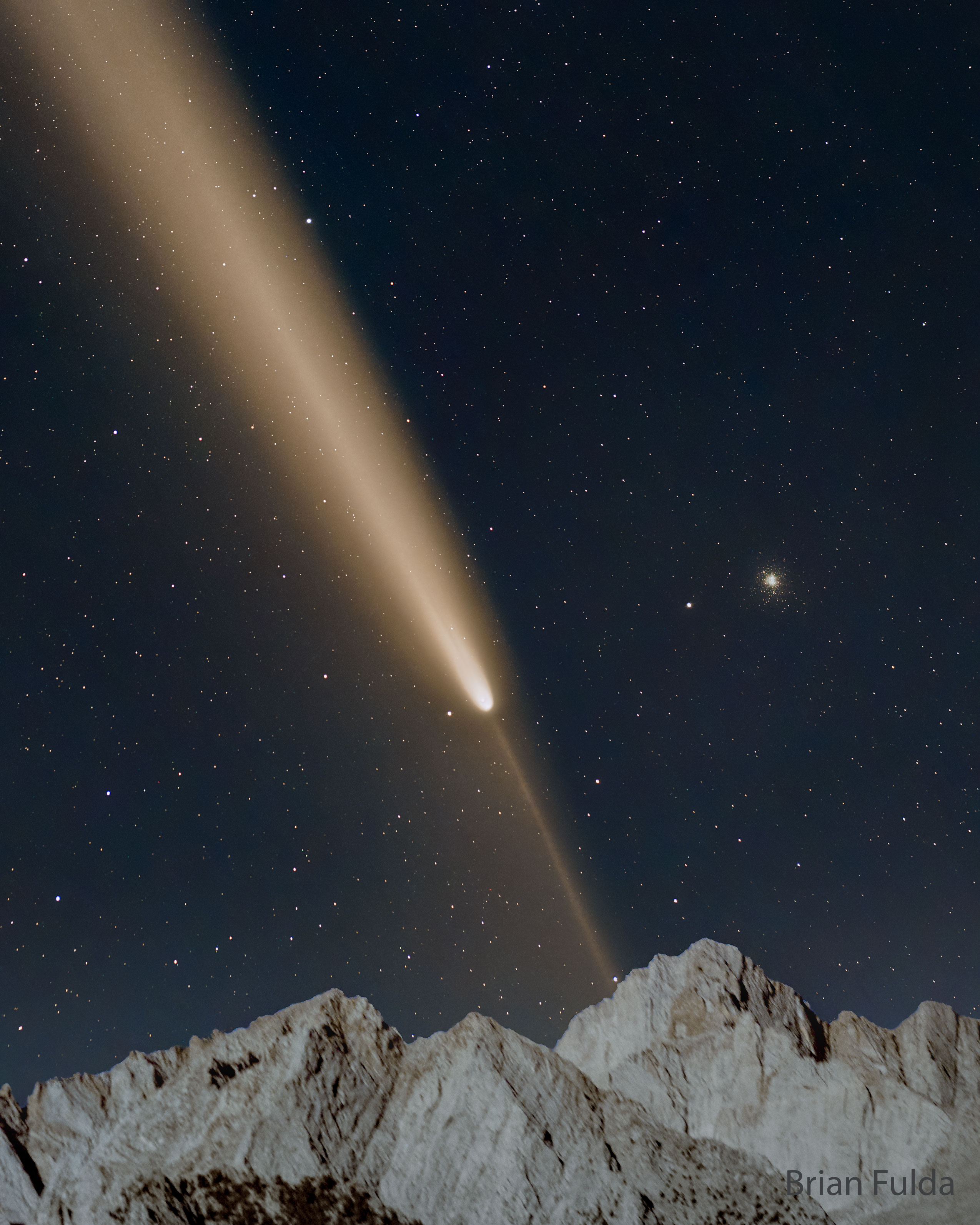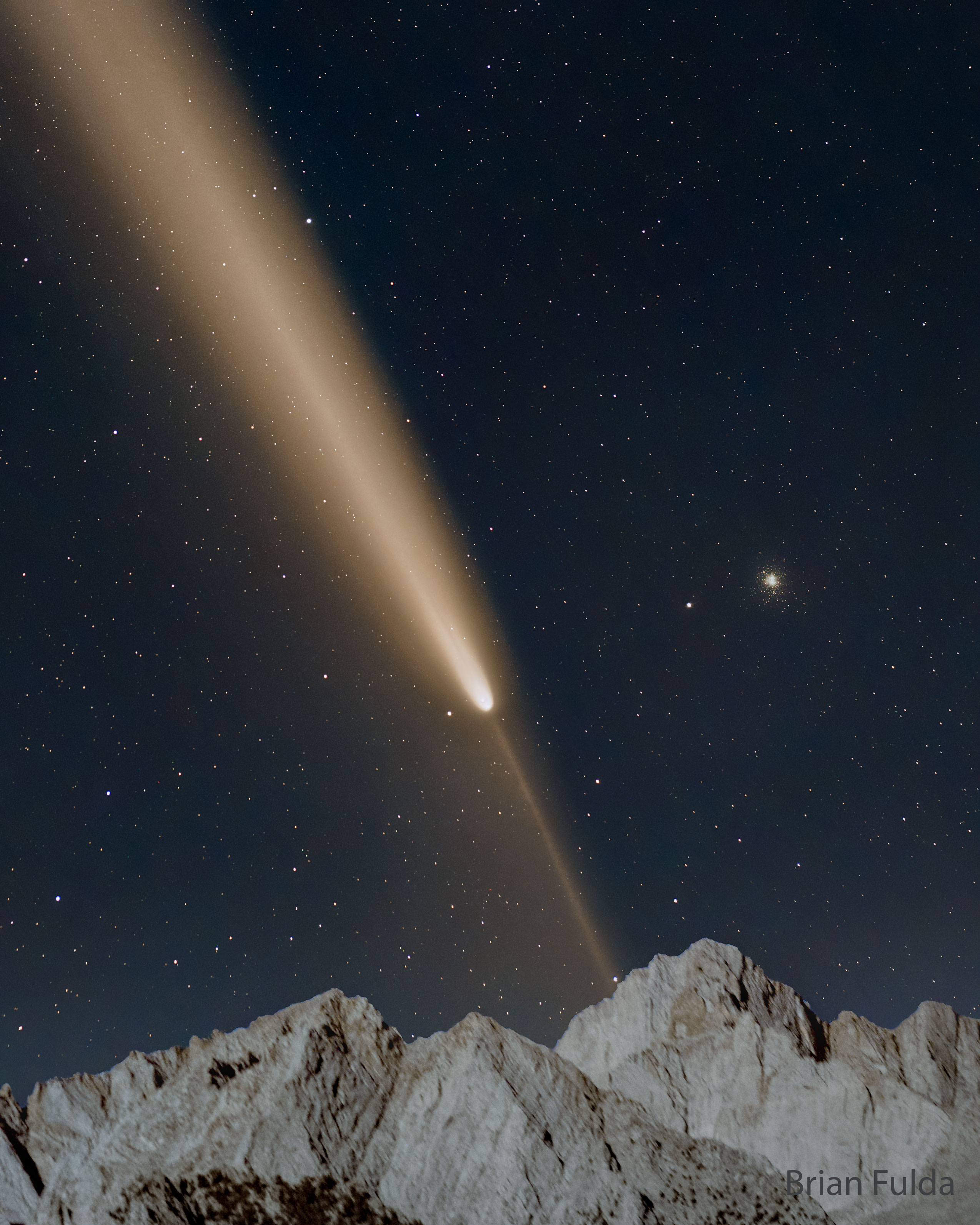
The tails of Comet Tsuchinshan-ATLAS were a sight to behold. Pictured, C/2023 A3 (Tsuchinshan–ATLAS) was captured near peak impressiveness last week over the Eastern Sierra Mountains in California, USA. The comet not only showed a bright tail, but a distinct anti-tail pointing in nearly the opposite direction. The globular star cluster M5 can be seen on the right, far in the distance. As it approached, it was unclear if this crumbling iceberg would disintegrate completely as it warmed in the bright sunlight. In reality, the comet survived to become brighter than any star in the night (magnitude -4.9), but unfortunately was then so nearly in front of the Sun that it was hard for many casual observers to locate. Whether Comet Tsuchinshan-Atlas becomes known as the Great Comet of 2024 now depends, in part, on how impressive incoming comet C/2024 S1 (ATLAS) becomes over the next two weeks. Your Sky Surprise: What picture did APOD feature on your birthday? (post 1995)
Las colas del cometa Tsuchinshan-ATLAS eran un espectáculo digno de verse. En la imagen, C/2023 A3 (Tsuchinshan–ATLAS) fue capturado cerca de su máximo esplendor la semana pasada sobre las Montañas de Sierra Oriental en California, EE. UU. El cometa no solo mostró una cola brillante, sino también una cola antitail distintiva que apuntaba en dirección casi opuesta. Se puede ver el cúmulo globular M5 a la derecha, muy lejos. Cuando se acercaba, no estaba claro si este iceberg que se desmoronaba se desintegraría completamente al calentarse bajo la luz solar intensa. En realidad, el cometa sobrevivió y llegó a brillar más que cualquier estrella en la noche (magnitud -4.9), pero desafortunadamente quedó tan cerca del Sol que resultó difícil para muchos observadores casuales localizarlo. Si el cometa Tsuchinshan-ATLAS termina siendo conocido como el Gran Cometa de 2024 dependerá, en parte, de lo impresionante que resulte el cometa entrante C/2024 S1 (ATLAS) en las próximas dos semanas.