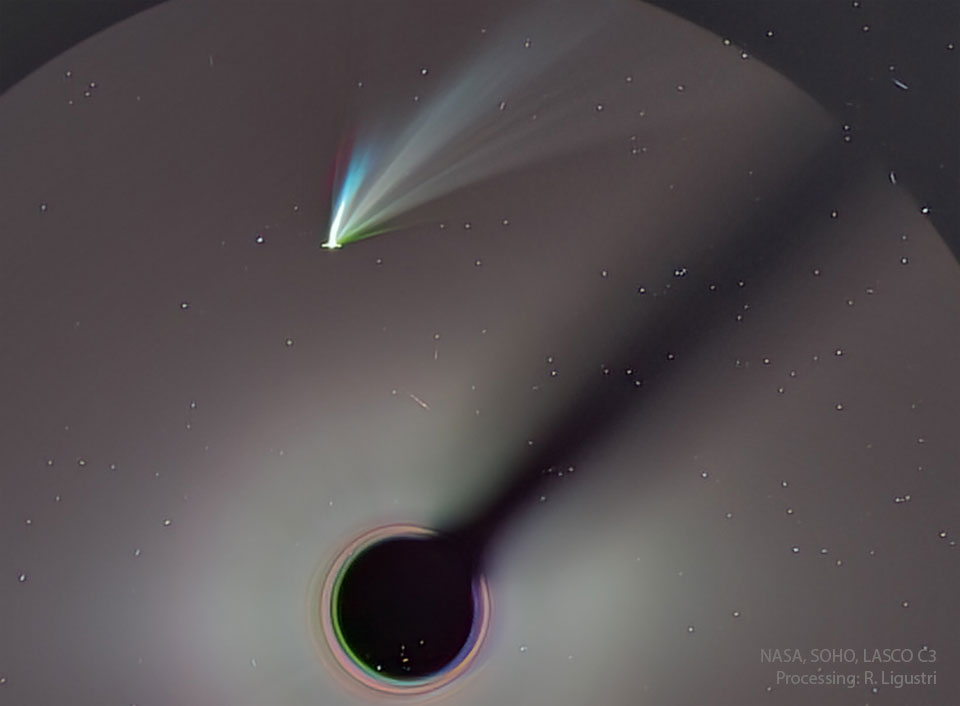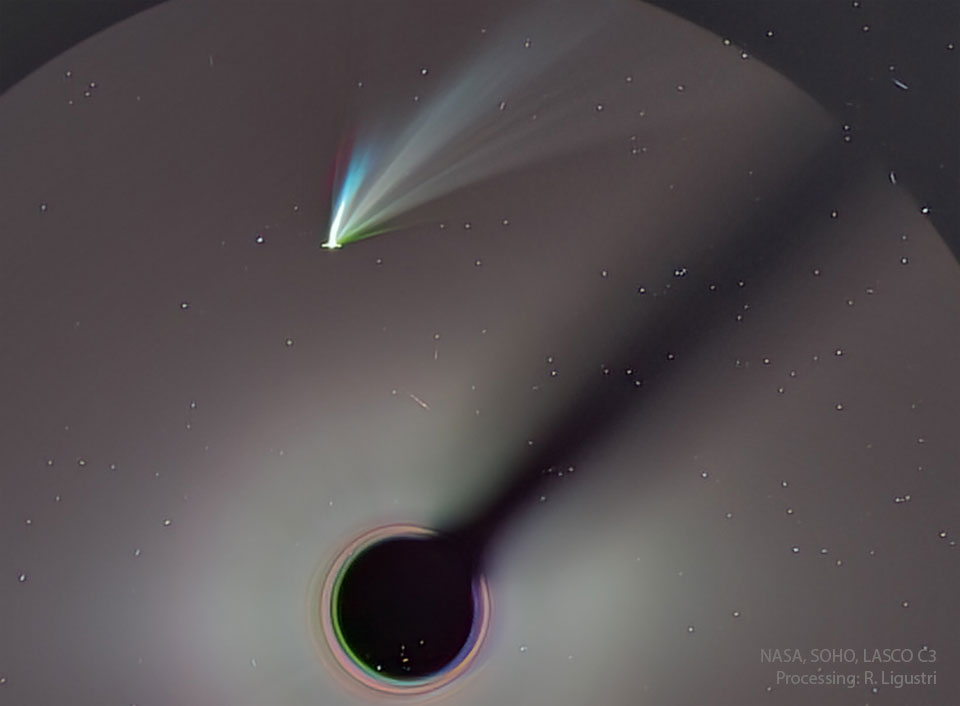
Why does Comet ATLAS have such colorful tails? Last week Comet C/2024 G3 (ATLAS) passed its closest to the Sun -- well inside the orbit of Mercury -- and brightened dramatically. Unfortunately, the comet was then so angularly near the Sun that it was very hard for humans to see. But NASA's SOHO spacecraft saw it. Pictured is a SOHO (LASCO C3) image of Comet ATLAS that is a composite of several different color filters. Of the several tails visible, the central white tails are likely made of dust and just reflecting back sunlight. The red, blue, and green tails are likely ion tails with their colors dominated by light emitted by specific gases that were ejected from the comet and energized by the Sun. Currently, Comet ATLAS is showing long tails in southern skies but fading as it moves out of the inner Solar System. Growing Gallery: Comet ATLAS (G3)
¿Por qué el cometa ATLAS tiene colas tan coloridas? La semana pasada, el cometa C/2024 G3 (ATLAS) pasó a su distancia más cercana del Sol, dentro de la órbita de Mercurio, y se aclaró drásticamente. Desafortunadamente, el cometa estaba entonces muy cerca del Sol desde el punto de vista angular, lo que lo hacía muy difícil de ver para los humanos. Pero la nave espacial SOHO de la NASA lo observó. La imagen mostrada es una imagen de SOHO (LASCO C3) del cometa ATLAS, que es una composición de varios filtros de color diferentes. De las varias colas visibles, las colas centrales blancas probablemente estén compuestas por polvo y simplemente reflejen la luz solar. Las colas rojas, azules y verdes probablemente sean colas iónicas, cuyos colores están dominados por la luz emitida por gases específicos que fueron eyectados del cometa y energizados por el Sol. Actualmente, el cometa ATLAS muestra colas largas en el cielo sur, pero se está desvaneciendo a medida que se aleja del sistema solar interior.