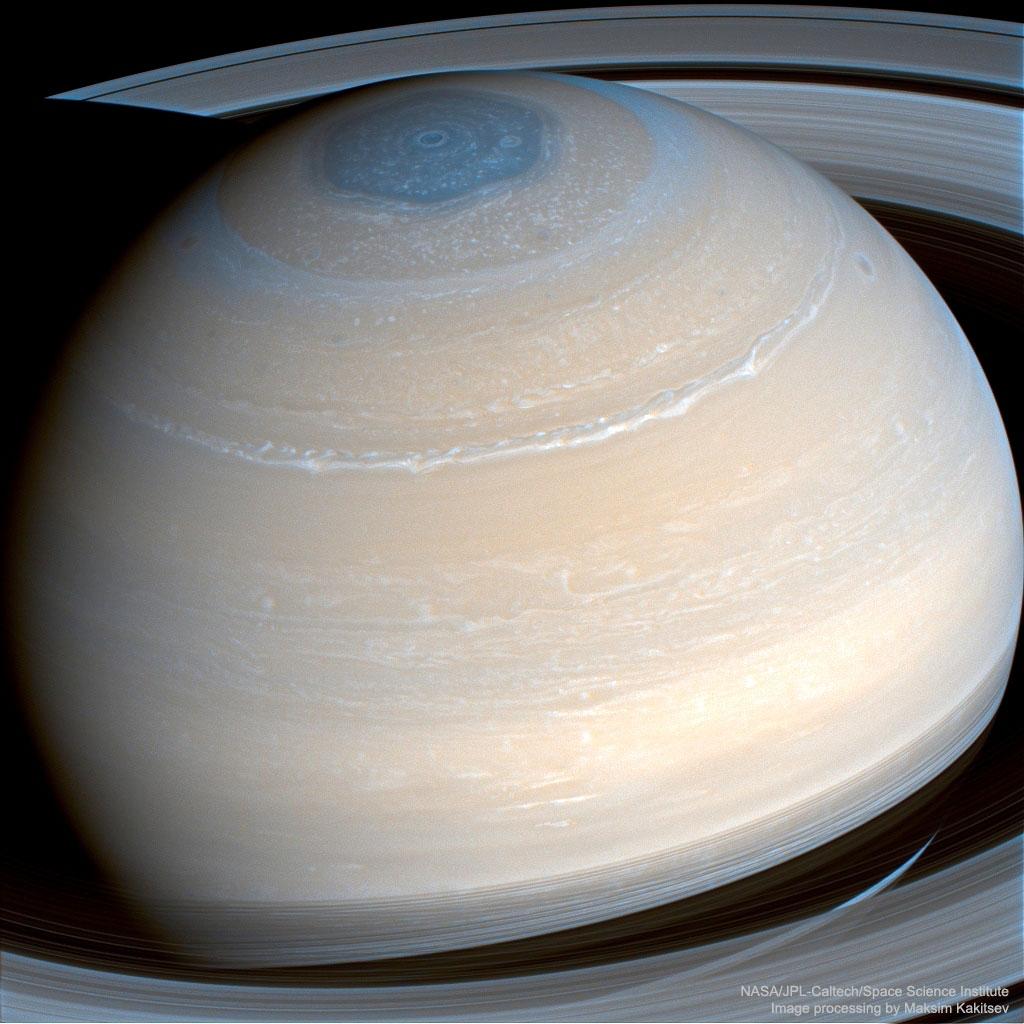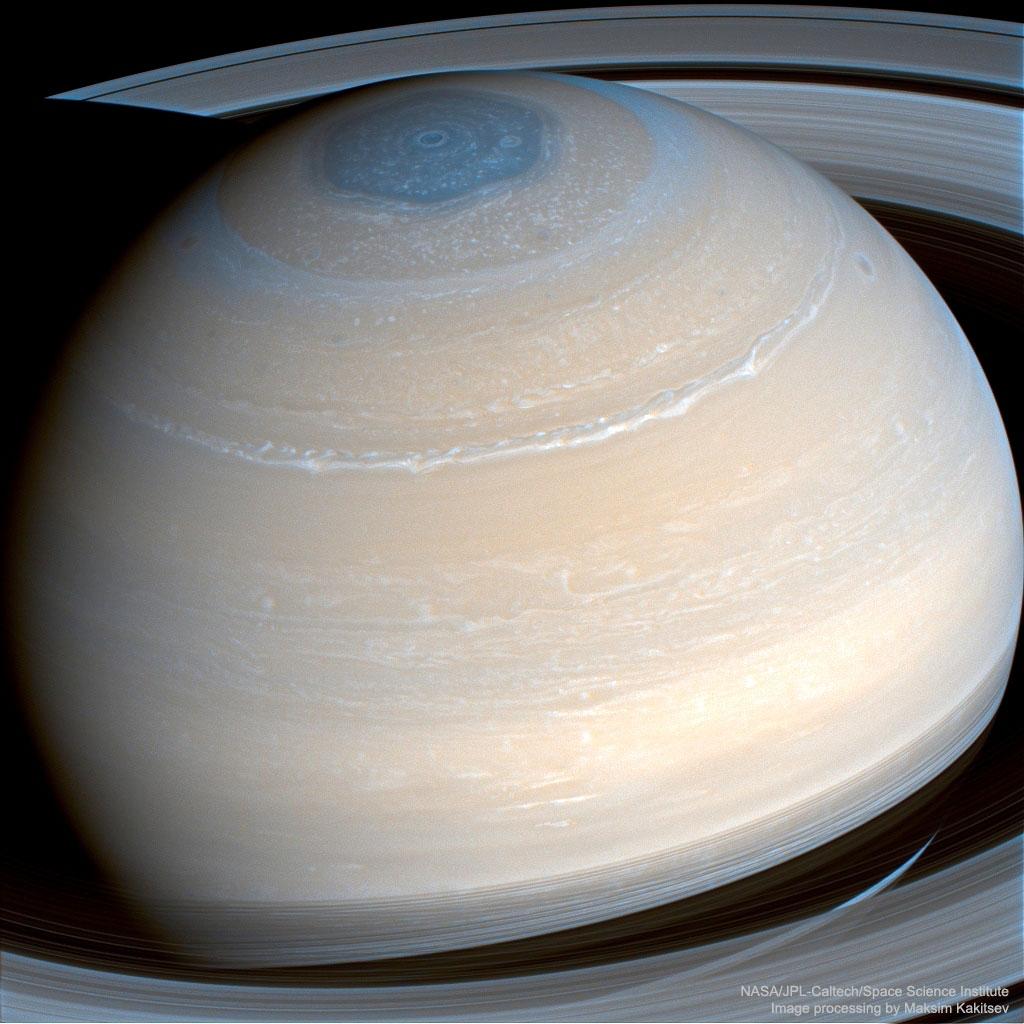
Saturn looks slightly different in infrared light. Bands of clouds show great structure, including long stretching storms. Also quite striking in infrared is the unusual hexagonal cloud pattern surrounding Saturn's North Pole. Each side of the dark hexagon spans roughly the width of our Earth. The hexagon's existence was not predicted, and its origin and likely stability remain a topics of research. Saturn's famous rings circle the planet and cast shadows below the equator. The featured image was taken by the robotic Cassini spacecraft in 2014 in several infrared colors. In 2017 September, the Cassini mission was brought to a dramatic conclusion when the spacecraft was directed to dive into the ringed giant. Your Sky Surprise: What picture did APOD feature on your birthday? (post 1995)
Saturno se ve ligeramente diferente en luz infrarroja. Las bandas de nubes muestran una gran estructura, incluyendo tormentas que se extienden largamente. También es bastante llamativo en infrarrojo el patrón de nubes hexagonal inusual que rodea el Polo Norte de Saturno. Cada lado del hexágono oscuro tiene aproximadamente el ancho de la Tierra. La existencia del hexágono no fue predicha, y su origen y probable estabilidad siguen siendo temas de investigación. Los famosos anillos de Saturno rodean al planeta y proyectan sombras debajo del ecuador. La imagen destacada fue tomada por la nave espacial robótica Cassini en 2014 en varios colores infrarrojos. En septiembre de 2017, la misión Cassini llegó a una conclusión dramática cuando la nave espacial fue dirigida a sumergirse en el gigante anillado.