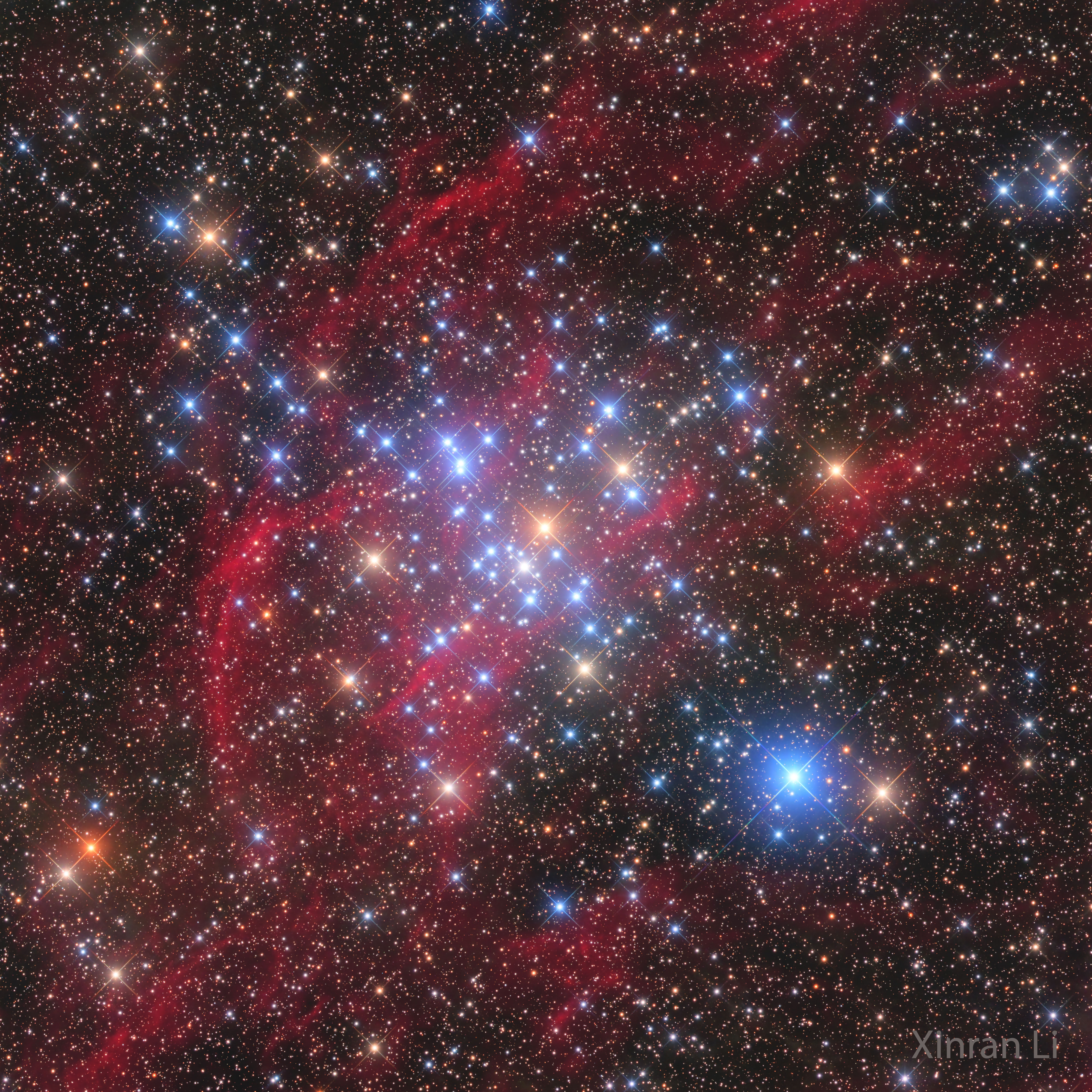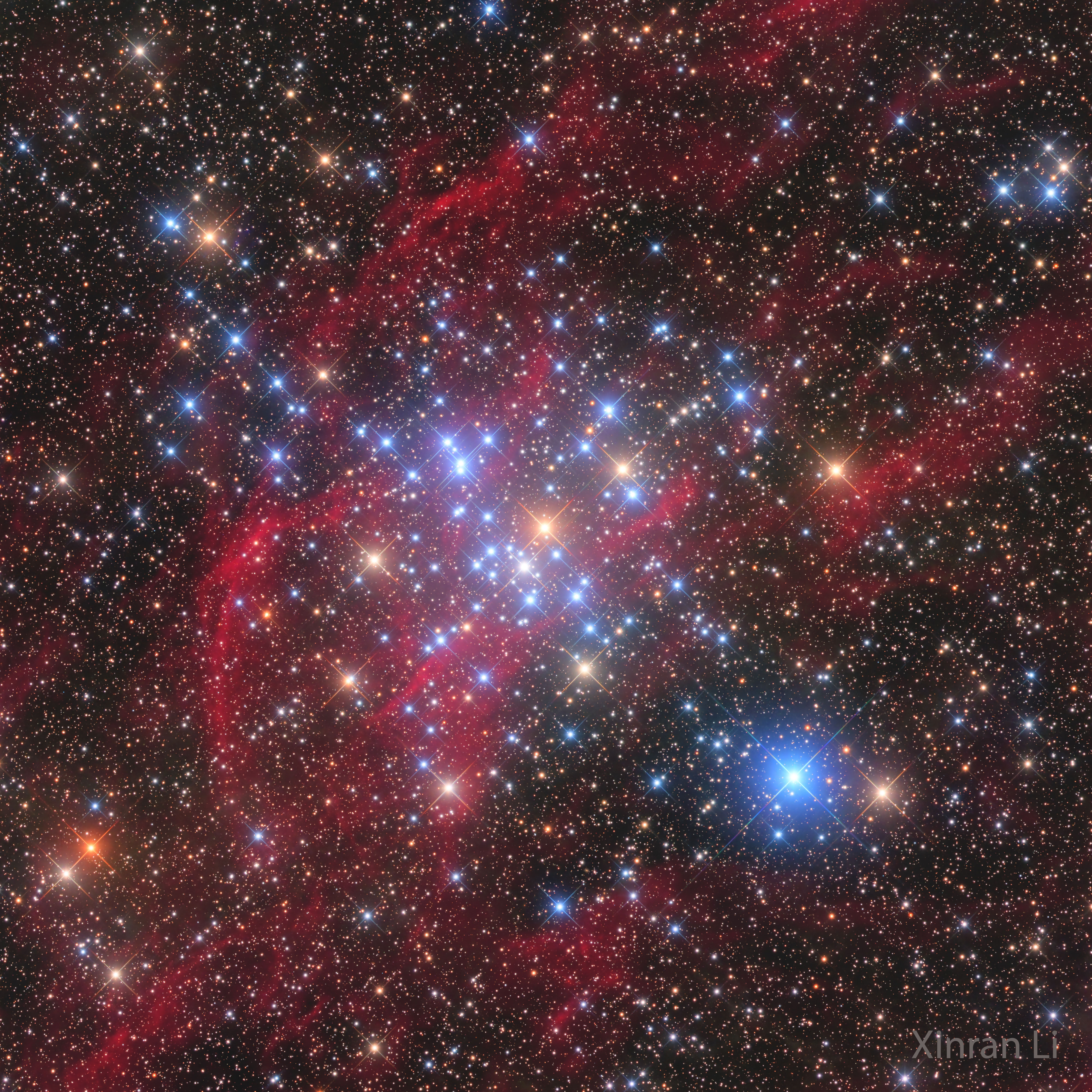
Why are there so many bright blue stars? Stars are usually born in clusters, and the brightest and most massive of these stars typically glow blue. Less-bright, non-blue stars like our Sun surely also exist in this M41 star cluster but are harder to see. A few bright orange-appearing red giant stars are visible. The red-light filaments are emitted by diffuse hydrogen gas, a color that was specifically filtered and enhanced in this image. In a hundred million years or so, the bright blue stars will have exploded in supernovas and disappeared, while the slightly different trajectories of the fainter stars will cause this picturesque open cluster to disperse. Similarly, billions of years ago, our own Sun was likely born into a star cluster like M41, but it has long since drifted apart from its sister stars. The featured image was captured over four hours with Chilescope T2 in Chile.
¿Por qué hay tantas estrellas brillantes de color azul? Las estrellas normalmente nacen en agrupaciones, y las más brillantes y masivas de estas estrellas típicamente brillan con un color azul. Estrellas menos brillantes y no azules, como nuestro Sol, seguramente también existen en este cúmulo estelar M41, pero son más difíciles de ver. Se pueden observar algunas estrellas gigantes rojas que aparecen de color naranja brillante. Los filamentos de luz roja son emitidos por gas de hidrógeno difuso, un color que fue específicamente filtrado y realzado en esta imagen. En unos cien millones de años, las estrellas brillantes de color azul habrán explotado en supernovas y desaparecido, mientras que las trayectorias ligeramente diferentes de las estrellas más tenues causarán que este pintoresco cúmulo abierto se disperse. De manera similar, hace miles de millones de años, nuestro propio Sol probablemente nació en un cúmulo estelar como M41, pero hace mucho tiempo que se separó de sus estrellas hermanas. La imagen destacada fue capturada durante más de cuatro horas con el Chilescope T2 en Chile.