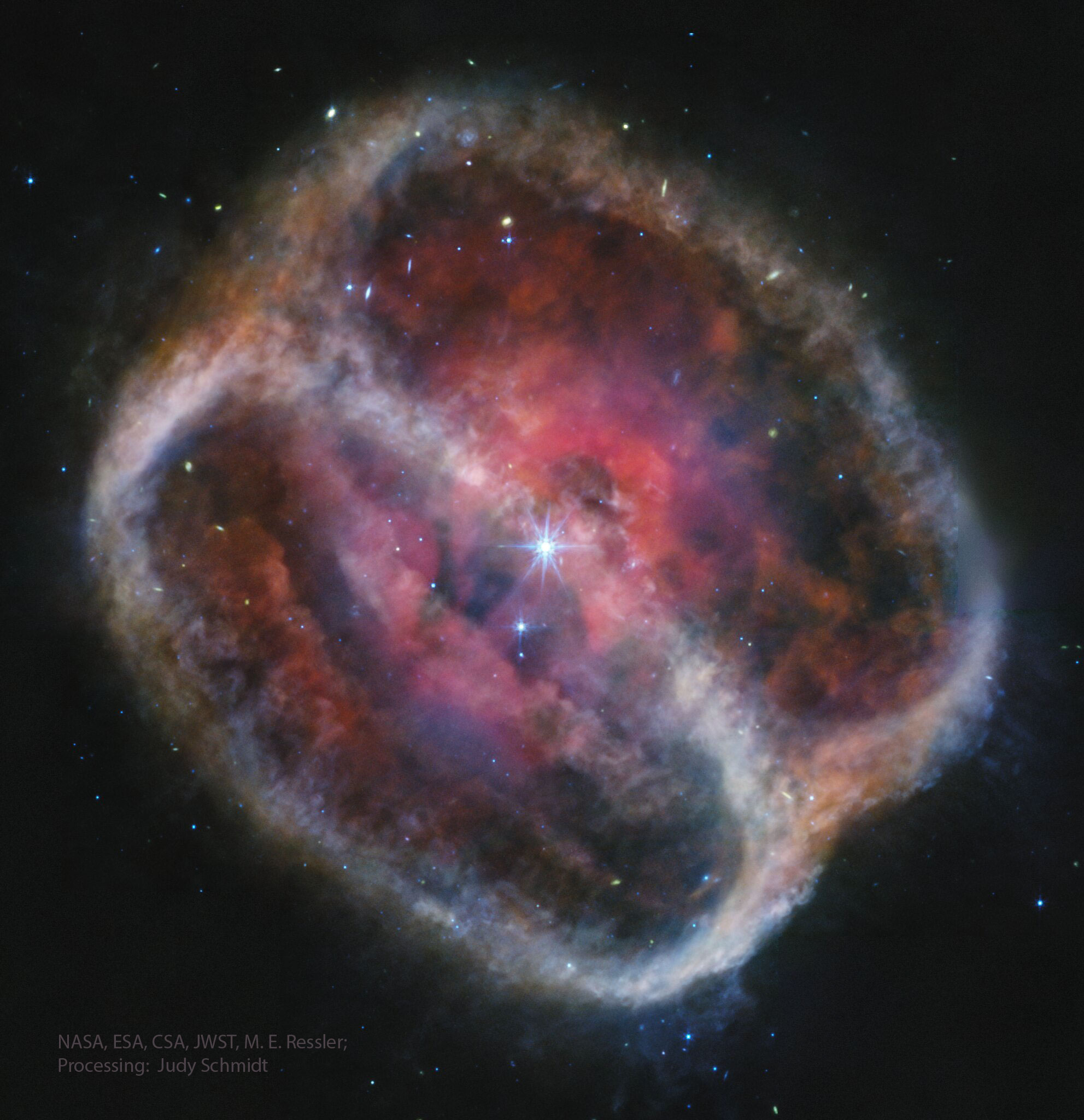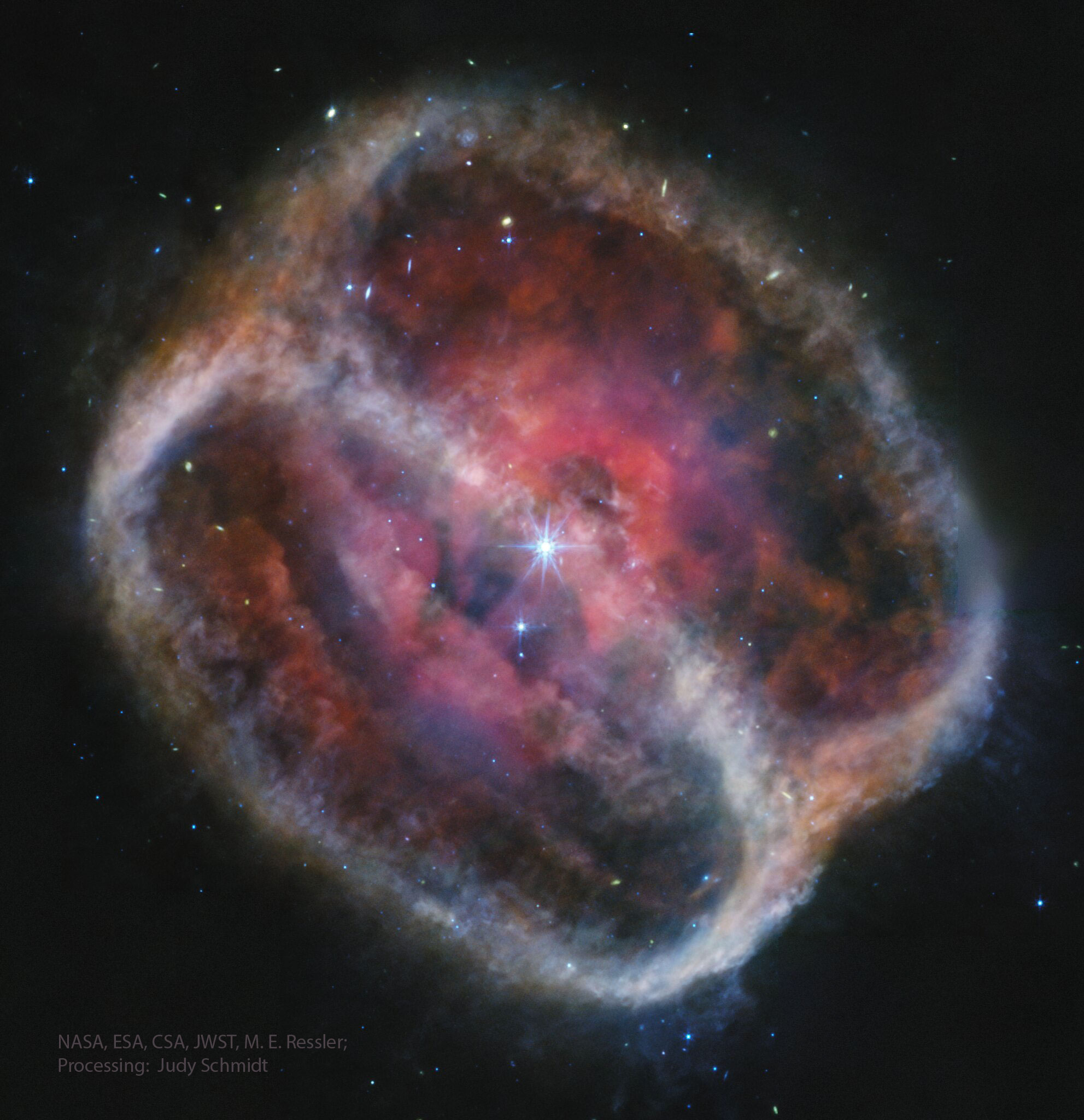
What happens when a star runs out of nuclear fuel? For stars like our Sun, the center condenses into a white dwarf while the outer atmosphere is expelled into space to appear as a planetary nebula. The expelled outer atmosphere of planetary nebula NGC 1514 appears to be a jumble of bubbles -- when seen in visible light. But the view from the James Webb Space Telescope in infrared, as featured here, confirms a different story: in this light the nebula shows a distinct hourglass shape, which is interpreted as a cylinder seen along a diagonal. If you look closely at the center of the nebula, you can also see a bright central star that is part of a binary system. More observations might better reveal how this nebula is evolving and how the central stars are working together to produce the interesting cylinder and bubbles observed. Jump Around the Universe: Random APOD Generator
¿Qué ocurre cuando una estrella se queda sin combustible nuclear? Para estrellas como nuestro Sol, el centro se condensa en una enana blanca mientras que la atmósfera exterior es expulsada al espacio, apareciendo como una nebulosa planetaria. La atmósfera expulsada de la nebulosa planetaria NGC 1514 parece un revoltijo de burbujas cuando se observa en luz visible. Pero la vista desde el Telescopio Espacial James Webb en el infrarrojo, como se muestra aquí, confirma una historia diferente: en esta longitud de onda, la nebulosa muestra una forma clara de horquilla, interpretada como un cilindro visto a lo largo de una diagonal. Si miras con atención en el centro de la nebulosa, también puedes ver una estrella central brillante que forma parte de un sistema binario. Observaciones adicionales podrían revelar mejor cómo se está desarrollando esta nebulosa y cómo las estrellas centrales trabajan juntas para producir el interesante cilindro y burbujas observadas.