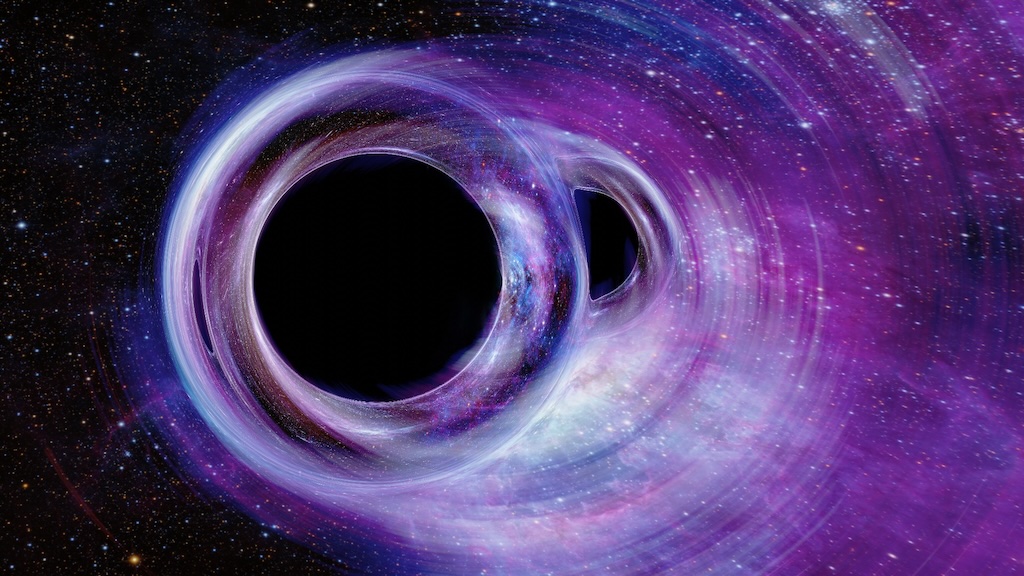
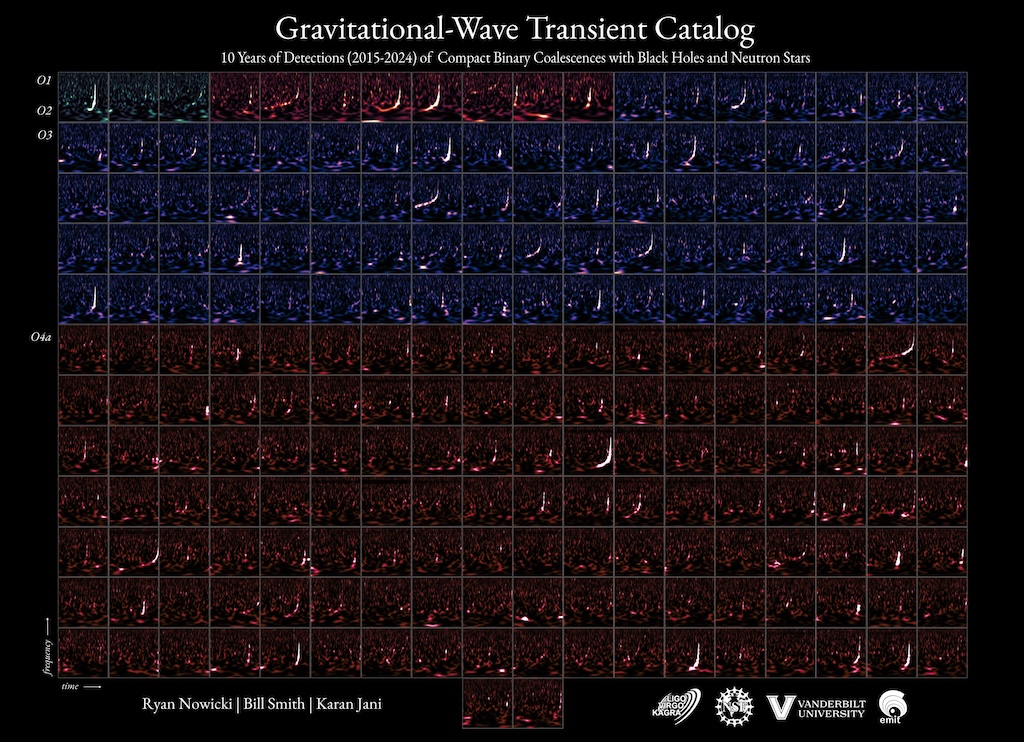
If one black hole looks strange, what about two? Light rays from accretion disks around a pair of orbiting supermassive black holes make their way through the warped space-time produced by extreme gravity in this detailed computer visualization. The simulated accretion disks have been given different false color schemes, red for the disk surrounding a 200-million-solar-mass black hole, and blue for the disk surrounding a 100-million-solar-mass black hole. For these masses, though, both accretion disks would actually emit most of their light in the ultraviolet. The video allows us to see both sides of each black hole at the same time. Red and blue light originating from both black holes can be seen in the innermost ring of light, called the photon sphere, near their event horizons. In the past decade, gravitational waves from black hole collisions have actually been detected, although the coalescence of supermassive black holes remains undiscovered. Hole New Worlds: It's Black Hole Week at NASA!
Crédito: NASA, CGRO SSC Si un agujero negro ya parece extraño, ¿qué tal dos? Los rayos de luz de los discos de acreción alrededor de un par de agujeros negros supermasivos en órbita se desplazan a través del espacio-tiempo curvado producido por la gravedad extrema en esta visualización detallada por computadora. Los discos de acreción simulados se han asignado esquemas de color falsos diferentes, rojo para el disco que rodea un agujero negro de 200 millones de masas solares, y azul para el disco que rodea un agujero negro de 100 millones de masas solares. Sin embargo, para estas masas, ambos discos de acreción emitirían la mayor parte de su luz en el ultravioleta. El video nos permite ver ambos lados de cada agujero negro al mismo tiempo. La luz roja y azul originada en ambos agujeros negros se puede ver en el anillo de luz más interno, llamado esfera de fotones, cerca de sus horizontes de sucesos. En la última década, se han detectado realmente ondas gravitacionales de colisiones de agujeros negros, aunque la coalescencia de agujeros negros supermasivos sigue sin ser descubierta.