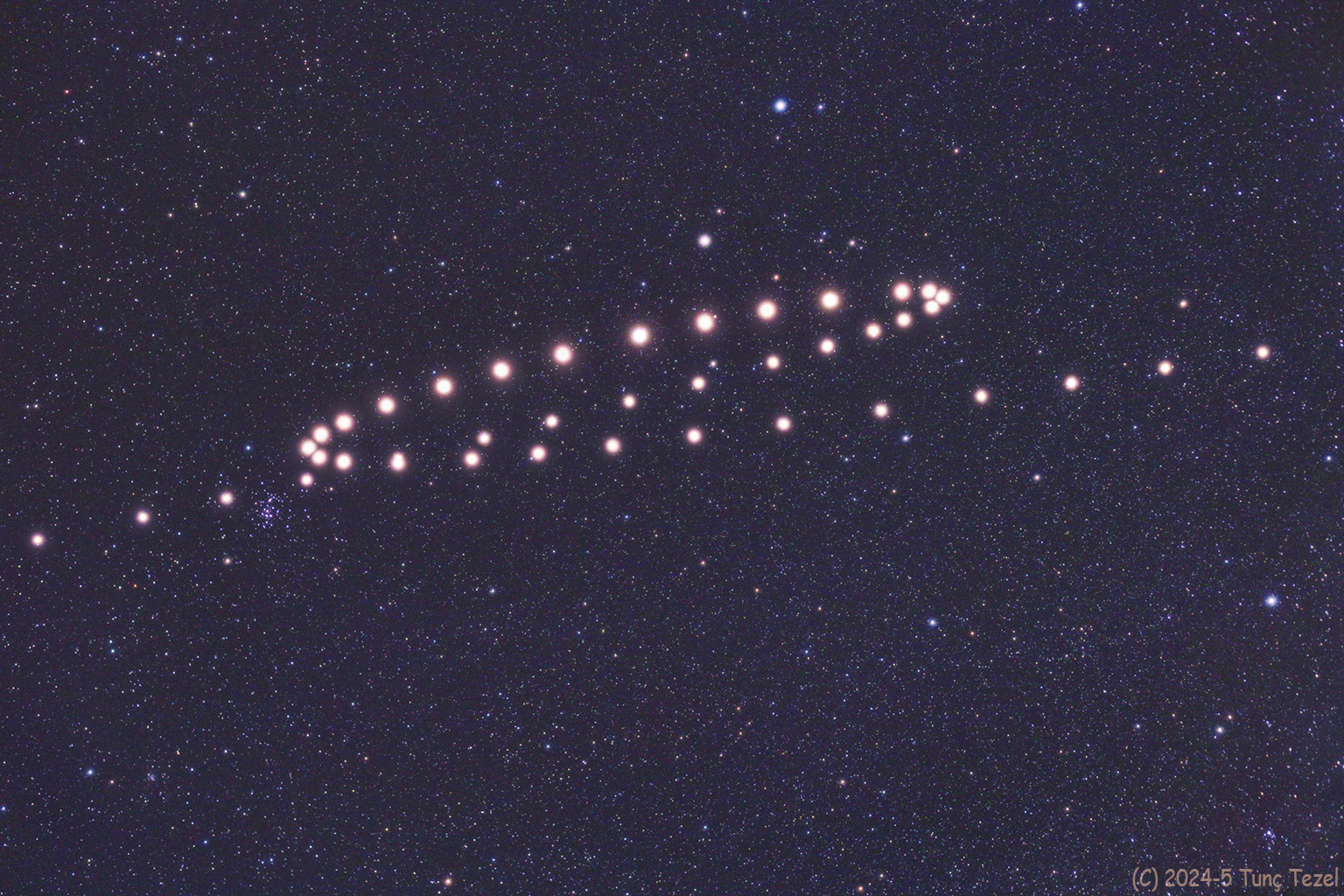
This composite of images spaced a weather-permitting 5 to 9 days apart, from 2024 September 19 (top right) through 2025 May 18 (bottom left), faithfully traces ruddy-colored Mars as it makes a clockwise loop through the constellations Gemini and Cancer in planet Earth's night sky. You can connect the dots and dates with your cursor over the image, but be sure to check out this animation of the Red Planet's 2024/25 retrograde motion. Of course Mars didn't actually reverse the direction of its orbit. Instead, the apparent backwards motion with respect to the background stars is a reflection of the orbital motion of Earth itself. Retrograde motion can be seen each time Earth overtakes and laps planets orbiting farther from the Sun, the Earth moving more rapidly through its own relatively close-in orbit. In this case Mars' apparent eastward motion began to reverse around December 8, when it seemed to linger near open star cluster M44 in Cancer. After wandering back to the west, under Gemini's bright stars Castor and Pollux, Mars returned to pose near M44 by early May. At its brightest near opposition on 2025 January 16, Mars was a mere 96 million kilometers away.
Esta composición de imágenes tomadas a intervalos de 5 a 9 días, cuando las condiciones climáticas lo permitieron, desde el 19 de septiembre de 2024 (arriba a la derecha) hasta el 18 de mayo de 2025 (abajo a la izquierda), rastrea fielmente el color rojizo de Marte a medida que describe un bucle en sentido horario a través de las constelaciones de Géminis y Cáncer en el cielo nocturno de la Tierra. Puedes conectar los puntos y las fechas con el cursor sobre la imagen, pero asegúrate de ver esta animación del movimiento retrógrado del Planeta Rojo en 2024/25. Por supuesto, Marte no invirtió realmente la dirección de su órbita. En cambio, el movimiento aparente hacia atrás con respecto a las estrellas de fondo es una reflexión del movimiento orbital de la Tierra misma. El movimiento retrógrado se puede observar cada vez que la Tierra rebasa y pasa a los planetas que orbitan más lejos del Sol, ya que la Tierra se mueve más rápidamente en su órbita relativamente cercana. En este caso, el movimiento aparente hacia el este de Marte comenzó a invertirse alrededor del 8 de diciembre, cuando parecía permanecer cerca del cúmulo estelar abierto M44 en Cáncer. Después de desplazarse hacia el oeste, bajo las brillantes estrellas de Géminis, Castor y Pollux, Marte regresó para posarse cerca de M44 a principios de mayo. En su punto más brillante, cerca de la oposición, el 16 de enero de 2025, Marte estaba a solo 96 millones de kilómetros de distancia.