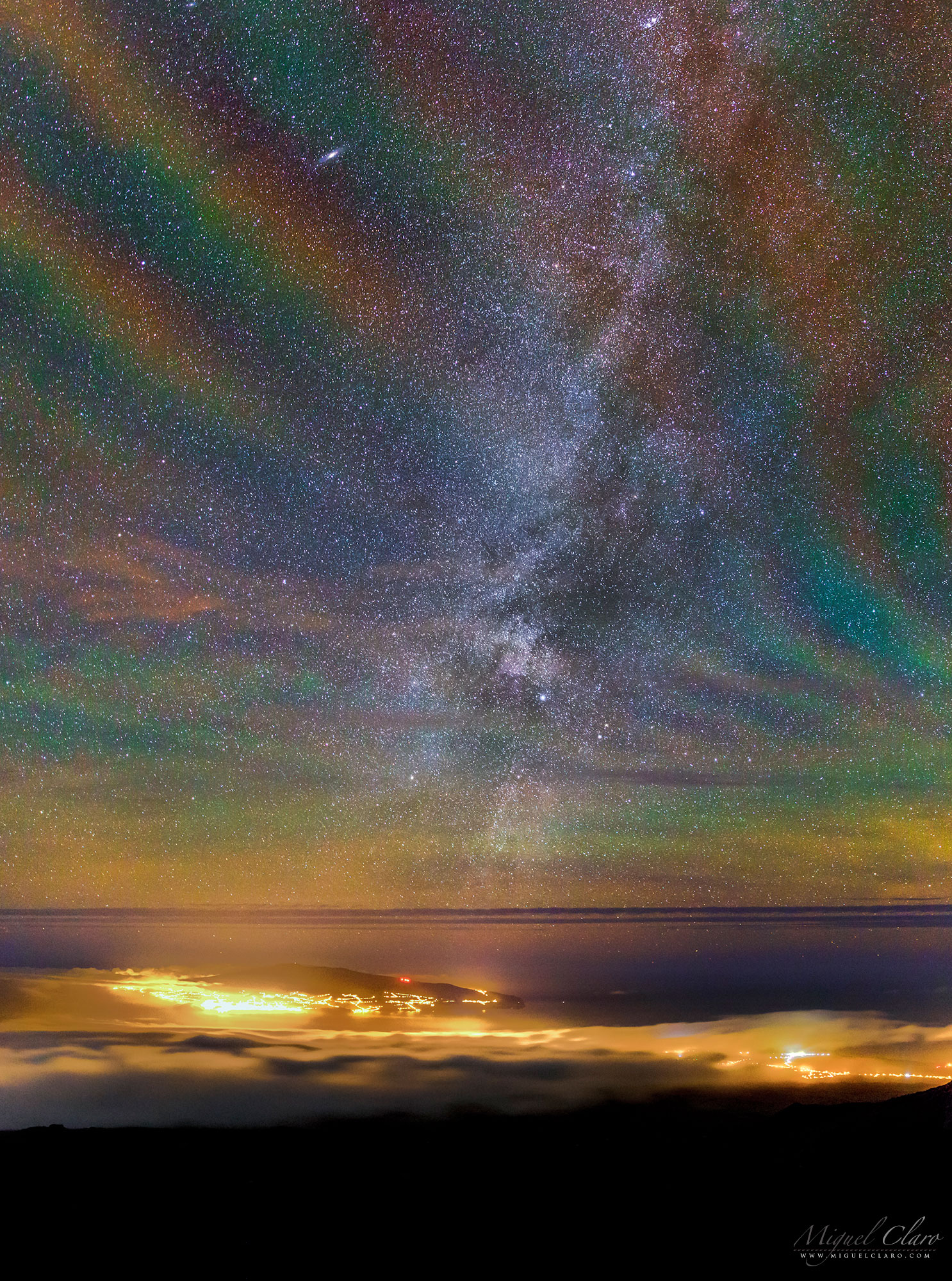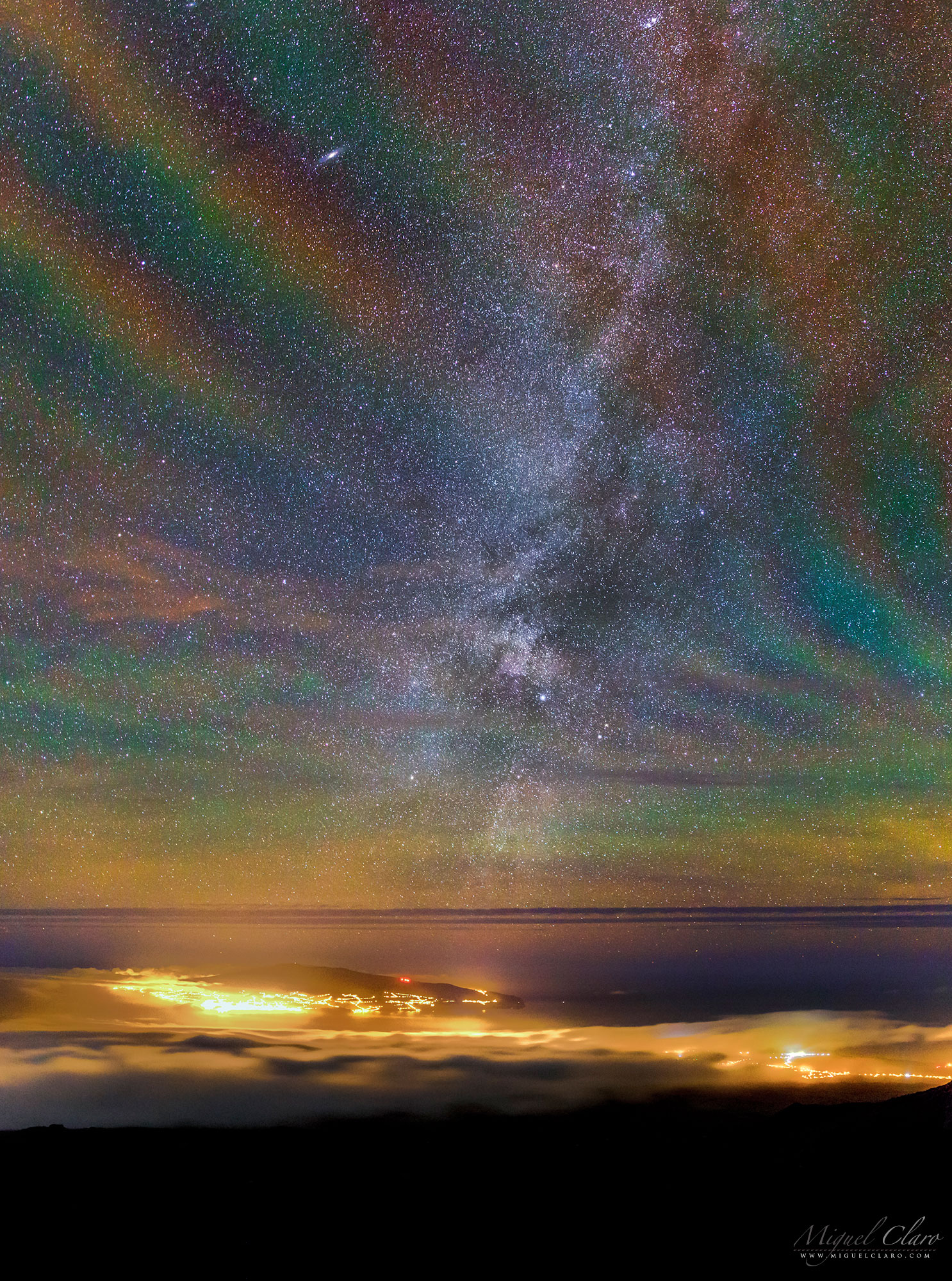
Why would the sky glow like a giant repeating rainbow? Airglow. Now, air glows all of the time, but it is usually hard to see. A disturbance however -- like an approaching storm -- may cause noticeable rippling in the Earth's atmosphere. These gravity waves are oscillations in air analogous to those created when a rock is thrown in calm water. The long-duration exposure nearly along the vertical walls of airglow likely made the undulating structure particularly visible. OK, but where do the colors originate? The deep red glow likely originates from OH molecules about 87 kilometers high, excited by ultraviolet light from the Sun. The orange and green airglow is likely caused by sodium and oxygen atoms slightly higher up. The featured image was captured during a climb up Mount Pico in the Azores of Portugal. Ground lights originate from the island of Faial in the Atlantic Ocean. A spectacular sky is visible through this banded airglow, with the central band of our Milky Way Galaxy running up the image center, and M31, the Andromeda Galaxy, visible near the top left. APOD Turns 30!: Free Public Lecture in Anchorage on June 11
Crédito: NASA, CGRO SSC ¿Por qué el cielo brillaría como un arcoíris gigante y repetitivo? Resplandor atmosférico. Ahora bien, el aire siempre brilla, pero normalmente es difícil de ver. Sin embargo, una perturbación, como una tormenta en aproximación, puede causar ondulaciones visibles en la atmósfera terrestre. Estas ondas gravitacionales son oscilaciones en el aire análogas a las que se crean cuando se tira una piedra en agua tranquila. La exposición de larga duración casi paralela a las paredes verticales del resplandor atmosférico probablemente hizo que la estructura ondulante fuera particularmente visible. Bien, ¿de dónde provienen los colores? El resplandor rojizo intenso probablemente proviene de moléculas de OH a unos 87 kilómetros de altura, excitadas por la luz ultravioleta del Sol. El resplandor anaranjado y verde probablemente es causado por átomos de sodio y oxígeno ligeramente más altos. La imagen mostrada fue capturada durante una ascensión al Monte Pico en las Azores de Portugal. Las luces del suelo provienen de la isla de Faial en el Océano Atlántico. Un cielo espectacular es visible a través de este resplandor atmosférico en bandas, con la banda central de nuestra Vía Láctea ascendiendo por el centro de la imagen, y M31, la Galaxia de Andrómeda, visible cerca de la parte superior izquierda.