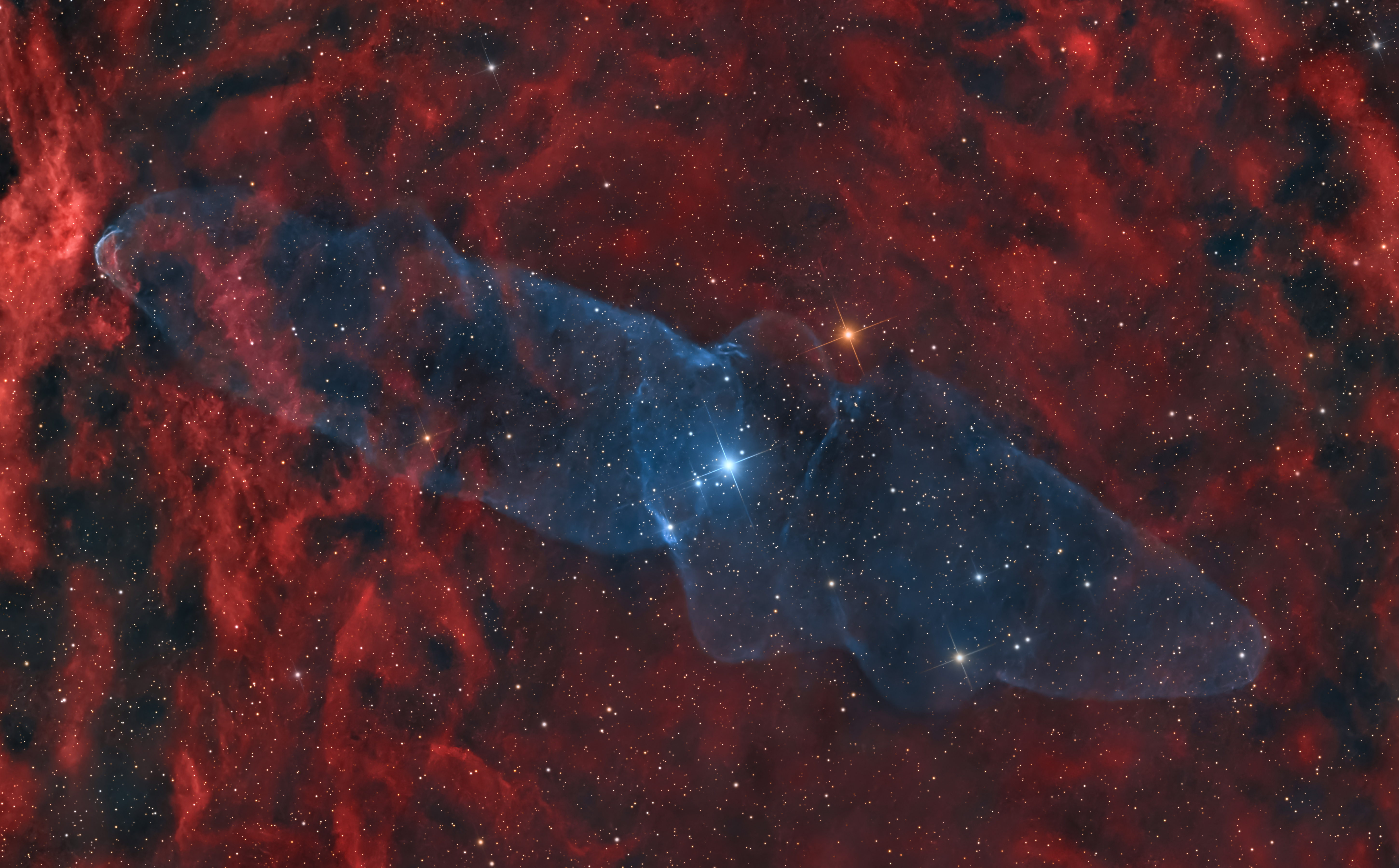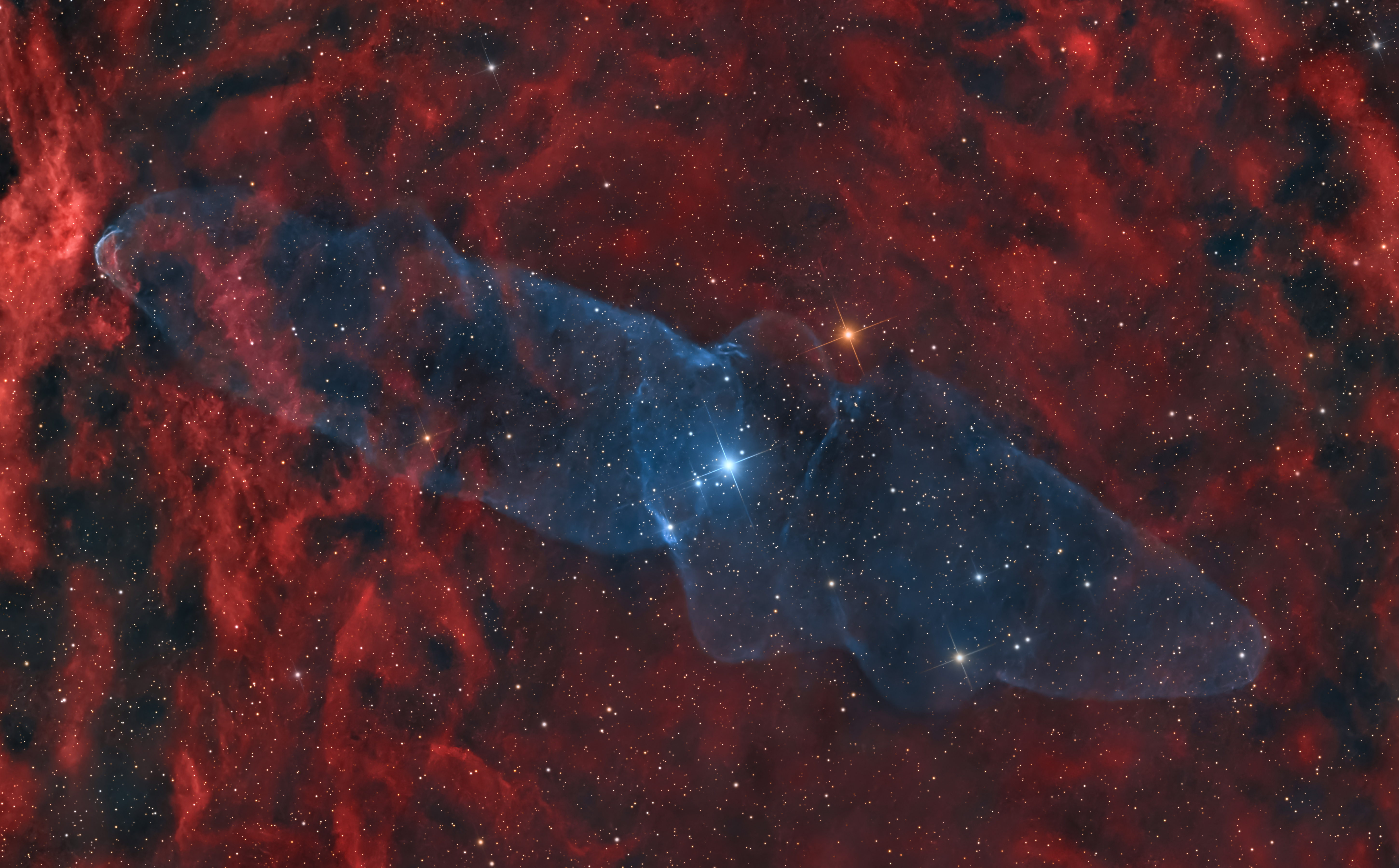
Difficult to capture, this mysterious, squid-shaped interstellar cloud spans nearly three full moons in planet Earth's sky. Discovered in 2011 by French astro-imager Nicolas Outters, the Squid Nebula's bipolar shape is distinguished here by the telltale blue emission from doubly ionized oxygen atoms. Though apparently surrounded by the reddish hydrogen emission region Sh2-129, the true distance and nature of the Squid Nebula have been difficult to determine. Still, one investigation suggests Ou4 really does lie within Sh2-129 some 2,300 light-years away. Consistent with that scenario, the cosmic squid would represent a spectacular outflow of material driven by a triple system of hot, massive stars, cataloged as HR8119, seen near the center of the nebula. If so, this truly giant squid nebula would physically be over 50 light-years across.
Difícil de capturar, esta misteriosa nube interestelar en forma de pulpo abarca casi tres veces el tamaño de la Luna llena en el cielo terrestre. Descubierta en 2011 por el astrofotógrafo francés Nicolas Outters, la forma bipolar de la Nebulosa Pulpo se distingue aquí por la emisión azul característica de átomos de oxígeno doblemente ionizados. Aunque aparentemente rodeada por la región de emisión rojiza de hidrógeno Sh2-129, la verdadera distancia y naturaleza de la Nebulosa Pulpo han sido difíciles de determinar. Sin embargo, un estudio sugiere que Ou4 realmente se encuentra dentro de Sh2-129, a unos 2300 años luz de distancia. Consistente con este escenario, el pulpo cósmico representaría un impresionante flujo de material impulsado por un sistema triple de estrellas calientes y masivas, catalogado como HR8119, visible cerca del centro de la nebulosa. Si es así, esta verdadera nebulosa pulpo gigante tendría físicamente más de 50 años luz de diámetro.