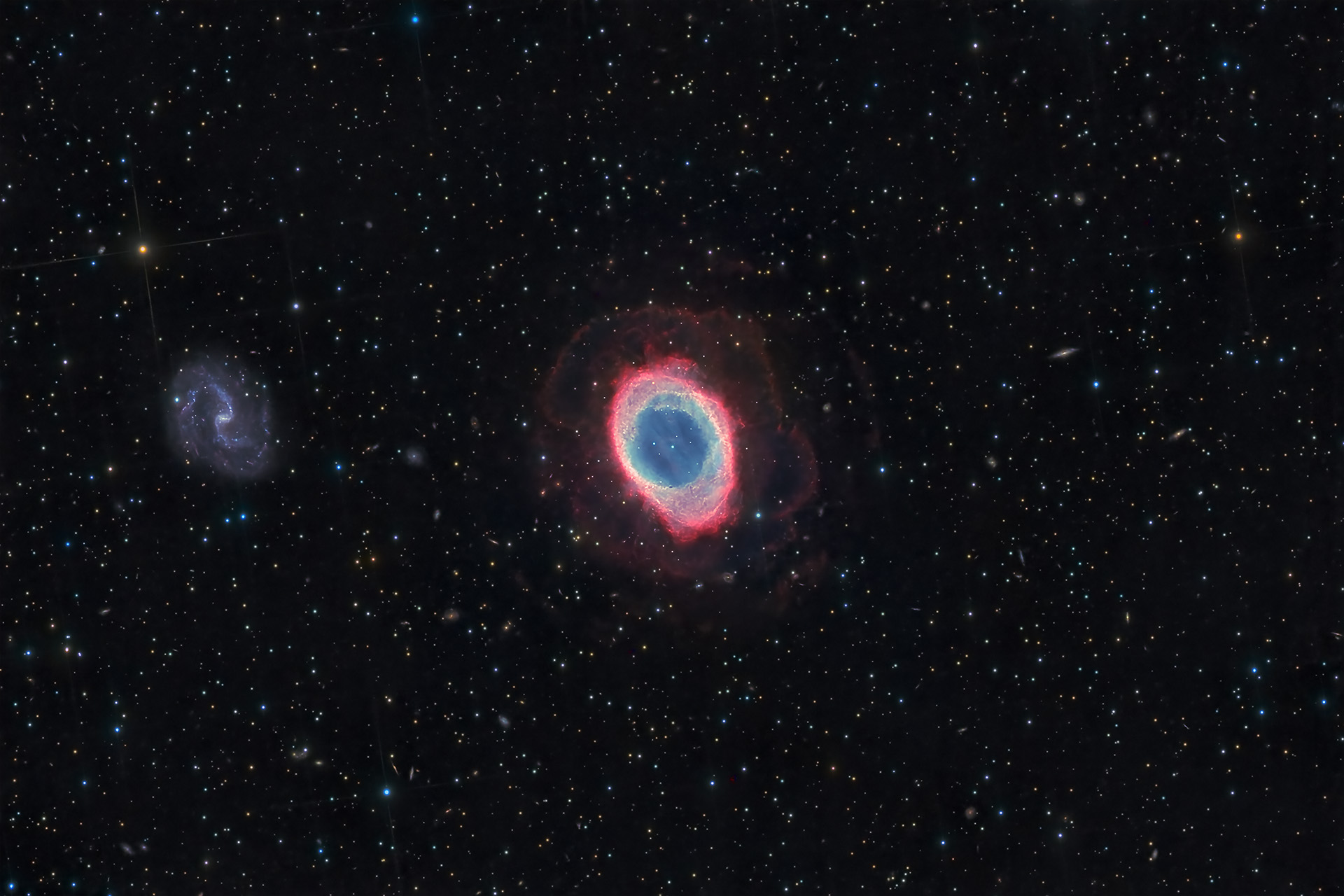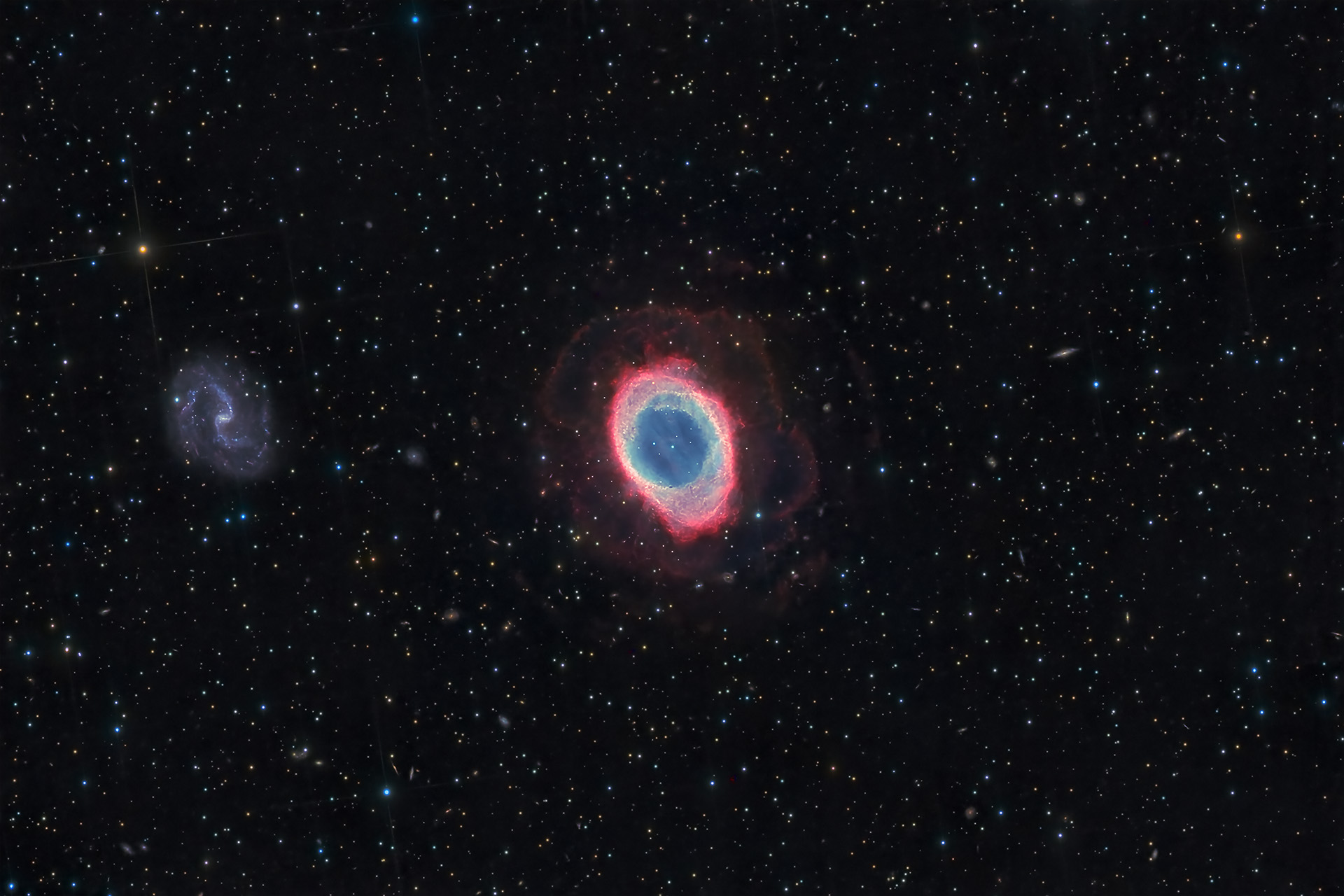
This colorful telescopic view towards the musical northern constellation Lyra reveals the faint outer halos and brighter central ring-shaped region of M57, popularly known as the Ring Nebula. To modern astronomers M57 is a well-known planetary nebula. With a central ring about one light-year across, M57 is definitely not a planet though, but the gaseous shroud of one of the Milky Way's dying sun-like stars. Roughly the same apparent size as M57, the fainter and more often overlooked barred spiral galaxy at the left is IC 1296. In fact, over 100 years ago IC 1296 would have been known as a spiral nebula. By chance the pair are in the same field of view, and while they appear to have similar sizes they are actually very far apart. At a distance of a mere 2,000 light-years M57 is well within our own Milky Way galaxy. Extragalactic IC 1296 (aka PGC62532) is more like 200,000,000 light-years distant. That's about 100,000 times farther away than M57 but since they appear roughly similar in size, former spiral nebula IC 1296 must also be about 100,000 times larger than planetary nebula M57. Look closely at the sharp 21st century astroimage to spot even more distant background galaxies scattered through the frame.
Esta colorida imagen obtenida con telescopio hacia la constelación norteña musical Lyra revela los halos externos tenues y la región central más brillante en forma de anillo de M57, popularmente conocida como la Nebulosa Anular. Para los astrónomos modernos, M57 es una nebulosa planetaria bien conocida. Con un anillo central de aproximadamente un año luz de diámetro, M57 definitivamente no es un planeta, sino la envoltura gaseosa de una estrella similar al Sol en la Vía Láctea que está muriendo. Aproximadamente del mismo tamaño aparente que M57, la galaxia en espiral con barra más tenue y a menudo pasada por alto a la izquierda es IC 1296. De hecho, hace más de 100 años, IC 1296 habría sido conocida como una nebulosa espiral. Por casualidad, el par está en el mismo campo de visión, y aunque parecen tener tamaños similares, en realidad están muy separados. A una distancia de solo 2000 años luz, M57 está claramente dentro de nuestra propia galaxia, la Vía Láctea. La galaxia extragaláctica IC 1296 (también conocida como PGC62532) está a unos 200 millones de años luz de distancia. Eso es aproximadamente 100 000 veces más lejos que M57, pero como aparecen aproximadamente del mismo tamaño, la antigua nebulosa espiral IC 1296 debe ser también aproximadamente 100 000 veces más grande que la nebulosa planetaria M57. Mire de cerca en la imagen astronómica nítida del siglo XXI para detectar incluso más galaxias de fondo distantes dispersas por el marco.