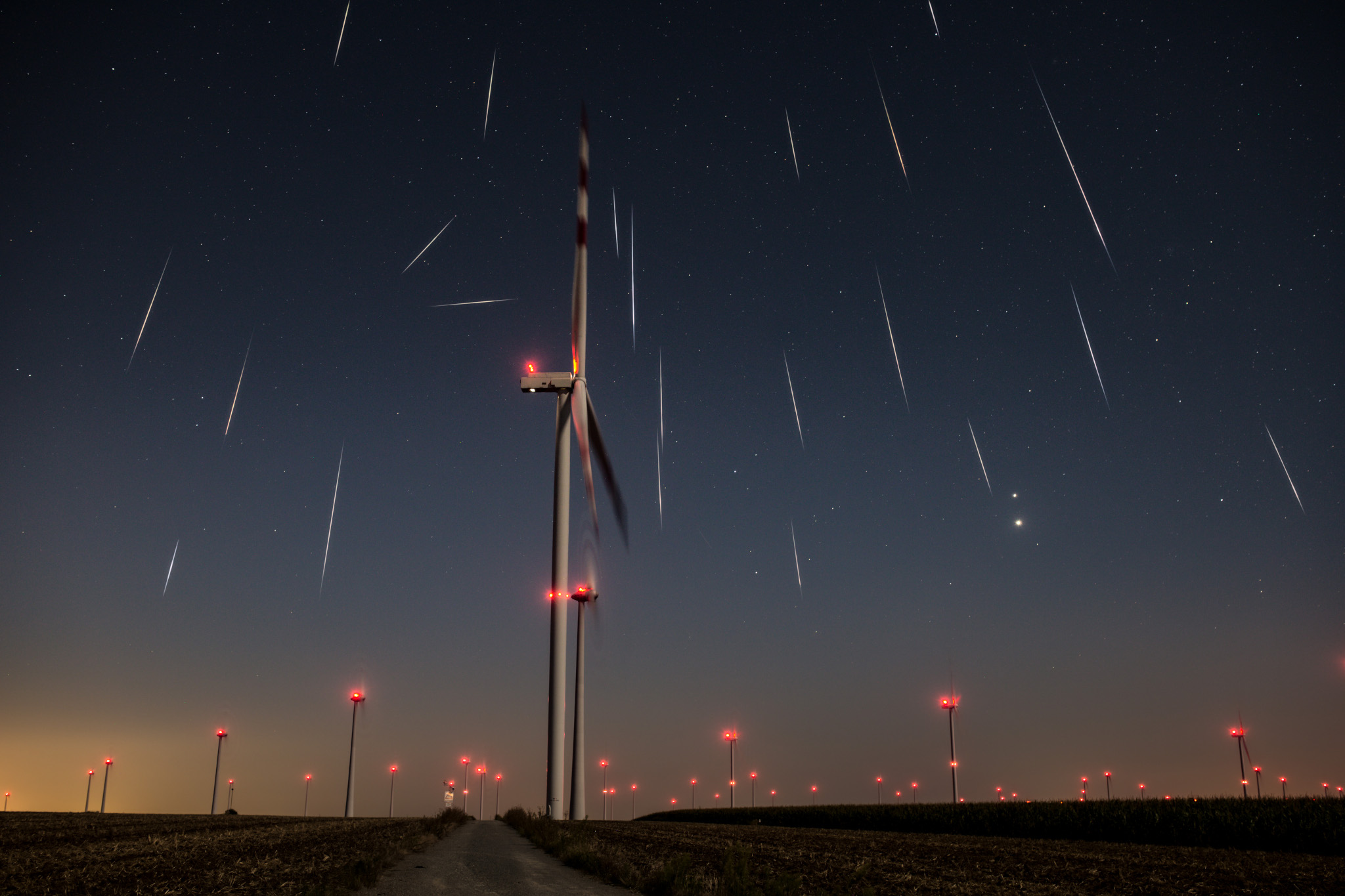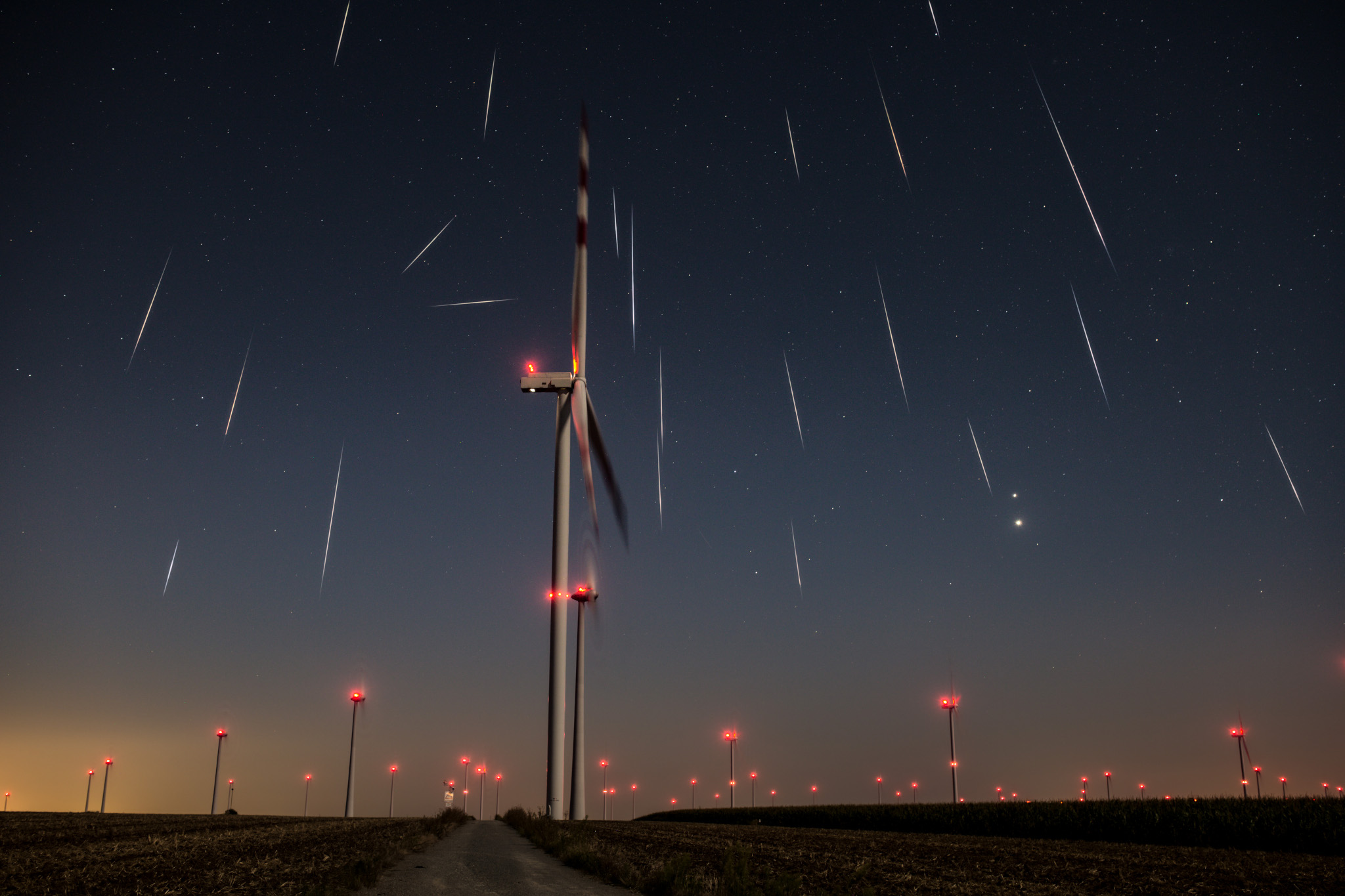
In this predawn skyscape recorded during the early morning hours of August 13, mostly Perseid meteors are raining down on planet Earth. You can easily identify the Perseid meteor streaks. They're the ones with trails that seem to converge on the annual meteor shower's radiant, a spot in the heroic constellation Perseus, located off the top of the frame. That's the direction in Earth's sky that looks along the orbit of this meteor shower's parent, periodic Comet Swift-Tuttle. Of course the scene is a composite, a combination of about 500 digital exposures to capture meteors registered with a single base frame exposure. But all exposures were taken during a period of around 2.5 hours from a wind farm near Mönchhof, Burgenland, Austria. Red lights on the individual wind turbine towers dot the foreground. In their spectacular close conjunction, bright planets Jupiter and Venus are poised above the eastern horizon.
En esta escena del cielo capturada durante las primeras horas de la mañana del 13 de agosto, mayormente meteoros Perseidas caen sobre la Tierra. Puedes identificar fácilmente las trazas de los meteoros Perseidas. Son aquellas cuyas colas parecen converger hacia el radiante de la lluvia de meteoros anual, un punto ubicado en la constelación heroica de Perseo, fuera del borde superior del marco. Esa es la dirección en el cielo terrestre que apunta a lo largo de la órbita del cometa Swift-Tuttle, progenitor de esta lluvia de meteoros. Por supuesto, la escena es una composición, una combinación de aproximadamente 500 exposiciones digitales para capturar los meteoros, superpuestas sobre una única imagen base. Todas las exposiciones fueron tomadas durante un período de alrededor de 2.5 horas desde un parque eólico cerca de Mönchhof, en Burgenland, Austria. Las luces rojas en las torres individuales de los molinos de viento decoran el primer plano. En su espectacular conjunción cercana, los brillantes planetas Júpiter y Venus se alzan sobre el horizonte oriental.