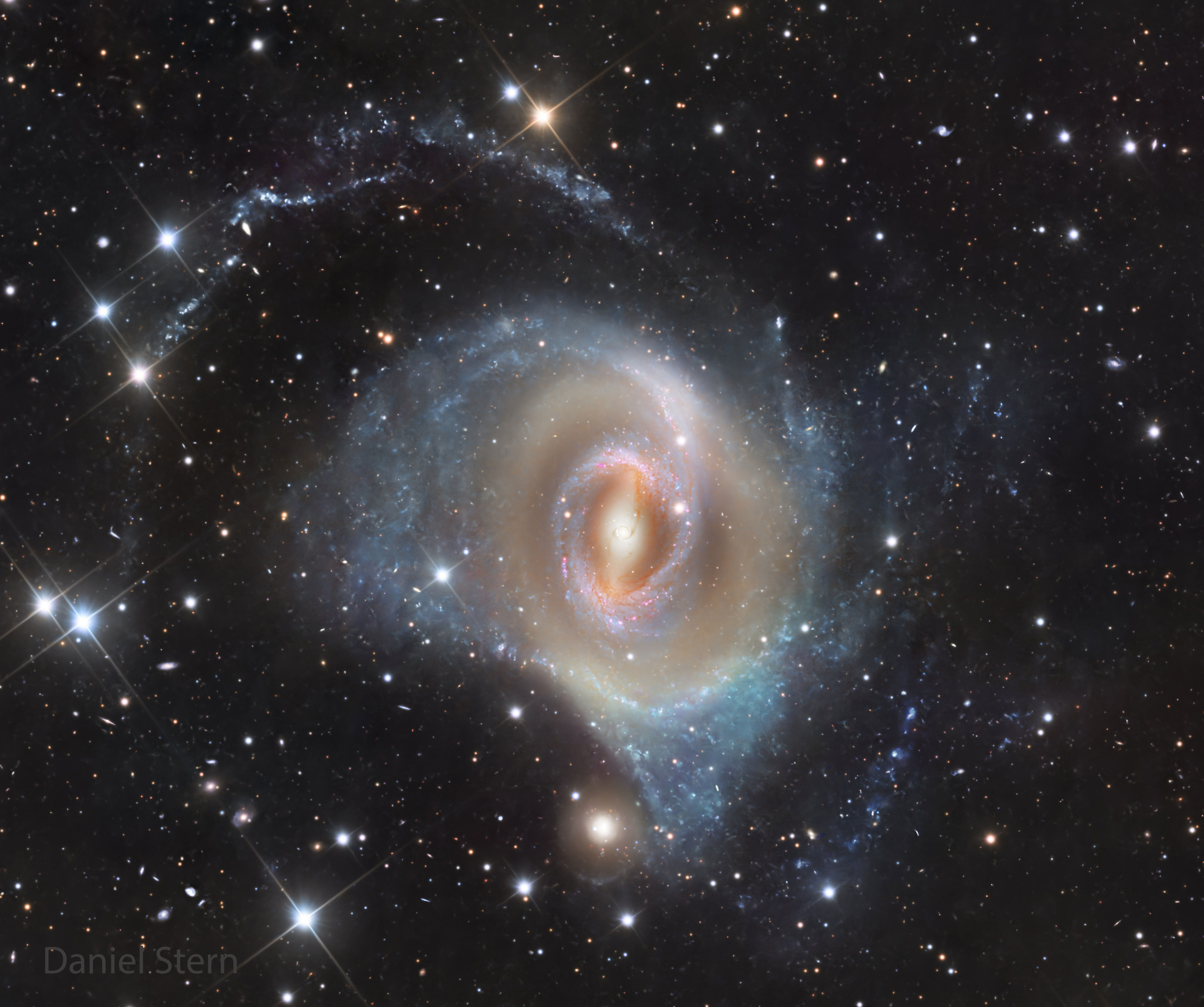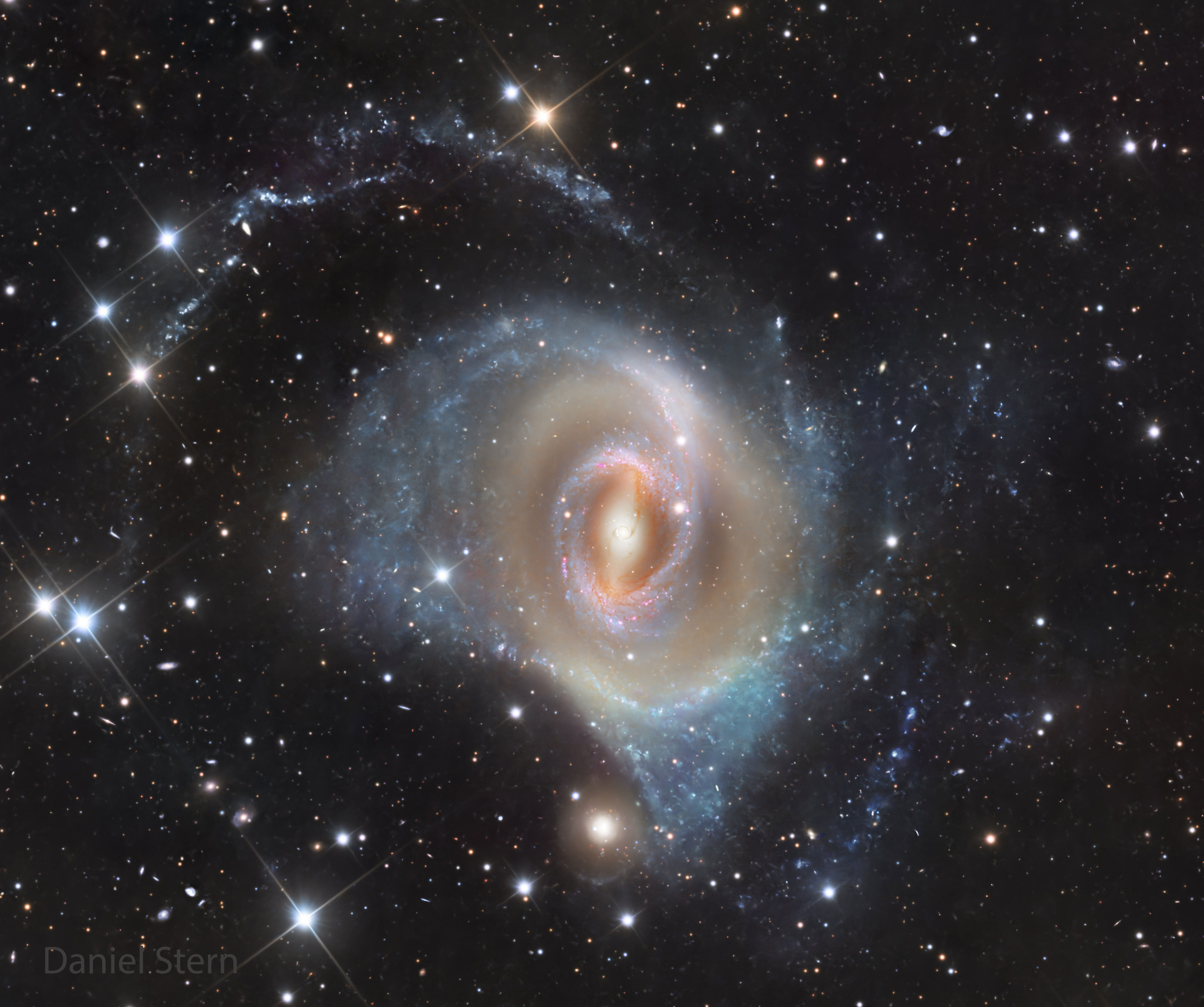
Most galaxies don't have any rings -- why does this galaxy have three? To begin, a ring that's near NGC 1512's center -- and so hard to see here -- is the nuclear ring which glows brightly with recently formed stars. Next out is a ring of stars and dust appearing both red and blue, called, counter-intuitively, the inner ring. This inner ring connects ends of a diffuse central bar of stars that runs horizontally across the galaxy. Farthest out in this wide field image is a ragged structure that might be considered an outer ring. This outer ring appears spiral-like and is dotted with clusters of bright blue stars. All these ring structures are thought to be affected by NGC 1512's own gravitational asymmetries in a drawn-out process called secular evolution. The featured image was captured last month from a telescope at Deep Sky Chile in Chile.
La mayoría de las galaxias no tienen anillos; entonces, ¿por qué esta galaxia tiene tres? Para comenzar, un anillo cercano al centro de NGC 1512 —y por ello difícil de ver aquí— es el anillo nuclear, que brilla intensamente gracias a estrellas formadas recientemente. Más hacia afuera se encuentra un anillo de estrellas y polvo que presenta tonalidades tanto rojas como azules, denominado, de manera poco intuitiva, el anillo interior. Este anillo interior conecta los extremos de una difusa barra central de estrellas que atraviesa la galaxia horizontalmente. La estructura más alejada visible en esta imagen de campo amplio es una formación irregular que podría considerarse un anillo exterior. Este anillo exterior presenta una apariencia espiral y está salpicado de cúmulos de brillantes estrellas azules. Se cree que todas estas estructuras anulares están influenciadas por las asimetrías gravitacionales de la propia NGC 1512, a través de un prolongado proceso denominado evolución secular. La imagen destacada fue capturada el mes pasado desde un telescopio en Deep Sky Chile, en Chile.