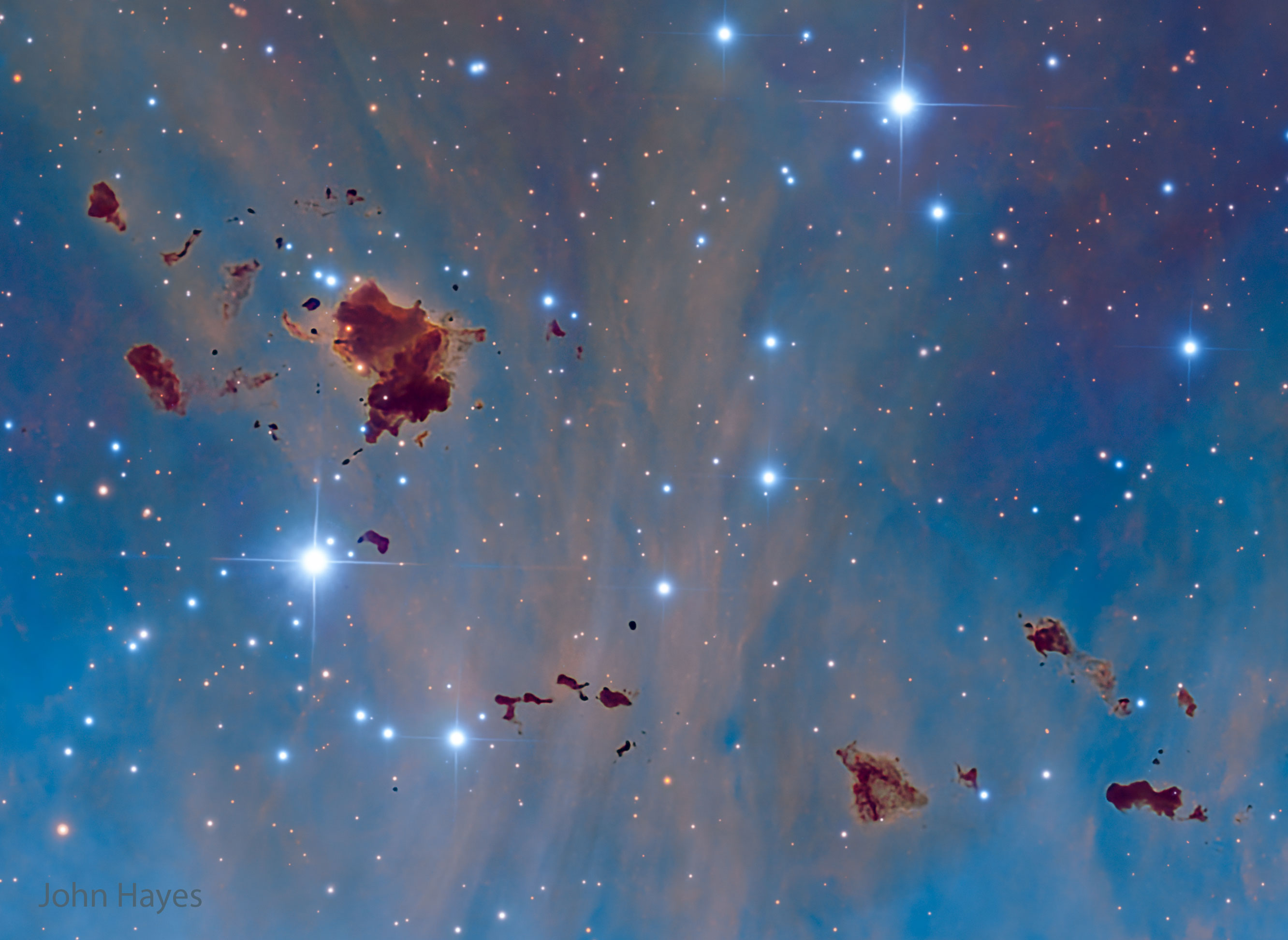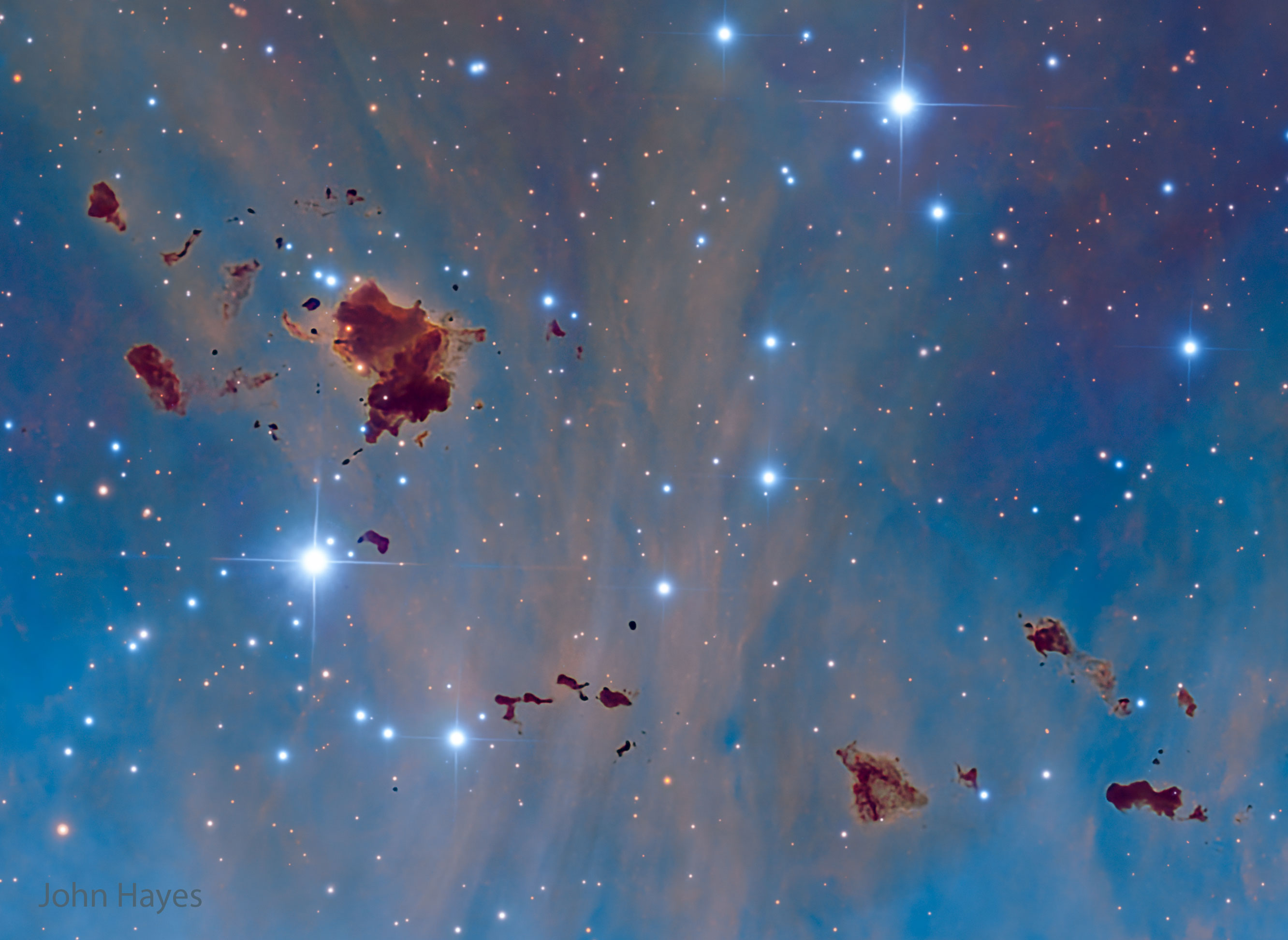
What are these strange space globs? Situated in rich star fields and glowing hydrogen gas, these opaque clouds of interstellar dust and gas are so large they might be able to form stars. Their home is known as IC 2944, a bright stellar nursery located about 7,600 light years away toward the constellation of the Centaur (Centaurus). The largest of these dark globules, first spotted by A. D. Thackeray in 1950 using a telescope in South Africa, is likely two separate but overlapping clouds, each more than one light-year wide. Along with other data, the featured Hubble palette image from the El Sauce Observatory in Chile, indicates that Thackeray's globules are fractured and churning as a result of intense ultraviolet radiation from young, hot stars already energizing and heating the bright emission nebula. These and similar dark globules known to be associated with other star forming regions may ultimately be dissipated by their hostile environment -- like cosmic lumps of butter in a hot frying pan. Interstellar Jigsaw: Astronomy Puzzle of the Day
¿Qué son estos extraños glóbulos espaciales? Situadas en ricos campos estelares y rodeadas de gas hidrógeno luminoso, estas nubes opacas de polvo y gas interestelar son tan grandes que podrían ser capaces de formar estrellas. Su hogar es IC 2944, un brillante vivero estelar ubicado a unos 7.600 años luz de distancia, en dirección a la constelación del Centauro (Centaurus). El mayor de estos glóbulos oscuros, detectado por primera vez por A. D. Thackeray en 1950 mediante un telescopio en Sudáfrica, consiste probablemente en dos nubes separadas aunque superpuestas, cada una de más de un año luz de diámetro. La imagen en paleta Hubble aquí presentada, obtenida desde el Observatorio El Sauce en Chile, junto con otros datos, indica que los glóbulos de Thackeray se encuentran fracturados y en turbulencia como consecuencia de la intensa radiación ultravioleta proveniente de estrellas jóvenes y calientes que ya están energizando y calentando la brillante nebulosa de emisión. Estos y otros glóbulos oscuros similares asociados a otras regiones de formación estelar podrían ser disipados en última instancia por su hostil entorno, como si fueran terrones de mantequilla cósmica en una sartén caliente.