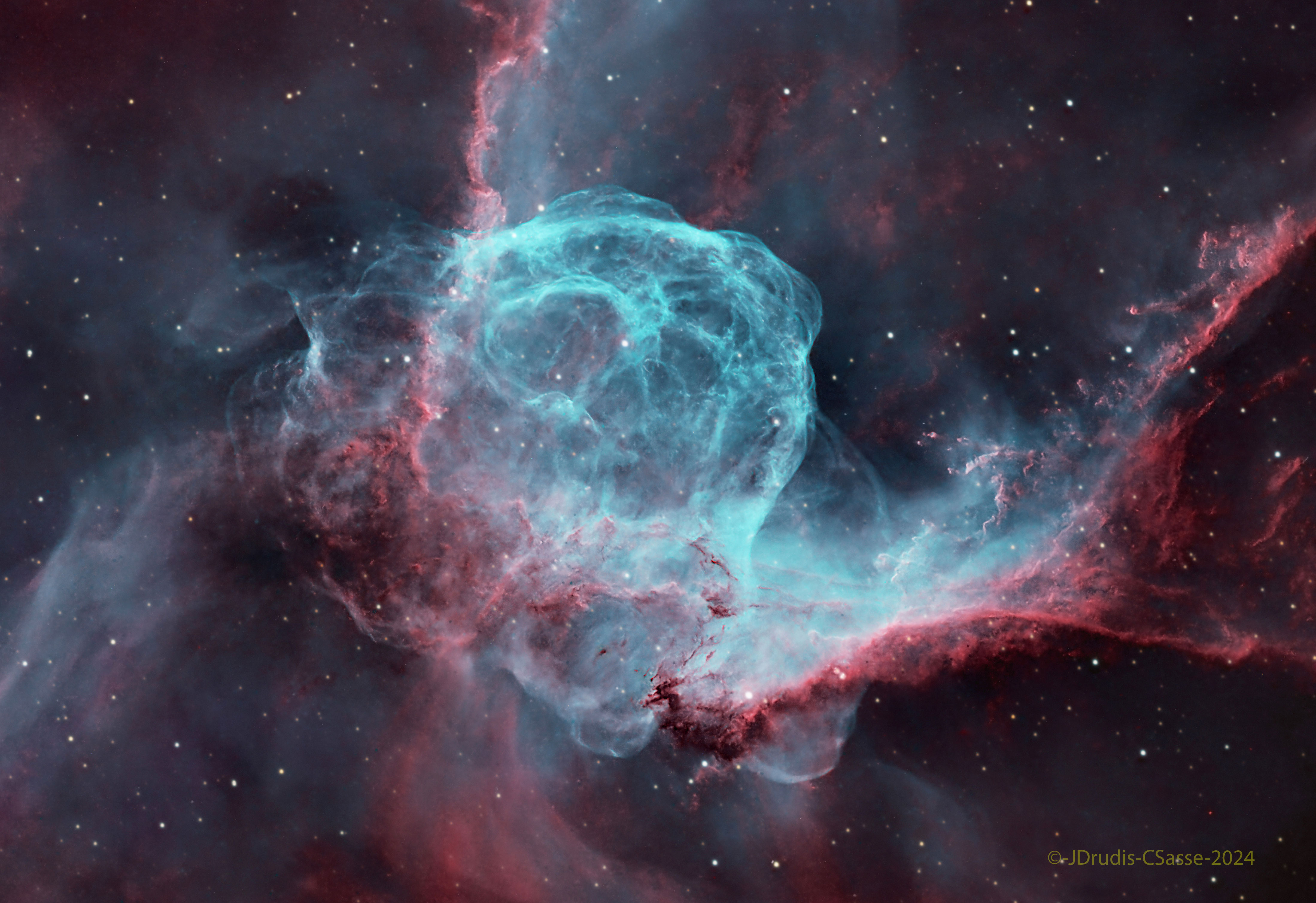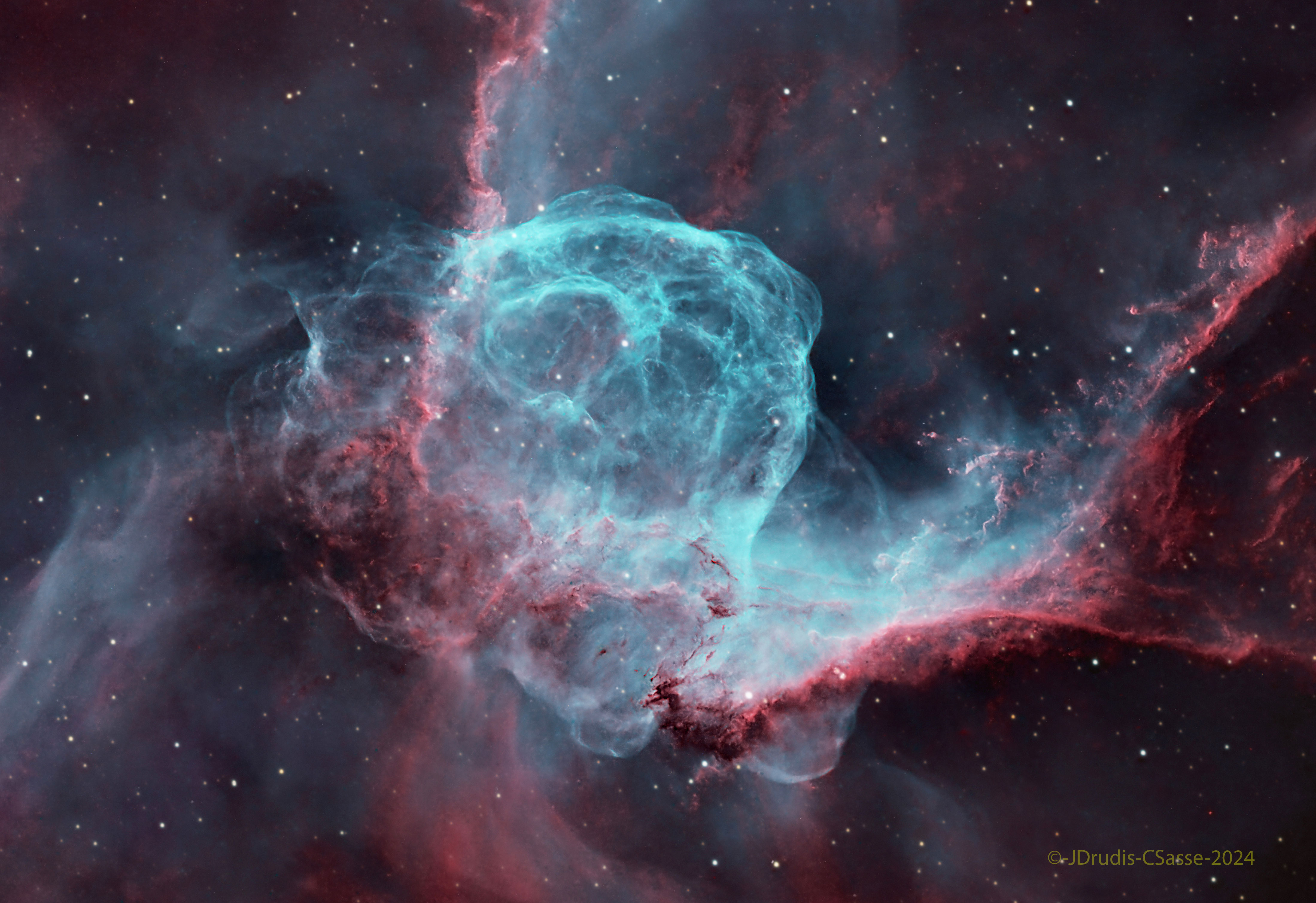
Thor not only has his own day (Thursday), but a helmet in the heavens. Popularly called Thor's Helmet, NGC 2359 is a hat-shaped cosmic cloud with wing-like appendages. Heroically sized even for a Norse god, Thor's Helmet is about 30 light-years across. In fact, the cosmic head-covering is more like an interstellar bubble, blown by a fast wind from the bright, massive star near the bubble's center. Known as a Wolf-Rayet star, the central star is an extremely hot giant thought to be in a brief, pre-supernova stage of evolution. NGC 2359 is located about 15,000 light-years away toward the constellation of the Great Overdog. This sharp image is a combination of deep images taken in light emitted by hydrogen (red) and oxygen (blue). The star in the center of Thor's Helmet is expected to explode in a spectacular supernova sometime within the next few thousand years. Sky Surprise: What picture did APOD feature on your birthday? (after 1995)
Thor no solo tiene su propio día (el jueves), sino también un casco en los cielos. Popularmente llamada el Casco de Thor, NGC 2359 es una nube cósmica con forma de sombrero y apéndices similares a alas. De dimensiones heroicas incluso para un dios nórdico, el Casco de Thor mide unos 30 años-luz de diámetro. En realidad, esta cubierta cósmica se asemeja más a una burbuja interestelar, soplada por el viento veloz proveniente de la brillante y masiva estrella ubicada cerca del centro de la burbuja. Conocida como una estrella de Wolf-Rayet, la estrella central es un gigante extremadamente caliente que se cree se encuentra en una breve etapa previa a una supernova en su evolución. NGC 2359 se localiza a unos 15.000 años-luz de distancia, en dirección a la constelación del Can Mayor. Esta nítida imagen es una combinación de imágenes profundas tomadas en la luz emitida por hidrógeno (rojo) y oxígeno (azul). Se espera que la estrella en el centro del Casco de Thor explote en una espectacular supernova en algún momento dentro de los próximos miles de años.