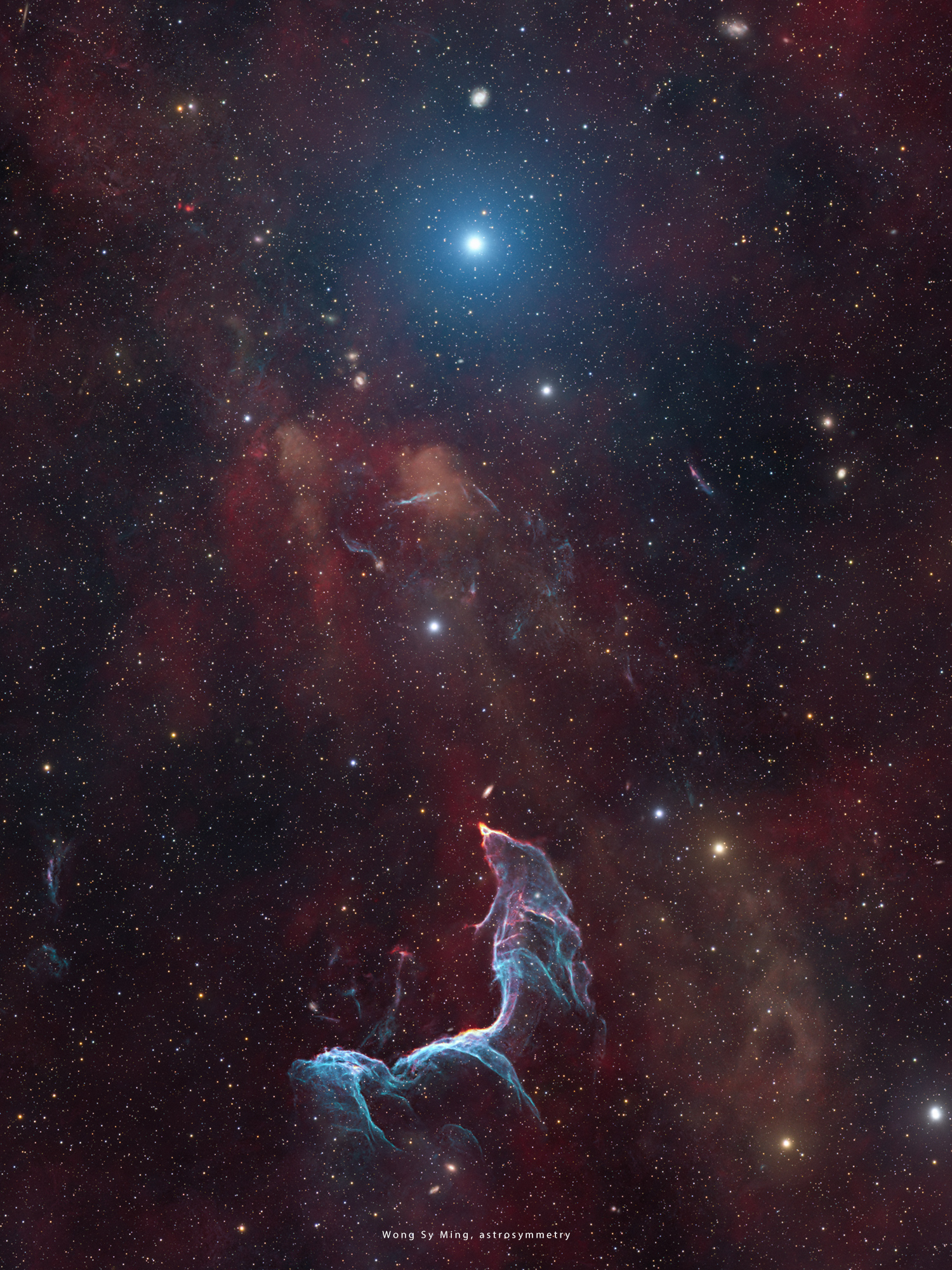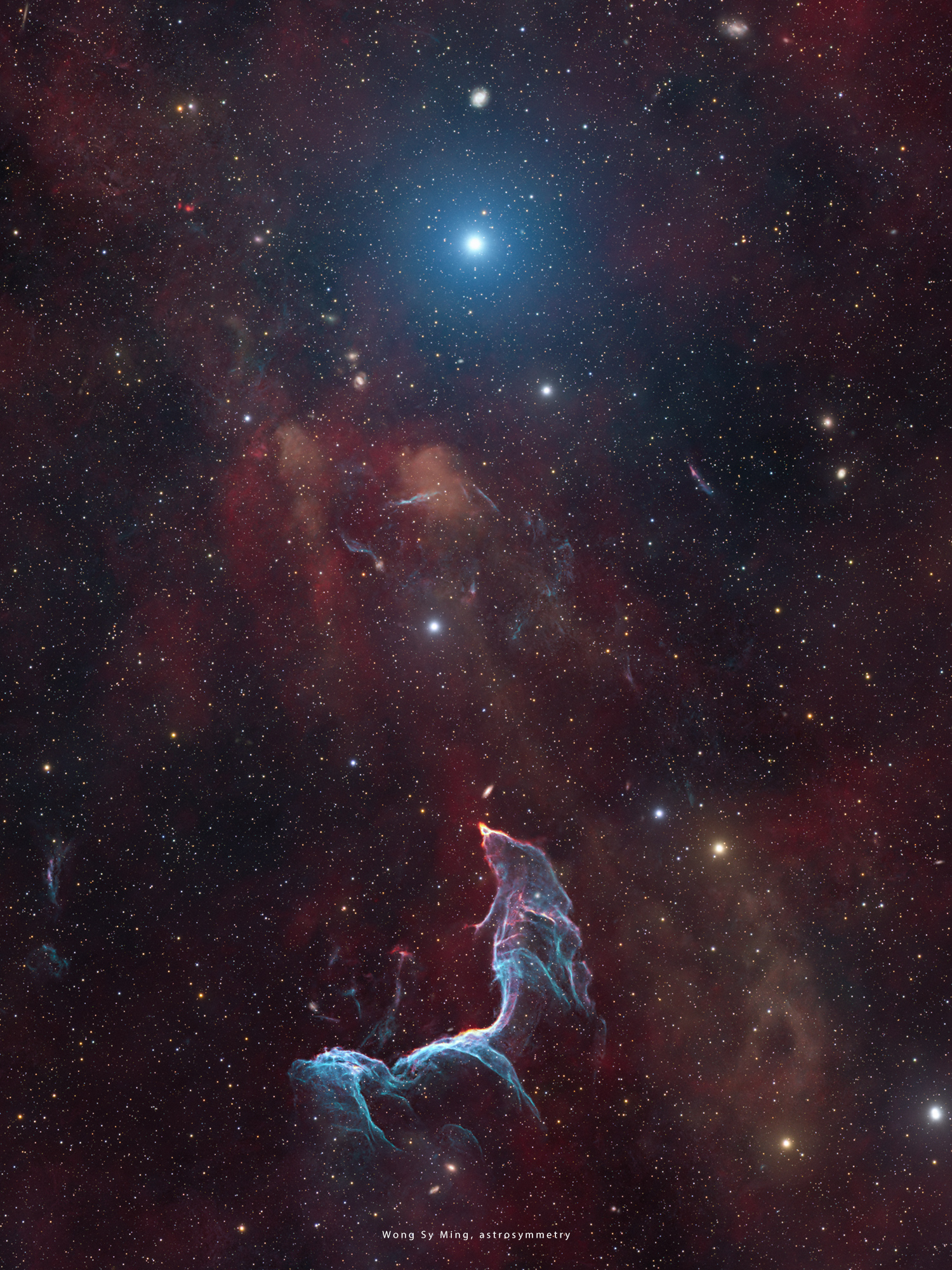
Could the Little Mermaid turn into stardust instead of seafoam? It would seem so in this beautiful nebula. The featured image shows the Mermaid Nebula, also known as the Betta Fish Nebula, which is part of the G296.5+10.0 Supernova Remnant. The blue color visible here originates from doubly ionized oxygen (OIII), while the deep red is emitted by hydrogen gas. Estimated to be located a few thousand light-years away and about 10,000 years old, this nebula was formed when a massive star exploded as a supernova. It left behind a peculiar pulsar, a young radio-quiet neutron star that spins around about twice every second. The bright stars shown in the image are unassociated with the nebula. The pulsar can be detected in the X-rays but it does not have a confirmed detection in the optical (visible light) so far. As a result, the pulsar itself is not visible in this image.
¿Podría la Sirenita convertirse en polvo de estrellas en lugar de espuma de mar? Así lo sugiere esta hermosa nebulosa. La imagen presenta la Nebulosa de la Sirena, también conocida como la Nebulosa del Pez Betta, que forma parte del remanente de supernova G296.5+10.0. El color azul visible aquí se origina en el oxígeno doblemente ionizado (OIII), mientras que el rojo intenso es emitido por el gas de hidrógeno. Se estima que esta nebulosa se encuentra a varios miles de años luz de distancia y tiene aproximadamente 10.000 años de antigüedad; se formó cuando una estrella masiva explotó como supernova. Dejó atrás un peculiar púlsar: una joven estrella de neutrones radiotranquila que gira aproximadamente dos veces por segundo. Las estrellas brillantes que aparecen en la imagen no están asociadas con la nebulosa. El púlsar puede detectarse en rayos X, pero hasta ahora no cuenta con una detección confirmada en el óptico (luz visible). Por ello, el púlsar en sí no es visible en esta imagen.