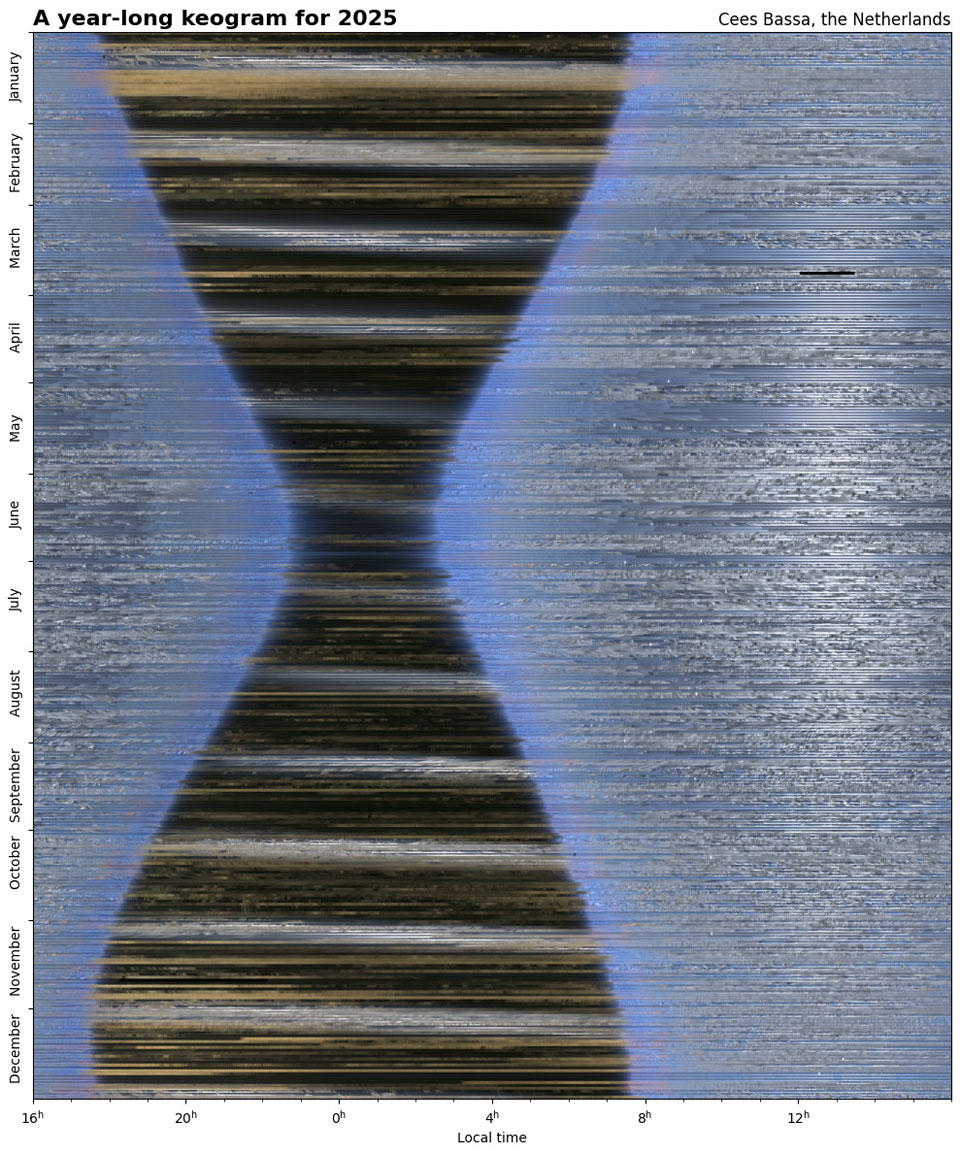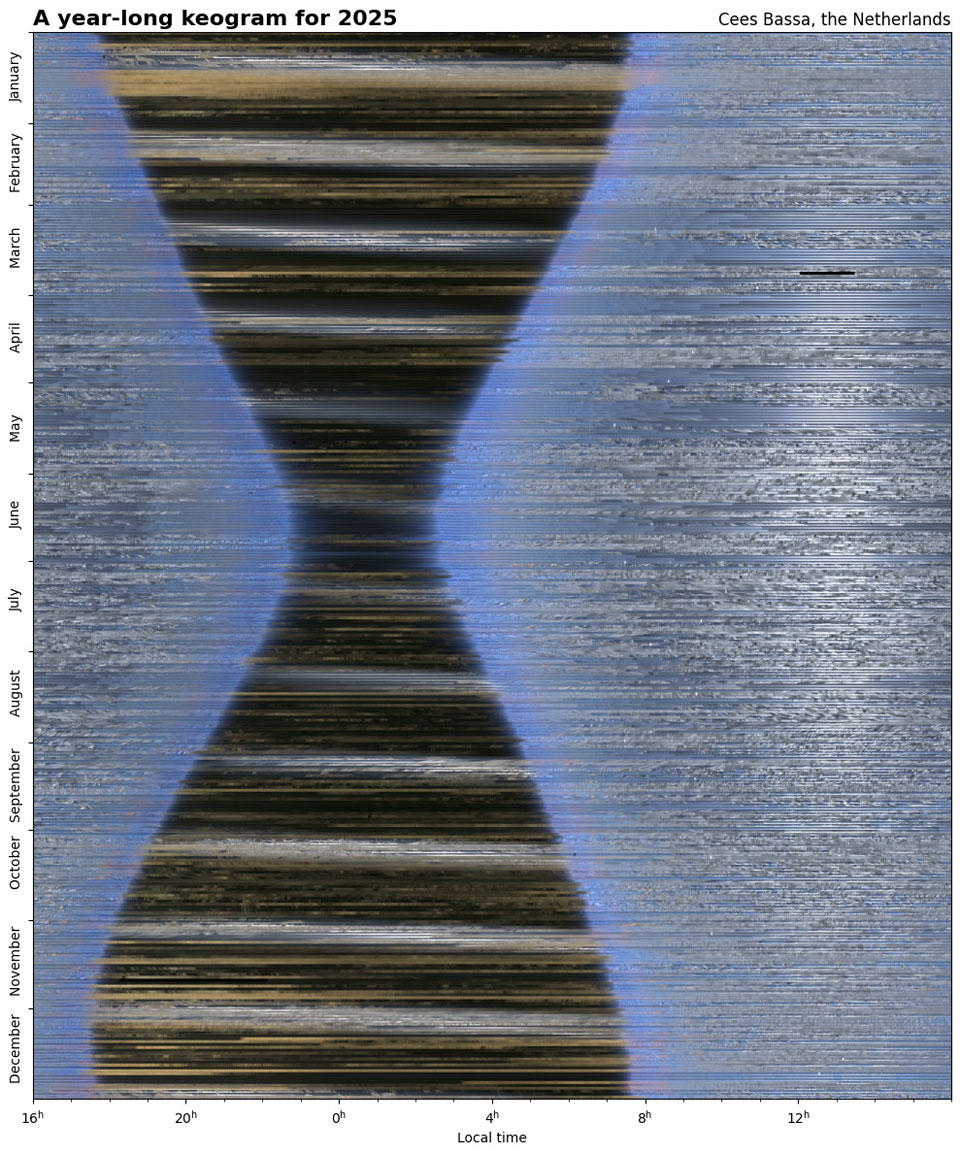
What if you could see the entire sky -- all at once -- for an entire year? That, very nearly, is what is pictured here. Every 15 seconds during 2025, an all-sky camera took an image of the sky over the Netherlands. Central columns from these images were then aligned and combined to create the featured keogram, with January at the top, December at the bottom, and the middle of the night running vertically just left of center. What do we see? Most obviously, the daytime sky is mostly blue, while the nighttime sky is mostly black. The twelve light bands crossing the night sky are caused by the glow of the Moon. The thinnest part of the black hourglass shape occurs during the summer solstice, like today, when days are the longest, while the thickest part occurs at the winter solstice. Equinoxes can also be located in the keogram, for example the northern-spring equinox from one year ago is about three-quarters of the way up.
¿Qué ocurriría si pudieras ver todo el cielo —de una sola vez— durante un año entero? Eso es, prácticamente, lo que se muestra aquí. Cada 15 segundos a lo largo de 2025, una cámara de cielo completo capturó una imagen del cielo sobre los Países Bajos. Las columnas centrales de estas imágenes fueron luego alineadas y combinadas para crear el keograma que se presenta, con enero en la parte superior, diciembre en la inferior, y la medianoche discurriendo verticalmente justo a la izquierda del centro. ¿Qué podemos observar? De manera más evidente, el cielo diurno es predominantemente azul, mientras que el cielo nocturno es predominantemente negro. Las doce bandas luminosas que atraviesan el cielo nocturno están causadas por el resplandor de la Luna. La parte más estrecha de la forma de reloj de arena negro corresponde al solsticio de verano, como hoy, cuando los días son más largos, mientras que la parte más ancha corresponde al solsticio de invierno. Los equinoccios también pueden localizarse en el keograma; por ejemplo, el equinoccio de primavera boreal de hace un año se encuentra aproximadamente a tres cuartos de altura desde la parte inferior.