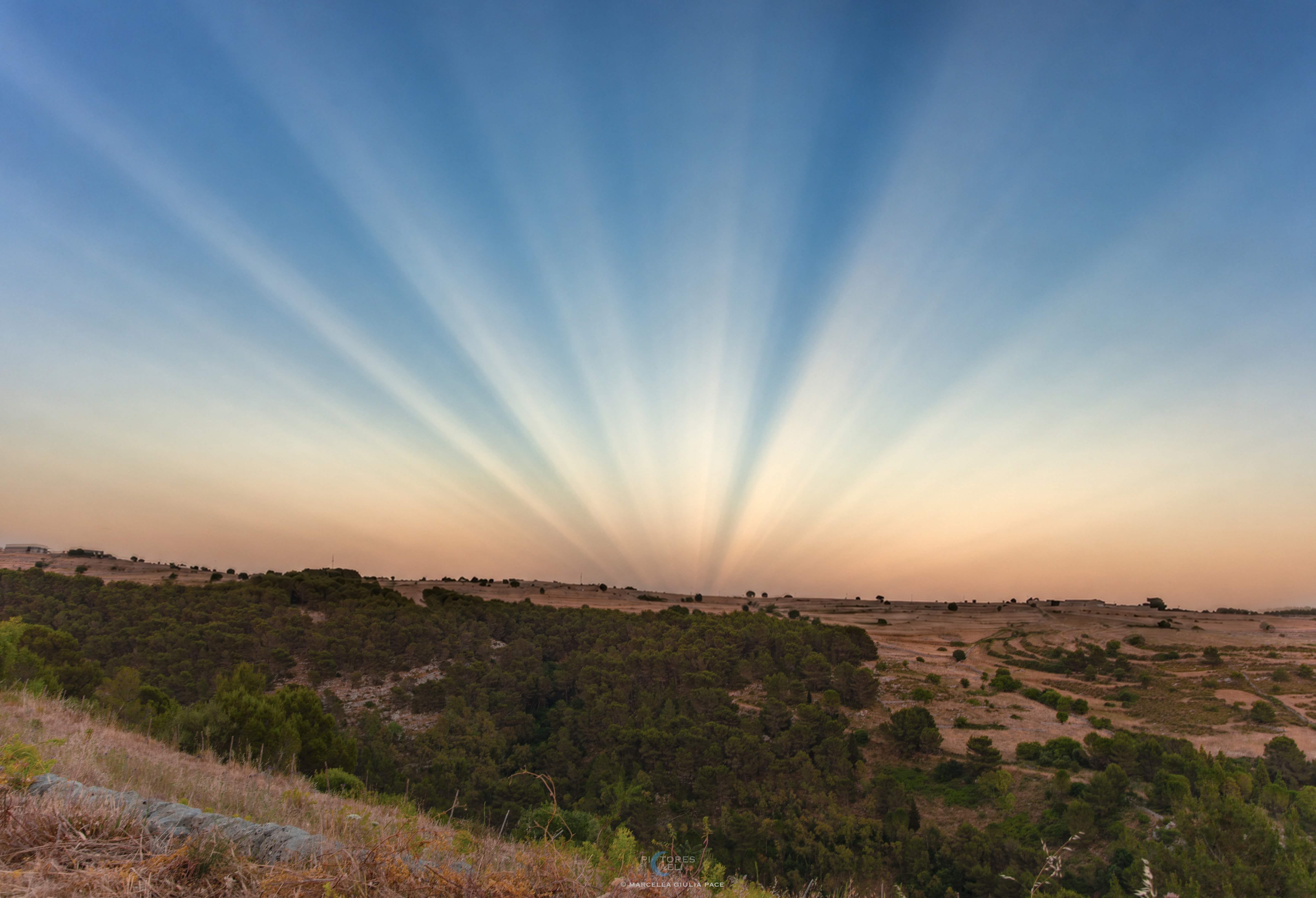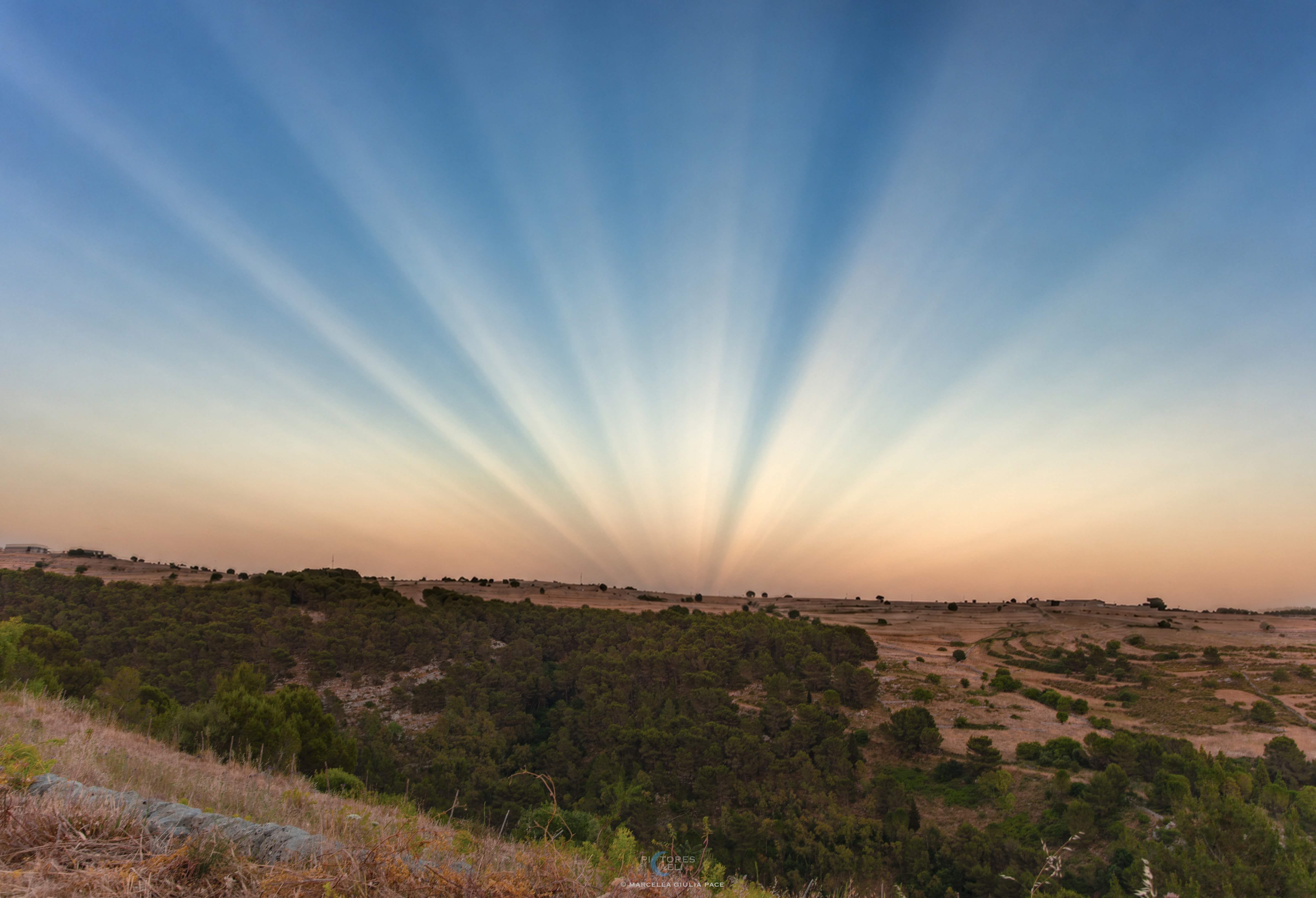
The Sun has just set... in the opposite side of the sky. Pictured here are anticrepuscular rays apparently converging in the east in this image of the limestone plateau in the heart of the Hyblaean Mountains of southeastern Sicily, in Italy. How were these anticrepuscular rays formed, if the Sun wasn't there? After the Sun set (in the west, as usual) its light still illuminated a cloud higher up in the sky. Partially blocked by the cloud, the sunlight produced patterns of light and shadow, crossing the sky in parallel lines. Perspective makes it look like they converge in the east, in the same way that train tracks appear to meet in the distance. This effect can also happen at sunrise, only the directions are exchanged. In rare cases, both crepuscular and anticrepuscular rays can be seen at the same time.
El Sol acaba de ponerse... en el lado opuesto del cielo. En esta imagen se aprecian rayos anticrepusculares que convergen aparentemente hacia el este, sobre la meseta calcárea en el corazón de los Montes Hiblcos del sureste de Sicilia, en Italia. ¿Cómo se formaron estos rayos anticrepusculares si el Sol no se encontraba en esa dirección? Tras la puesta de Sol (por el oeste, como es habitual), su luz seguía iluminando una nube a mayor altitud en el cielo. Parcialmente bloqueada por la nube, la luz solar generó patrones de luz y sombra que cruzaron el cielo en líneas paralelas. La perspectiva hace que parezcan converger hacia el este, del mismo modo que las vías del tren parecen unirse en la distancia. Este efecto también puede producirse al amanecer, solo que las direcciones se invierten. En casos excepcionales, es posible observar simultáneamente tanto rayos crepusculares como anticrepusculares.