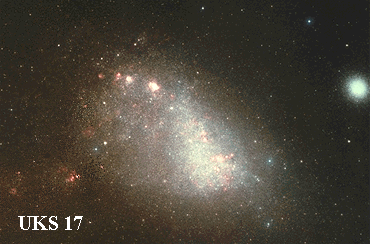
Almost unknown to casual observers in the northern hemisphere, the southern sky contains two diffuse wonders known as the Magellanic Clouds. The Magellanic Clouds are small irregular galaxies orbiting our own larger Milky Way spiral galaxy. The Small Magellanic Cloud (SMC), pictured here, is about 250,000 light years away and contains a preponderance of young, hot, blue stars indicating it has undergone a recent period of star formation. There is evidence that the SMC is actually two galaxies superposed to appear as one. The bright blob near the right hand edge of the frame is a globular cluster near the outskirts of the Milky Way.
Casi desconocidas para los observadores casuales del hemisferio norte, el cielo austral contiene dos maravillas difusas conocidas como las Nubes de Magallanes. Las Nubes de Magallanes son pequeñas galaxias irregulares que orbitan nuestra propia galaxia espiral más grande, la Vía Láctea. La Pequeña Nube de Magallanes (PMN), mostrada aquí, se encuentra a aproximadamente 250.000 años luz de distancia y contiene una preponderancia de estrellas jóvenes, calientes y azules que indican que ha experimentado un período reciente de formación estelar. Existe evidencia de que la PMN es en realidad dos galaxias superpuestas que aparecen como una sola. La mancha brillante cerca del borde derecho del encuadre es un cúmulo globular cerca de las afueras de la Vía Láctea.