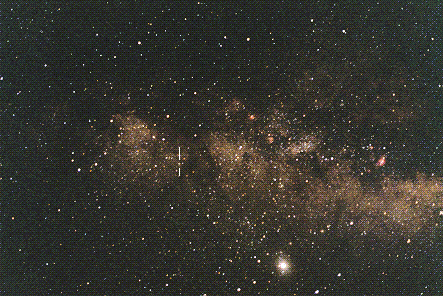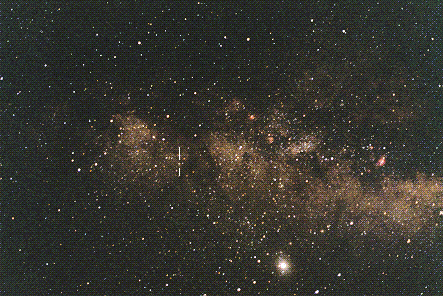
Shining brightly, the mighty Jupiter rules this gorgeous Kodacolor photo of the Milky Way near Sagittarius. Astronomer Bill Keel took the picture earlier this month (July 7) while standing near the summit of Hawaii's Mauna Kea contemplating the sky in the direction of the center of the Galaxy (right of picture center). In addition to the gas giant planet, which is well placed for evening viewing, the image contains an impressive sampler of celestial goodies. Many famous emission nebulae are visible as reddish patches - M16, the Eagle nebula, is just above and right of center, with the Horseshoe nebula, M17, just below it and farther to the right. Also, look for the Lagoon Nebula, M8, as the brightest red patch at the right of the picture with the Trifid Nebula, M20, just above it and to the left. The milky glow of distant unresolved stars in the plane of our Galaxy (thus the term Milky Way) runs through the image cut by dark, absorbing, interstellar dust clouds. The much anticipated comet Hale-Bopp is also clearly visible. Where's the comet? Click on the picture to view the comet's location flanked by superposed vertical lines. The comet was discovered while still beyond the orbit of Jupiter a year ago today independently by Alan Hale and Thomas Bopp. Astronomers monitoring Hale-Bopp's activity report that having now brightened to almost 6th magnitude it is still on track for becoming an extremely bright naked-eye comet in early 1997.
Brillando intensamente, el poderoso Júpiter domina esta magnífica fotografía en Kodacolor de la Vía Láctea cerca de Sagitario. El astrónomo Bill Keel tomó la imagen a principios de este mes (7 de julio) mientras se encontraba cerca de la cima del Mauna Kea, en Hawái, contemplando el cielo en dirección al centro de la Galaxia (a la derecha del centro de la imagen). Además del gigante gaseoso, que se encuentra bien posicionado para la observación nocturna, la imagen contiene una impresionante muestra de tesoros celestes. Muchas nebulosas de emisión famosas son visibles como manchas rojizas: M16, la Nebulosa del Águila, se encuentra justo por encima y a la derecha del centro, con la Nebulosa de la Herradura, M17, justo debajo y más hacia la derecha. También se puede distinguir la Nebulosa de la Laguna, M8, como la mancha roja más brillante a la derecha de la imagen, con la Nebulosa Trífida, M20, justo encima y a su izquierda. El resplandor lechoso de las estrellas distantes no resueltas en el plano de nuestra Galaxia (de ahí el término Vía Láctea) atraviesa la imagen, cortado por oscuras nubes de polvo interestelar absorbente. El muy esperado cometa Hale-Bopp también es claramente visible. ¿Dónde está el cometa? Haga clic en la imagen para ver la ubicación del cometa flanqueada por líneas verticales superpuestas. El cometa fue descubierto cuando aún se encontraba más allá de la órbita de Júpiter, hace exactamente un año, de manera independiente por Alan Hale y Thomas Bopp. Los astrónomos que monitorean la actividad de Hale-Bopp informan que, habiendo alcanzado casi la magnitud 6, sigue en camino de convertirse en un cometa a simple vista de extraordinario brillo a principios de 1997.