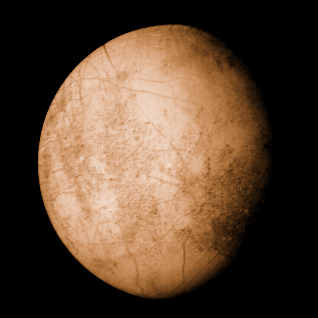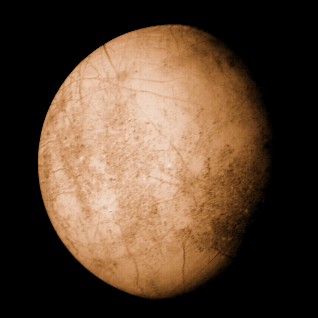
Is there life beneath Europa's frozen surface? Some believe the oceans found there of carbon-enriched water are the best chance for life, outside the Earth, in our Solar System. Europa, the fourth largest moon of Jupiter, was recently discovered to have a thin oxygen atmosphere by scientists using the Hubble Space Telescope. Although Earth's atmospheric abundance of oxygen is indicative of life, astronomers speculate that Europa's oxygen arises purely from physical processes. But what an interesting coincidence! The above picture was taken by a Voyager spacecraft in 1979, but the spacecraft Galileo is currently circling Jupiter and has been photographing Europa. The first of these pictures will be released two days from today. Will they show the unexpected? Late News: NASA to Release New Europa and Jupiter Pictures Thursday More Late News: New Evidence Suggests Microscopic Life Existed on Mars
¿Existe vida bajo la superficie helada de Europa? Algunos científicos creen que los océanos de agua rica en carbono que se encuentran en ella representan la mejor oportunidad para la vida fuera de la Tierra en nuestro Sistema Solar. Europa, el cuarto satélite más grande de Júpiter, fue descubierto recientemente por científicos que utilizaban el Telescopio Espacial Hubble como portador de una tenue atmósfera de oxígeno. Aunque la abundancia de oxígeno en la atmósfera terrestre es indicativa de vida, los astrónomos especulan que el oxígeno de Europa surge de procesos puramente físicos. ¡Pero qué coincidencia tan interesante! La imagen anterior fue tomada por una nave espacial Voyager en 1979, aunque la nave Galileo se encuentra actualmente orbitando Júpiter y ha estado fotografiando Europa. Las primeras de estas imágenes serán publicadas dentro de dos días. ¿Mostrarán algo inesperado? Última hora: NASA publicará el jueves nuevas imágenes de Europa y Júpiter. Más última hora: Nuevas evidencias sugieren que existió vida microscópica en Marte.